Lead Core Color Depth Calculator
Estimate trolling depth from lead core colors, speed, line construction, backing, leader length, current, and lure behavior.
📌Scenario presets
⚙Depth settings
Lead core depth forecast
Full breakdown
📋Lead core line reference grid
Light Core
Standard Core
Heavy Core
Dense Core
📊Depth and adjustment tables
| Colors out | Lead out | Standard core at 2 mph | Heavy core at 2 mph | Metric lead out |
|---|---|---|---|---|
| 1 color | 10 yd | 5 ft | 6 ft | 9.1 m |
| 2 colors | 20 yd | 10 ft | 12 ft | 18.3 m |
| 3 colors | 30 yd | 15 ft | 17 ft | 27.4 m |
| 5 colors | 50 yd | 25 ft | 29 ft | 45.7 m |
| 7 colors | 70 yd | 35 ft | 41 ft | 64.0 m |
| 10 colors | 100 yd | 50 ft | 58 ft | 91.4 m |
| Variable | Low value | High value | Depth effect | Calculator use |
|---|---|---|---|---|
| Trolling speed | 1.5 mph | 2.8 mph | Slower deeper | Speed curve |
| Lure drag | Spoon | Flasher | Drag lifts line | Drag factor |
| Leader length | 8 ft | 60 ft | Small bonus | Leader sag |
| Backing out | 0 ft | 120 ft | Small bonus | Line catenary |
| Current | Following | Against | Changes speed | Water factor |
| Turn shape | Straight | Wide turns | Depth swings | Band width |
| Target species | Common speed | Core range | Typical lure | Starting depth |
|---|---|---|---|---|
| Walleye | 1.7-2.2 mph | 3-7 colors | Spoon/crank | 15-35 ft |
| Rainbow trout | 1.8-2.5 mph | 2-6 colors | Spoon | 10-30 ft |
| Brown trout | 1.6-2.3 mph | 1-5 colors | Stickbait | 6-25 ft |
| Salmon | 2.1-2.8 mph | 5-10 colors | Flasher/fly | 25-55 ft |
| Lake trout | 1.4-2.0 mph | 6-10 colors | Spoon | 35-65 ft |
| Crappie | 1.0-1.6 mph | 1-3 colors | Jig | 5-15 ft |
💡Practical checks
Tip: Treat any lead core color depth calculator as a starting estimate. Confirm with sonar, lure ticks, or a controlled pass over known bottom.
Tip: When a lure runs higher than expected, reduce speed first, then add a half color before changing the whole spread.
Lead core line exist in the middle of monofilament line and downrigger equipment. Many anglers uses lead core line because it allows the persons to go to more greater depths than there surface presentations of bait or lure. Lead core line is used if the angler want to fish in a specific depth in the water but still want to use their standard fishing rods and reel.
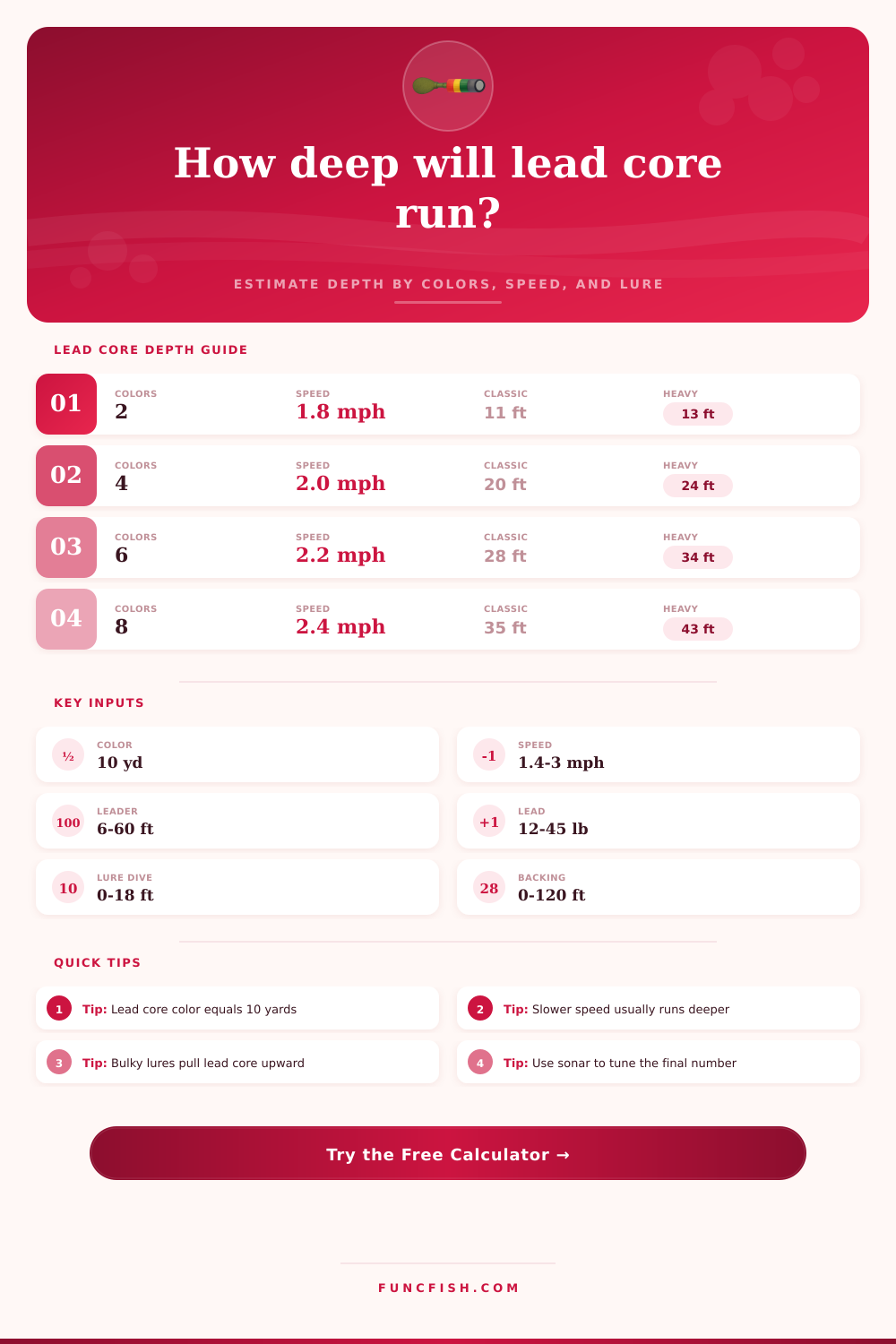
The lead core line comes in different color, and each color represent ten yard of the lead core line. The speed of the boat will impacts the depth of the lead core line. If the boat change speeds while the lead core line is in the water, this will change the depth of the line.
How Lead Core Line Sinks and How to Find Its Depth
If the boat moves at a slow speed, the lead core line will settle to a deeper portion of the water. If the boat is traveling at a faster speed, the lead core line will experience more lift from the water and will remain in a shallow depth in the water. The type of lure being use will also change the depth at which the lead core line sink.
Different type of lures have more drag than other, and this drag will change the depth at which the lead core line sink. For example, if the lure is bulky, it will plane upwards through the water, requiring the angler to release more colors of lead core line to reach the desired depth. If the lure is more slimmer in appearance, it will allow the lead core line to travel further and reach the desired depth with the release of few colors of lead core line.
This calculation account for the type of lure by applying a factor to the calculation that determine the drag of the lure. The currents in the water and the movement of the boat will change the depth of the lead core line. If the boat is moving with the current, the current will slow the movement of the lure in the water.
This will allow the lead core line to travel to a deeper portion of the water. If the boat is moving against the current, the current will increase the movement of the lure in the water compared than the movement of the boat, causing the lead core line to not go as deep into the water. If the boat make wide turn in the water, the line on the inside of the turn will slow the movement of the lead core line, while the outside line will increase in speed.
Additional factor in the lead core line that can change the depth are the length of the leader and the amount of backing for the lead core line. The length of the leader can create a sag in the line, which will allow the lead core line to travel to a deeper portion of the water. Adding additional length of backing behind the lead core line will also allow the lead core line to travel to a deeper portion of the water.
These two factor will not notably change the depth of the lead core line by themselves. There are different weight of lead core line that can be purchased. Light lead core line will allow the bait or lure to travel at a slower rate through the water compared than heavy lead core line.
Therefore, light lead core line is used for traveling in shallow water. If the angler desire to travel to deeper portions of the water in a shorter length of lead core line, using heavy lead core line will accomplish this goal. The weight of lead core line that should be used depend upon the depth desired and the weight of the reel.
A depth finder will allow the angler to find the depth of the lead core line in the water. The lead core line depth calculator will give the angler an estimated depth of the lead core line. However, the calculator do not account for every possible variable in the lake in which the angler will use the lead core line.
The calculator will provide the angler with an estimated depth to which to fish. However, the angler should adjust the amount of lead core line released by half color of line once the angler sees the depth of the lead core line on the depth finder. If any condition change in the water while the lead core line is in play, the calculator should be used again to determine if the amount of lead core line should be adjust.