Float Buoyancy to Weight Calculator
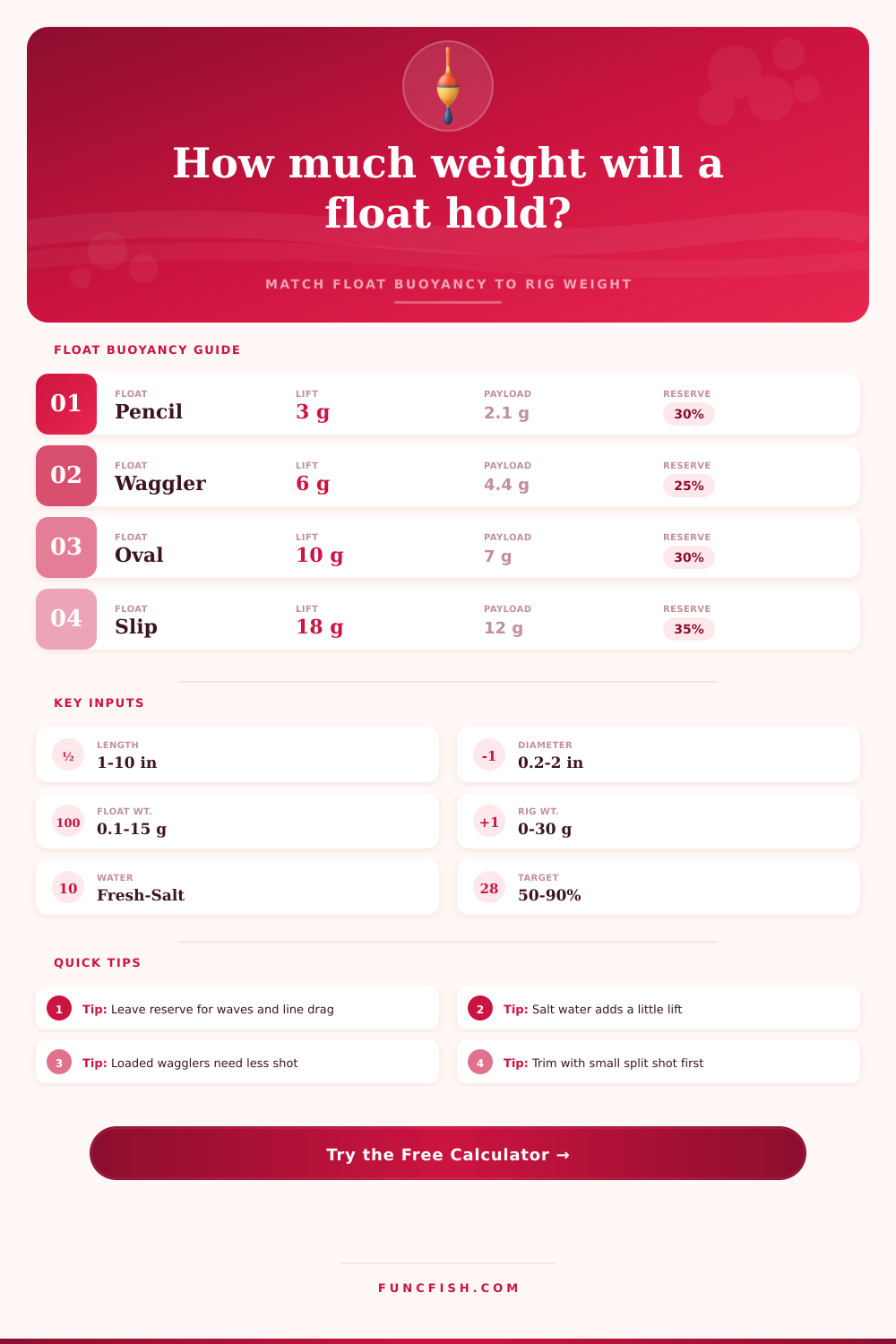
Estimate how much shot, bait, swivel, and leader weight a fishing float can carry from its size, shape, dry weight, water type, and target sink depth.
📌Scenario presets
⚙Float and rig inputs
Float buoyancy plan
Calculated from float displacement, water density, float dry weight, rig load, and target submergence.
Full breakdown
📋Float material reference grid
Balsa Drift
Foam Peg
Cork Oval
Loaded Waggler
📏Buoyancy and shot reference tables
| Float style | Typical body size | Common payload | Reserve target | Best matching rig |
|---|---|---|---|---|
| Quill or pencil | 2-5 in / 5-13 cm | 0.2-2 g / 0.01-0.07 oz | 20-30% | Tiny hooks, maggots, small jigs. |
| Foam peg float | 1-3 in / 3-8 cm | 1-5 g / 0.04-0.18 oz | 25-35% | Panfish, crappie, trout bait. |
| Balsa drift float | 3-6 in / 8-15 cm | 2-8 g / 0.07-0.28 oz | 25-40% | Split shot and river leaders. |
| Loaded waggler | 4-8 in / 10-20 cm | 0.5-6 g / 0.02-0.21 oz | 18-28% | Stillwater shot trimming. |
| Slip float | 2-5 in / 5-13 cm | 4-16 g / 0.14-0.56 oz | 30-45% | Minnows, jigs, deeper stops. |
| Popping cork | 3-6 in / 8-15 cm | 6-24 g / 0.21-0.85 oz | 35-55% | Shrimp, jigheads, tide swing. |
| Shot size | Approx weight | Metric weight | Use in trim | Float response |
|---|---|---|---|---|
| No. 8 split shot | 0.002 oz | 0.06 g | Fine antenna trim | Very small change. |
| No. 6 split shot | 0.004 oz | 0.10 g | Light pencil floats | Noticeable on small floats. |
| No. 4 split shot | 0.007 oz | 0.20 g | General stillwater | Good final adjustment. |
| BB split shot | 0.014 oz | 0.40 g | Bulk shot stacks | Moves trim quickly. |
| AAA split shot | 0.028 oz | 0.80 g | River and waggler | Strong cocking weight. |
| SSG split shot | 0.057 oz | 1.60 g | Large floats | Use sparingly near small baits. |
| Water and condition | Density or reserve | Effect on weight | Practical trim | Calculator note |
|---|---|---|---|---|
| Freshwater | 0.997 g per cm3 | Baseline lift | Use normal shot ladder. | Default density. |
| Saltwater | 1.025 g per cm3 | About 3% more lift | Add tiny shot if needed. | More buoyant than fresh. |
| Calm stillwater | 18% reserve minimum | Can trim fine | Show less tip for lift bites. | Most sensitive setup. |
| Steady current | 28% reserve minimum | Needs extra lift | Keep more body above water. | Line drag can bury the float. |
| Chop or tide | 35% reserve minimum | Needs larger margin | Choose larger float or remove shot. | Reserve protects visibility. |
💡Calculation notes
Trim in small steps: Add the calculated weight with several smaller split shot when sensitivity matters. One large shot can overload a small pencil float too abruptly.
Check in real water: Paint, swivels, line floatant, bait movement, and trapped air can shift the final trim, so use the result as a starting balance.
A fishing float must be balanced to ensure that the fishing float remains visible and sensitive while it is in the water. If the fishing float carry too much weight, the fishing float will sink to the deepest portion of the water where the tip of the fishing float will dissapears from view. If the fishing float carry too little weight, the fishing float will remain near the waters surface creating ripples in the water that will hide the movement of the fishing float.
It is important to find the right amount of weight that the fishing float can carry. The weight of the fishing float consist of the weight of the shot, the weight of the bait, and the weight of the terminal tackle attached to the fishing float. The amount of weight that an fishing float can carry can change based off the type of water in which the fishing float will be used.
How to Balance a Fishing Float
Additionally, the amount of weight that a fishing float can carry can also change according to the strength of the current in the fishing area. The material from which the fishing float is made is also important to consider because it will determine the weight and the displacement of the fishing float. Balsa floats are among the lightest and most responsive to the presence of fish on the line.
Foam fishing floats are lighter than balsa floats but retain their buoyancy in the water for longer period of time. Cork fishing floats are more dens than foam floats and have slower sinking rates yet are the most durable for those who uses live bait. The weight capacity of a fishing float can be calculated to ensure that the fishing float is loaded within its capabilities.
The calculation of the weight capacity of a fishing float require the fishing float’s material and the fishing float’s shape to be entered into a formula that calculates the maximum load that the fishing float can take. The shape of the fishing float determines how much water it will displace, which then determines the amount of weight that the fishing float can take. Fishing floats in the shape of pencils will displace less water than fishing floats that are in the shape of cylinders; thus, fishing floats in the shape of pencils can carry less weight than those in the shape of cylinders.
Fishing floats in the shape of ovals or pears will displace an amount of water in between the weight capacity of fishing floats in the shape of pencils and fishing floats in the shape of cylinders. The fishing float weight calculator uses a shape factor that determines the difference in the weight carrying capacities of the various fishing float shapes. The type of water in which the fishing float will be used can change the way the fishing float behaves in the water.
The density of the water will change the amount of lift that the fishing float experiences. Saltwater creates more lift on the fishing float than freshwater so that more weight can be added to the fishing float for those conditions. Current and chop on the water’s surface can also change the way the fishing float behaves.
Chop may pull the fishing float beneath the water so the fishing float must have some extra weight to compensate for this condition. The fishing float weight calculator allows users to choose the conditions in which the fishing float will be used so that the amount of reserve buoyancy that is needed can be appropriate selected. The placement of the shot on the fishing float is the last consideration for the weight of the fishing float.
Placing the shot close to the fishing hook will cause the bait to drop quickly into the water. This is a good technique to use for fishing with short hook lengths. Placing the shot in various patterns throughout the fishing line allow the bait to fall naturaly into the water.
This fishing technique is used for various fishing needs. The fishing float weight calculator allows users to see how the total weight of the fishing float can be distributed among the various shot patterns. The calculated weight that the fishing float should carry is merely a starting point for the fishermen.
Small adjustments should be made according to the type of painted fishing float that is used, the type of swivel that is used, and the type of bait that is being used in the fishing effort. Observations of the fishing float while on the water will allow the fishermen to make small adjustments to the total weight of the fishing rig so that the fishing float is at the correct depth while on the water. You should of made small adjustments to the total weight of the fishing rig so that the fishing float is at the correct depth while on the water.