Fishing Rod Guide Count Calculator
Estimate guide count, tip-top included total, stripper distance, transition spacing, and static-load risk for spinning, casting, fly, surf, trolling, and ice rods.
📌Scenario presets
⚙Rod blank and guide settings
For casting reels, use spool width if it is wider than diameter.
Recommended guide layout
Calculation breakdown
🔧Guide family data
Micro Ceramic
K-Frame Ceramic
Double-Foot
Snake Guides
Roller Guides
Surf Train
Recoil Wire
Standard Ceramic
📊Reference tables
| Rod class | Common length | Running guides | Tip spacing start | Notes |
|---|---|---|---|---|
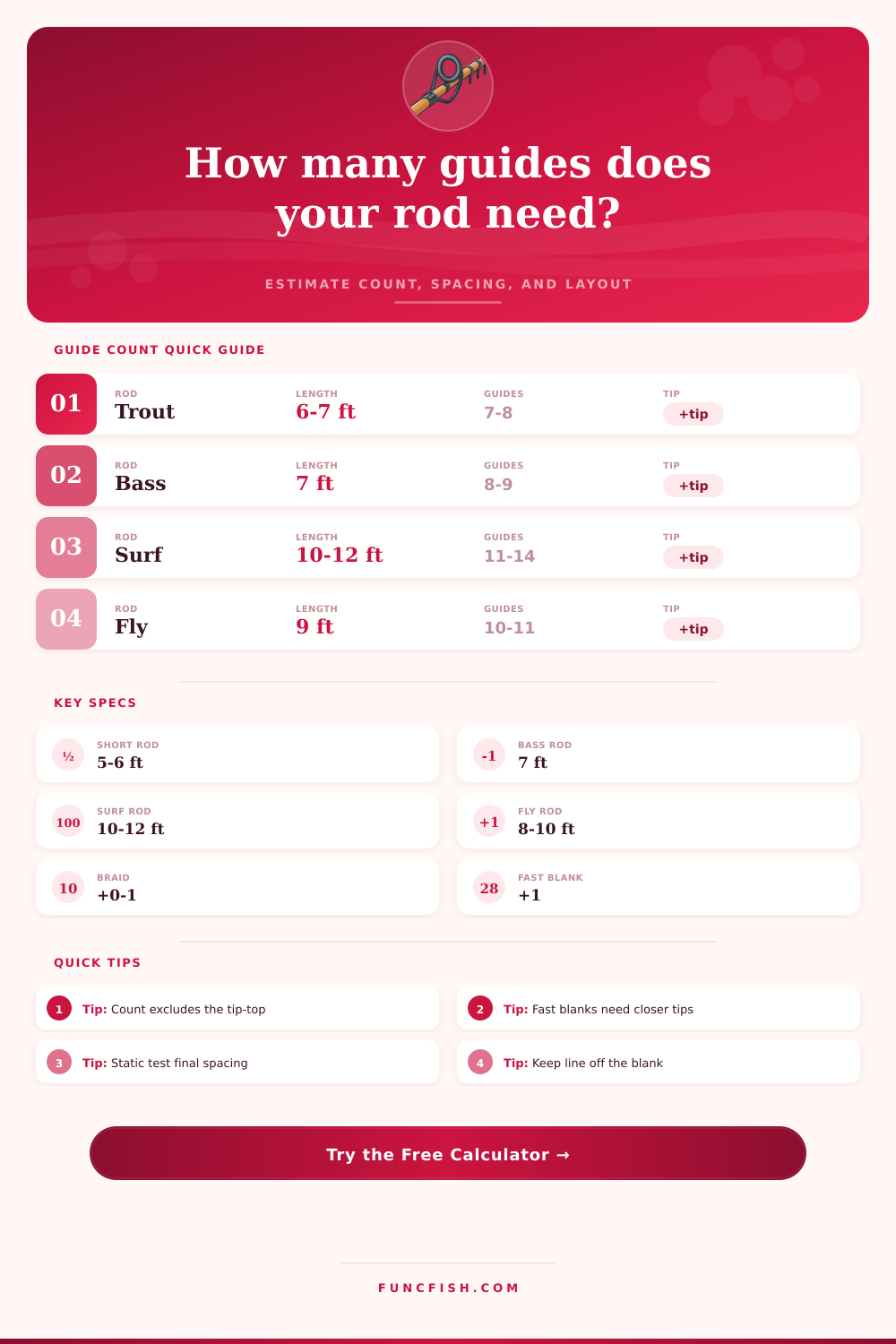
| Ultralight spinning | 5 ft 6 in to 6 ft 6 in | 6-8 plus tip-top | 3.5-4.5 in | Small tip spacing protects light line. |
| Bass casting | 6 ft 10 in to 7 ft 6 in | 8-10 plus tip-top | 4-5 in | Micro trains may add one running guide. |
| Inshore spinning | 7 ft to 8 ft | 8-10 plus tip-top | 4.25-5.25 in | Use taller reduction guides for large spools. |
| Surf spinning | 9 ft to 12 ft | 10-14 plus tip-top | 5-6.5 in | Long casts need controlled line choke. |
| Fly rod | 8 ft to 10 ft | 9-12 plus tip-top | 4-5 in | Snake guides usually follow line path closely. |
| Boat trolling | 5 ft 6 in to 7 ft | 6-9 plus tip-top | 4.5-6 in | Rollers and double-foot guides reduce count. |
| Species setup | Rod power | Line range | Guide priority | Static-load target |
|---|---|---|---|---|
| Panfish / creek trout | UL to light | 2-6 lb / 1-3 kg | Low weight | Light bend, no flat spots |
| Bass / walleye | ML to MH | 6-20 lb / 3-9 kg | Tip recovery | Line clears blank at 60 degrees |
| Catfish / pike | MH to heavy | 20-50 lb / 9-23 kg | Durability | Deep bend with load sharing |
| Redfish / snook | Medium to MH | 10-30 lb / 5-14 kg | Abrasion clearance | No line touch near mid blank |
| Surf stripers | Medium to heavy | 15-50 lb / 7-23 kg | Line control | Reduction guides stay stable |
| Offshore trolling | Heavy to XH | 50-100 lb / 23-45 kg | Load transfer | Rollers aligned under pressure |
| Adjustment | Add guides when | Remove guides when | Spacing effect | Final check |
|---|---|---|---|---|
| Fast action | Tip bends sharply | Blank remains shallow | Closer top third | Line angle between tip guides |
| Braid | Thin line tracks blank | Conventional guides are tall | One extra runner possible | Check wind knots on spinning rods |
| Heavy load | Drag exceeds 30% line | Light lure casting only | More even stress sharing | Static test under expected drag |
| Travel ferrules | Ferrule lands between guides | One-piece blank | Avoid wraps on ferrule edges | Assemble and flex before marking |
| Long cast | Large spool or surf leader | Short pitch casting | Longer butt section | Line slap around stripper guide |
💡Layout notes
Static test note: Use the calculator count as a starting layout, tape the guides in place, load the rod, and move guides until the line follows the blank curve without touching it.
Spacing note: The first few measurements near the tip are intentionally close. Increase spacing gradually toward the butt, then tune the stripper guide around the reel and casting path.
The number of guide on a custom rod impacts how the rod cast and fights the fish. Using too few guide will cause the line to slap against the rod blank when the rod is under load. Using too many guide adds unnecessary weight to the rod, making the recovery of the rod and the fishing experience badder.
Thus, the builder must calculate the number of guides that are placed on a custom rod before the wrapping of the rod. The length of the rod is one of the variable that starts the calculation for the placement of the guides. However, the length of the rod is not the only factor that impact the placement of the guides.
How to Choose and Place Guides on a Fishing Rod
For instance, both an ultralight spinning rod and a surf rod use guide to keep the fishing line from slapping against the rod blank. However, the placement of the guides on both of these rods isnt the same due to the load and the casting style of the rods. Other variables includes the action of the blank of the rod and the power of the blank.
For instance, fast tip rod have most of the bend of the rod concentrated near the end of the rod. Thus, the first few guide on these rods must be closer together. On the other hand, a slow, parabolic blank allow for wider spacing between the guides on the rod.
The type of fishing line that a person will use with the rod is another variable that affect the guide placement. For example, braided line are thin so they travel close to the rod blank when the rod is under load. However, lines like monofilament and fluorocarbon lines has a larger diameter and more stretch so they remain higher off the rod blank.
If a person changes from monofilament line to braided line, an extra guide might be needed since the braided line will travel closer to the rod blank at a shallower bend then the monofilament line will. A calculator can calculate these variable to create an initial guide layout for the rod. Another specific factor that impacts the placement of the guides is the placement of the stripper guide.
If it is too close to the rod’s reel will create an angle that is too steep for a cast. However, if the stripper guide is too far from the reel the rod will slap against the line when under load. Thus, the builder must calculate the distance of the stripper guide from the reel based off the spool diameter of the reel and the type of rod being used.
The remaining guides will have a steady opening to allow the fishing line to follow the curve of the rod blank. Another test that can be performed with the rod is a static load test to determine if the guides need to be adjusted. For instance, the person can tape the guides into place and the rod can be loaded to the same drag that is used when fishing.
If the fishing line touches the rod blank then the spacing of the guides is too wide for this type of load on the rod. If there is extra room for the fishing line to remain off of the rod blank then one of the guides might be removed to reduce the weight of the rod. A calculator will provide an initial placement for the guides and a static score for the rod so that a person can determine if the initial guide placement is safe or if another guide is needed.
The type of guides that are used on the rod will further impact the performance of the rod. For instance, micro single foot guides are the lightest guides and are suitable for fast tip rods. On the other hand, K frame guides and double foot guides are more durable and are used for rods that will experience heavy load with heavy fish but are heavier than micro single foot guides.
Additionally, people use roller guides on trolling rods to reduce the friction between the line and the rod. The weight of each guide impacts the weight of the finished rod and the impact of that weight on the casting of the rod. This is especially true of rods with long, lightweight blanks where the weight of the guides will impact the swing weight of the rod.
For multi-piece rods, the ferrules on the rods create a spot on the blank where the rod will be stiff when the line pass through it. Thus, placing a guide foot directly on the ferrule will place a weak spot on the rod that might fail over time. Thus, rod builders must shift the placement of the guides on the rod so that they dont fall directly on the ferrule.
Additionally, if a rod will have many sections, such as a travel rod, there will be more guides because each ferrule will require extra guides to provide support to the rod blank. The purpose of the guides is to allow the fishing line to travel through the rod blank when the rod is cast and when the rod fights the caught fish without the fishing line touching the rod blank. The calculator will provide an initial count of the number of guides that will be used on the rod and the initial distance between each guide.
Additionally, the static score will allow a person to determine if another guide is needed or if one of the guides can be removed to reduce the weight of the rod. Thus, using the calculation and the static score will ensure that the rod will function correctly when first used to fish.