Fishing Rod Blank Length Calculator
Estimate the catalog blank length, assembled blank length, ferrule allowance, butt-trim limit, and handle-to-tip working length for a custom fishing rod build.
🎯Rod build presets
⚙Blank length inputs
Rod blank length results
Calculation breakdown
🧱Blank material reference
High-Mod Graphite
Standard Graphite
Composite
Fiberglass
E-Glass Trolling
S-Glass Surf
Nano Graphite
Split Bamboo
📊Reference tables
| Rod category | Common finished length | Metric equivalent | Typical pieces | Blank length note |
|---|---|---|---|---|
| Ice rod | 24-42 in | 61-107 cm | 1 | Short blank, no ferrule allowance |
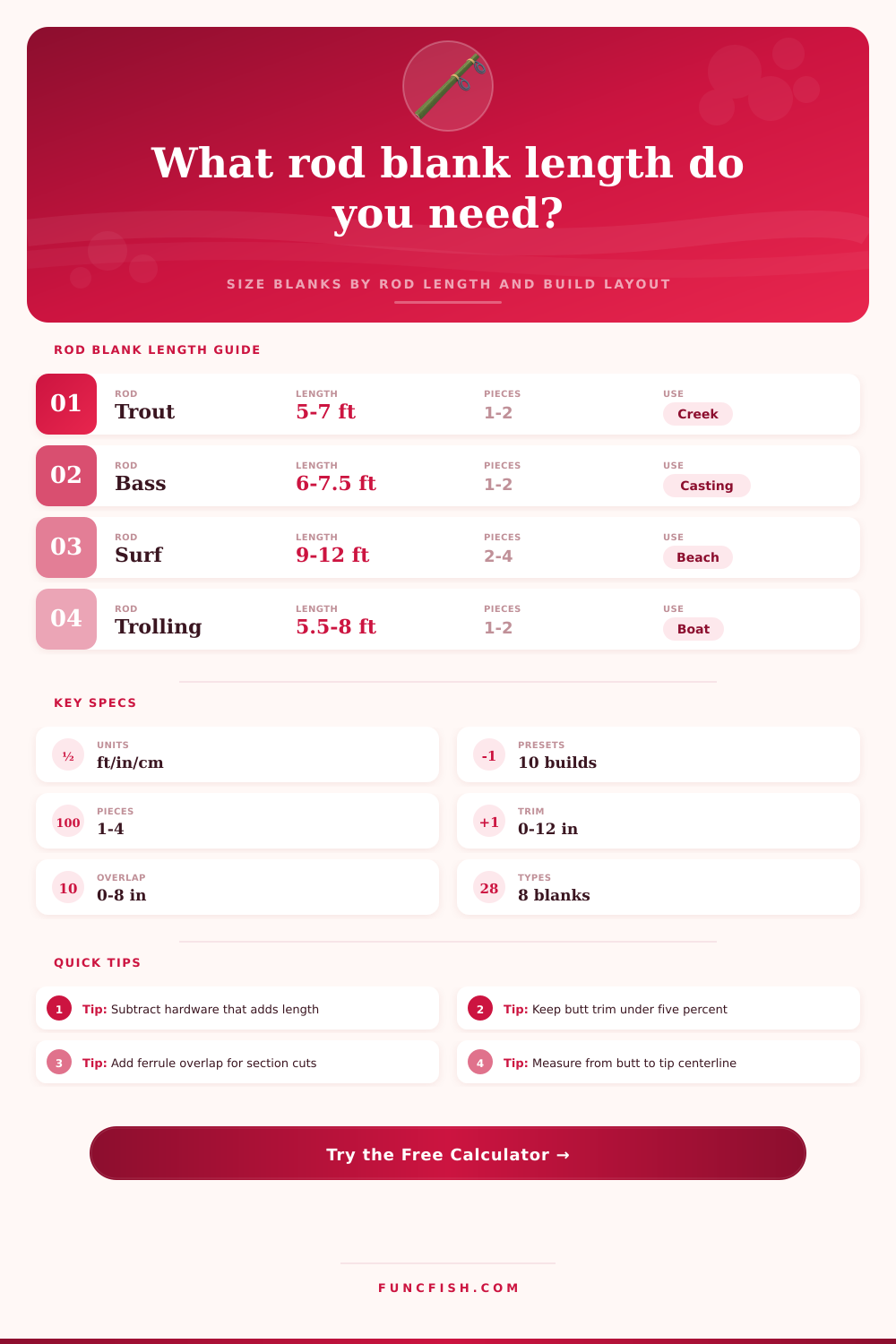
| Creek trout spinning | 5 ft 0 in-6 ft 6 in | 1.52-1.98 m | 1-2 | Handle length strongly changes working tip |
| Bass casting | 6 ft 6 in-7 ft 6 in | 1.98-2.29 m | 1-2 | Butt trim can stiffen lower third |
| Walleye jigging | 6 ft 3 in-7 ft 2 in | 1.91-2.18 m | 1-2 | Preserve tip for sensitivity |
| Inshore spinning | 7 ft 0 in-8 ft 0 in | 2.13-2.44 m | 1-2 | Longer rear grip affects boat clearance |
| Surf casting | 9 ft 0 in-12 ft 0 in | 2.74-3.66 m | 2-4 | Ferrule overlap matters for section cuts |
| Catfish bottom rod | 7 ft 0 in-10 ft 0 in | 2.13-3.05 m | 1-2 | Glass and composite tolerate more butt trim |
| Offshore trolling | 5 ft 6 in-7 ft 6 in | 1.68-2.29 m | 1-2 | Hardware and roller tip can add length |
| Pieces | Ferrule joints | Common overlap per joint | Metric overlap | Section planning rule |
|---|---|---|---|---|
| 1-piece | 0 | 0 in | 0 cm | Catalog blank length equals assembled blank length |
| 2-piece | 1 | 1.75-3.00 in | 4.4-7.6 cm | Add one overlap when cutting raw sections |
| 3-piece | 2 | 1.50-2.75 in | 3.8-7.0 cm | Add two overlaps to raw section total |
| 4-piece | 3 | 1.25-2.50 in | 3.2-6.4 cm | Balance sections after subtracting handle area |
| Spigot ferrule | 1-3 | 1.50-2.50 in | 3.8-6.4 cm | Account for exposed gap after seating |
| Tip-over-butt | 1-3 | 2.00-4.00 in | 5.1-10.2 cm | Overlap is hidden inside the upper section |
| Line class | Typical power | Lure range | Rod length range | Blank sizing note |
|---|---|---|---|---|
| 2-6 lb / 1-3 kg | Ultra-light | 1/64-1/8 oz | 4 ft 6 in-6 ft 6 in | Use short catalog steps if available |
| 4-10 lb / 2-5 kg | Light | 1/16-1/4 oz | 5 ft 6 in-7 ft 0 in | Protect the soft tip section |
| 8-17 lb / 4-8 kg | Medium | 1/4-3/4 oz | 6 ft 6 in-7 ft 6 in | Most blanks offered every 6 in |
| 12-25 lb / 6-11 kg | Medium-heavy | 3/8-1 1/2 oz | 7 ft 0 in-8 ft 0 in | Handle length affects leverage |
| 20-50 lb / 9-23 kg | Heavy | 1-6 oz | 7 ft 0 in-10 ft 0 in | Glass blanks allow stronger butt builds |
| 50-130 lb / 23-59 kg | Extra-heavy | Trolling load | 5 ft 6 in-7 ft 6 in | Roller tip may extend final length |
| Handle layout | Rear grip plus butt | Reel seat | Foregrip area | Working length effect |
|---|---|---|---|---|
| Ultralight spinning | 5-7 in | 3.5-4.0 in | 0-1 in | Maximizes active blank in short rods |
| Bass casting | 8-11 in | 4.0-4.5 in | 0-2 in | Balances casting leverage and tip control |
| Kayak inshore | 7-9 in | 4.0-4.5 in | 1-2 in | Keeps butt from catching on PFD or seat |
| Surf casting | 20-30 in | 5.0-6.0 in | 2-5 in | Long handle reduces working blank ahead of grip |
| Catfish bottom | 12-18 in | 4.5-5.5 in | 2-4 in | Long rear grip improves rod holder stability |
| Offshore trolling | 10-16 in | 5.0-6.0 in | 2-6 in | Butt hardware may add finished length |
💡Build notes
Blank length note: Finished rod length is measured from the butt end to the tip-top centerline. If a butt cap or tip-top adds length beyond the blank, subtract that extension before choosing the blank.
Trim note: Butt trimming generally raises effective power and can slow recovery. Keep high-modulus graphite trims conservative, and avoid tip trimming unless the blank maker allows it.
The rod blank is the most important component of a custom fishing rod. The rod blank will determine the performance that the fishing rod will have. If you order the incorrect length of rod blanks, the fishing rod will be either too stiff, too flexible, or not appropriate for the fishing environment in which you will fishing.
Because the rod blank determine the performance of a fishing rod, you must plan the length of the finished fishing rod against the specifications of the rod blank that you intend to order. The calculator provided above will mathematically calculate the requirements of the fishing rod once you have enter the length of the fishing rod that you would like to create and the specific hardware for that fishing rod. The finished length of a fishing rod is the length of the fishing rod from the butt cap to the tip top.
How to Plan Your Fishing Rod Length
It is rare for the finished length of the fishing rod to be the same than the length of the purchased rod blank. The tip top and butt cap will add to the length of the fishing rod, while the handle will remove from the length of the rod blank. For multi-piece fishing rods, the ferrules will require an overlap in relation to the length of the rod blank.
Furthermore, the trim allowance at the butt of the fishing rod will impact the way in which the lower third of the rod blank will load when fishing. Each of these factor will impact the length of the fishing rod that the customer purchase. Most builders will begin with a decision of the length of the finished fishing rod that they would like to have.
The finished length of the fishing rod will include the rear grip and the tip top, but each of these will add to the length of the fishing rod beyond the length of the rod blank. Therefore, you can calculate the length of the fishing rod by first subtracting the length of the hardware from the finished length, then adding the length of each ferrule overlap for each section of the fishing rod, the length of the trim of the butt of the fishing rod, and any allowance for safety margin for the fishing rod. The customer and the calculator that are available on this webpage can calculate the length of each component.
The materials of the fishing rod will impact the amount of trimming that can be done to the fishing rod. For instance, high-modulus graphite fishing rods will lose their action if shortened, while materials like fiberglass and composite fishing rods will allow for more trimming of the rod before losing their action. Additionally, the action of the fishing rod will also impact the amount of trimming that can be done to the fishing rod.
Faster fishing actions will lose their action if shorten, while slower actions will allow for more trimming. The layout of the fishing rod handle will also have an impact upon the length of the fishing rod. Fishing rods with long rear grips will allow for less of the rod blank to be located ahead of the fisherman’s hand.
Short ultralight spinning fishing rods will have more of the rod blank exposed from the grip, which will also impact how the guides is spaced along the fishing rod. This length can be entered into the calculator so that it impacts the length of the fishing rod that is calculated for the customer. Another component of creating a fishing rod that must be accounted for is the section planning of the fishing rod.
Any fishing rod that have more than one section will require an overlap for each section in addition to the length of the rod blank. For example, a two-piece fishing rod will have one overlap, and a three-piece fishing rod will have two overlaps. These overlaps will ensure that the sections of the fishing rod do not separate from each other during fishing efforts.
If the blanks are too short, they will not accommodate the overlap at the sections. The calculator will produce a raw total length for each section of the fishing rod. This raw length is the length that should be use to cut the rod blank into the appropriate sections.
Common mistake with the planning of the length of the fishing rod include purchasing the fishing rod to be the same length as the finished fishing rod. Such a purchase will not account for the lengths of the hardware that extend past the fishing rod blank. Furthermore, if the purchased length of the fishing rod is too short, there will not be enough room for error in the finished fishing rod.
Lastly, if the purchased length is too long, there will be requirement for aggressive trimming of the fishing rod, which may alter the action of the fishing rod. By planning the length of the fishing rod, it is ensured that the purchased fishing rod will have the action and feature that are required by the fisherman. By planning the length correctly, the tip of the fishing rod will have a lively action because the fishing rod was not trimmed incorrect.
Furthermore, the handle will sit in the proper position for the fisherman’s hand when fishing, and the guides along the fishing rod will be even with each other. Together, these factor will ensure that the fishing rod perform correctly while fishing.