Fishing Rod Two-Handed Length Calculator
Estimate two-handed rod length, grain or casting load, handle spacing, reach advantage, and fit score for switch, spey, surf, carp, and long-cast fishing setups.
📌Two-handed scenario presets
⚙Rod length inputs
Two-handed rod length results
Calculation breakdown
🎣Two-handed rod family data
Trout Spey
Switch Rod
Classic Spey
Surf Rod
📊Reference tables
| Rod family | Typical length | Common load | Best fit |
|---|---|---|---|
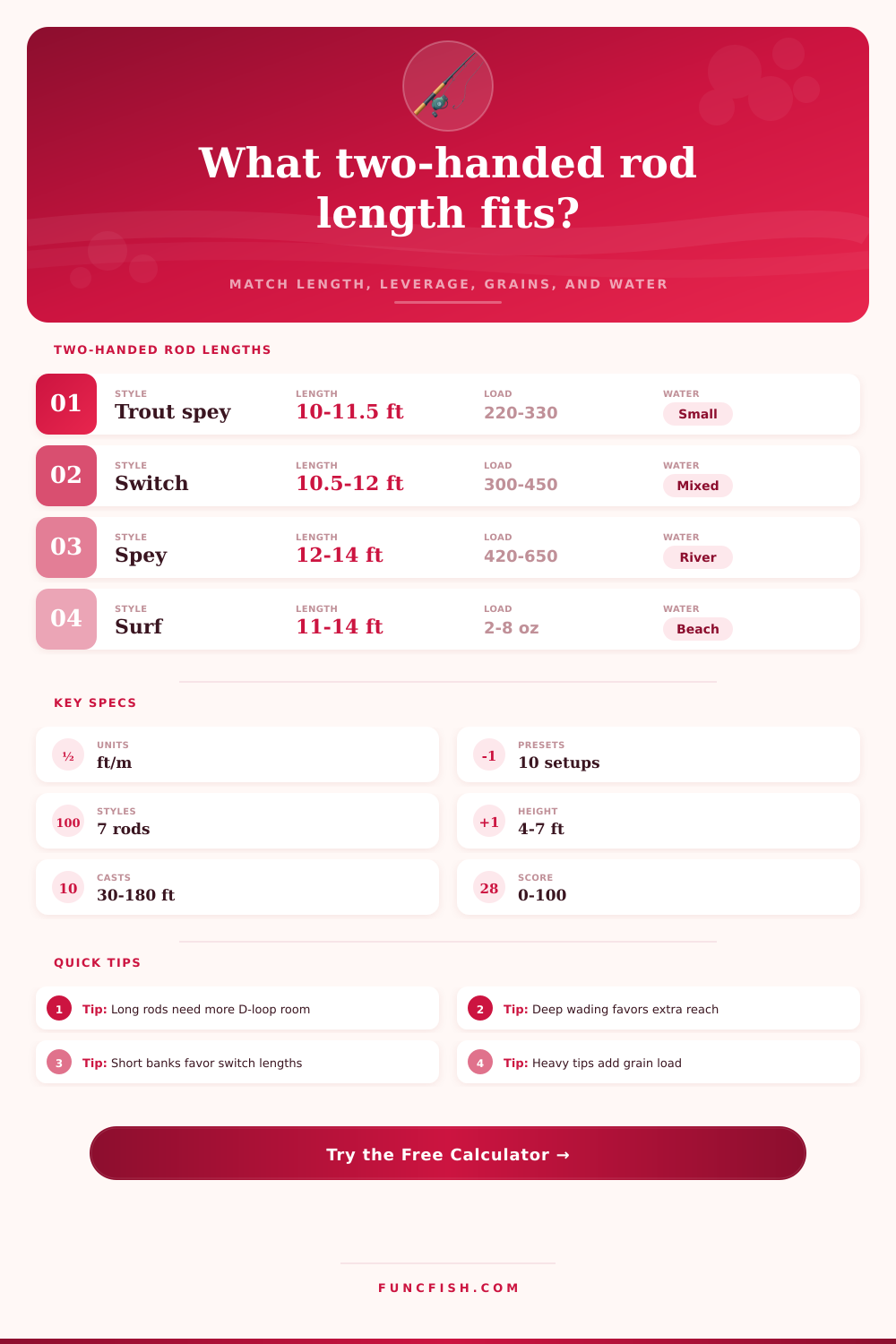
| Trout spey | 10 ft 6 in to 11 ft 6 in / 3.20 to 3.51 m | 220 to 330 grains | Small rivers, low tips, lighter fish |
| Switch rod | 10 ft 6 in to 12 ft / 3.20 to 3.66 m | 300 to 450 grains | Mixed overhead and spey casting |
| Classic spey | 12 ft 6 in to 14 ft / 3.81 to 4.27 m | 420 to 620 grains | Steelhead and salmon swing water |
| Heavy spey | 13 ft 6 in to 15 ft / 4.11 to 4.57 m | 560 to 750 grains | Large rivers, heavy tips, wind |
| Surf casting | 11 ft to 14 ft / 3.35 to 4.27 m | 2 to 8 oz lure or sinker | Beach distance and line clearance |
| Carp distance | 12 ft to 13 ft / 3.66 to 3.96 m | 2.75 to 4.5 lb test curve | Long leads, feeders, and spod work |
| Condition | Length effect | Load effect | Reason |
|---|---|---|---|
| Deep wading or surf wash | Add 0.2 to 0.6 ft | Small increase | Extra rod height clears current and waves |
| Brush or steep bank | Subtract 0.3 to 0.8 ft | Use compact heads | Shorter rods need less D-loop room |
| Long casts over broad water | Add 0.4 to 1.0 ft | Increase window | More carry and line control |
| Heavy sink tip or bait lead | Add 0.1 to 0.4 ft | Increase 35 to 90 grains | Mass needs a stronger lever |
| New two-hand caster | Subtract 0.2 to 0.5 ft | Slightly lower | Easier timing and less swing weight |
| Expert long-belly caster | Add 0.3 to 0.8 ft | Moderate increase | More line can be carried outside the tip |
💡Length planning checks
Tip: For spey and switch rods, treat the recommendation as a starting length. Final feel still depends on blank recovery, line head length, and your casting stroke.
Tip: For surf, carp, and shore rods, compare the recommended length with transport limits, beach angle, and the amount of load you cast most often.
The length of a two-handed rod is one of the primary factor that influence the performance of a two-handed rod when being cast. The length of a two-handed rod will determine how much reach a person has when the current pull against the fishing line. If a two-handed rod is too short, a person will lose reach when the current begins to pull against the line; the short rod cannot extend as far into the current as it should of been able to.
Alternatively, if a two-handed rod is too long, the rod becomes difficult to use in tight space; long two-handed rods become a burden to a fisherman who needs to make quick adjustment to the line. Beyond the length of the rod itself, the length must also work in conjunction with the line that a person uses with the rod, the water condition in which the rod will be used, and the movements of the fisherman himself. The type of fish that a fisherman wants to catch will influence the choice of two-handed rod that is used.
How to Pick the Right Two-Handed Rod Length
The type of fish that a person encounters will dictate whether a person need a light or heavy two-handed rod. For instance, trout setups for small rivers require the use of a lighter two-handed rod, while heavy spey rods is required for Chinook or winter steelhead. Additionally, the casting style that a person utilize will also influence the length of a two-handed rod that a person should use.
For example, a Scandi head casting requires less space behind the person than a Skagit head cast. Furthermore, the skill level of the person that is fishing will impact the two-handed rod requirement for that person. For instance, beginners may have more success using shorter two-handed rods than experienced angler.
The water conditions will require a two-handed rod of a certain length. Water conditions will force a decision of whether the two-handed rod that is used should be of a longer or shorter length. For instance, deep wading or fishing in surf wash location will require a longer two-handed rod to allow the rod to help a person clear the water.
In contrast, shorter rods will require less space to allow the line to form a D-loop for fishing areas near banks and drop-offs. Additionally, conditions of the wind will also play a role in the two-handed rod that is used. Winds may require a two-handed rod with a heavier payload, such as one with a larger sink tip.
Such a payload will require a longer two-handed rod to effective turn the fishing line. Finally, the distance that a person wants to reach will play a role in the length of a two-handed rod. A longer two-handed rod will allow a person to cast their line further and have more control over the line once it enter the water.
Beyond length, other aspect of a two-handed rod to consider for a person include the handle spacing of the rod and the grip that the person himself prefers when fishing. The handle spacing will influence how a person feel when fishing for long periods. For instance, a person with short rods may prefer a rod with a compact lower grip, while a longer handle will provide more leverage when fighting larger fish.
Proper handle spacing will keep a persons hands in comfortable position while fishing, and reduce the fatigue that a person may feel while fishing for extended periods of time. In some cases, the grip that a person prefers may change with the different families of rods; the handle on a light two-handed rod may not be the same as the persons preferred handle on a heavy two handed rod. In addition to these specification for two-handed rods, a fisherman should always test the two handed rod that a person intends to purchase.
These calculations for the length of a two-handed rod are merely a starting point for a person selecting fishing gear. The action of the two-handed rod itself may not coordinate with the tempo at which that person cast the line. In such a case, a person may order a two-handed rod that is close to the length that was calculated, but use different line heads to fine-tune the performance of the rod that is purchased.
A person will benefit the most from selecting the correct two-handed rod for fishing; it will allow the person to focus on fishing itself, instead of focusing on the fishing rods that they use. A two-handed rod that works well in one location may not work as well in another, and a two-handed rod that is effective in fishing for distance may not work well in fishing for fish in close range pockets of water. Essentials, a person will choose a two-handed rod that works best for their fishing by matching each of these aspect of the rod to the way in which the person fish.