Fishing Reel Line Lay Angle Calculator
Estimate the line lay angle, crossing angle, wrap pitch, and ridge risk created by spool diameter, line size, oscillation speed, and reel style.
📌Scenario presets
⚙Reel, spool, and line inputs
Line lay angle estimate
Calculated from axial travel per wrap against loaded spool circumference.
Calculation breakdown
🧵Line material reference
Monofilament
Fluorocarbon
8-Carrier Braid
Wire Line
📊Line lay reference tables
| Reel setup | Typical single-pass angle | Typical crossing angle | Best use | Watch for |
|---|---|---|---|---|
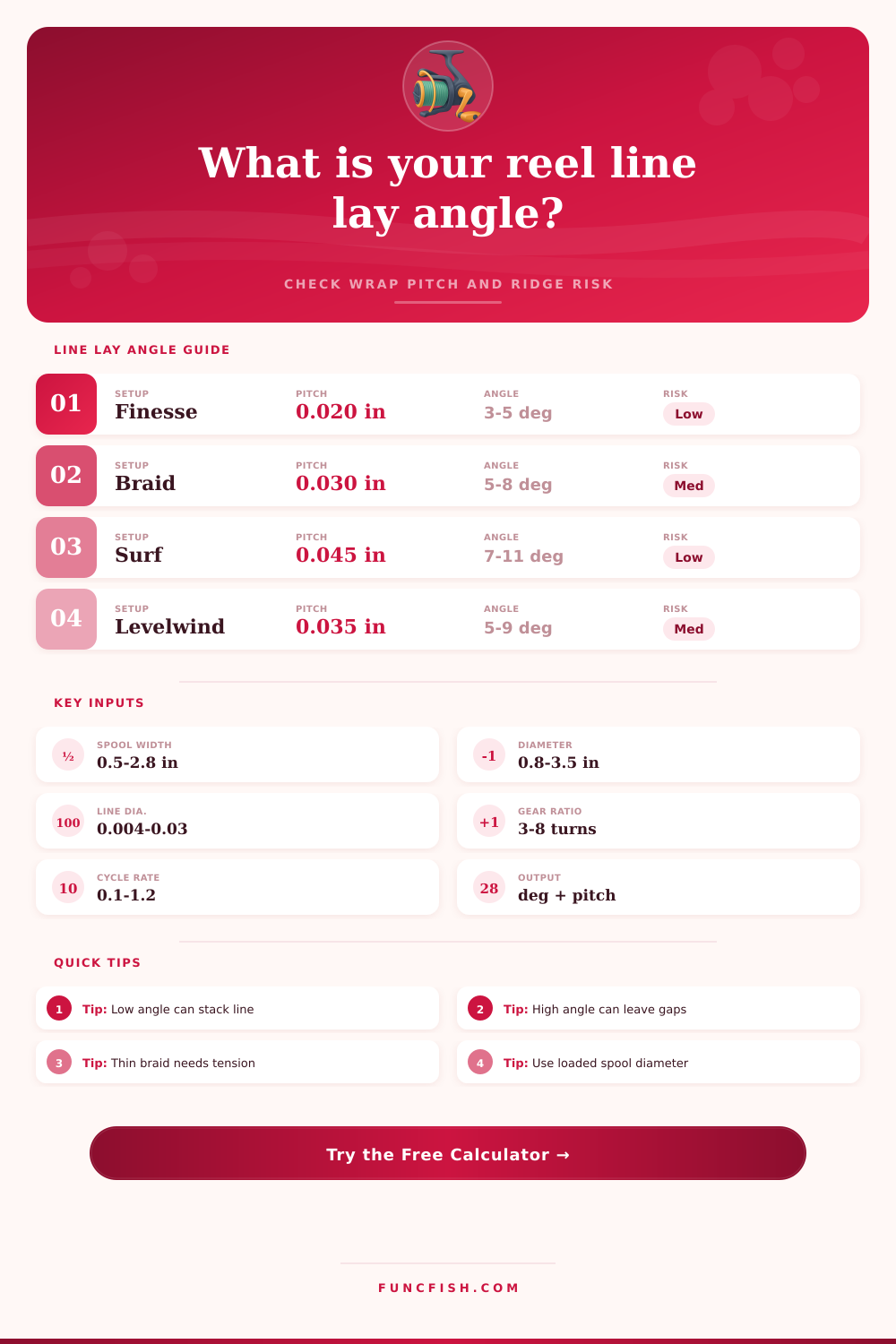
| Slow oscillation spinning | 2 to 5 deg | 4 to 10 deg | Thin braid, finesse casts | Too much parallel stacking |
| Standard spinning reel | 4 to 8 deg | 8 to 16 deg | General bass and inshore use | Wind knots when overfilled |
| Cross-wrap surf spool | 6 to 11 deg | 12 to 22 deg | Long casts and slick braid | High pitch with stiff mono |
| Levelwind casting reel | 3 to 9 deg | 6 to 18 deg | Braid or mono on compact spools | Guide timing at spool edges |
| Manual conventional reel | Variable | Variable | Trolling, jigging, heavy mono | Thumb-lay ridges and valleys |
| Technique | Line style | Pitch ratio target | Tension target | Practical read |
|---|---|---|---|---|
| Finesse spinning | 6 to 15 lb braid | 2.0x to 4.5x line diameter | 0.5 to 1.5 lb | Low memory, keep fill below lip |
| Fluoro baitcaster | 10 to 17 lb fluoro | 1.2x to 2.5x line diameter | 1.0 to 3.0 lb | Needs firm pack to avoid dig-in |
| Surf braid | 20 to 50 lb braid | 2.5x to 6.0x line diameter | 1.5 to 4.0 lb | Cross-wrap helps line peel off |
| Trolling mono | 15 to 40 lb mono | 1.1x to 2.2x line diameter | 2.0 to 6.0 lb | Even tension matters more than angle |
| Wire line | 7 strand or copper | 1.0x to 1.8x line diameter | 3.0 lb plus | Slow, flat lay reduces kinks |
These ranges are practical reel setup targets. The calculator uses geometry first, then adjusts the quality read for line material, fill level, tension, and oscillation style.
💡Line lay tuning notes
The same traverse speed creates a steeper line lay angle on a small arbor and a flatter angle as the spool fills. Measure near the fill level you actually fish.
Wrap pitch divided by line diameter shows whether adjacent wraps are tight, open, or highly crossed. Very low ratios can stack; very high ratios can leave visible grooves.
Soft braid peels from a crossed spool well, but it can dig under low tension. Heavy fluorocarbon usually wants a flatter, firmer, more controlled pack.
If line piles at the top or bottom lip, the angle may be fine while the stroke end timing is off. Reduce fill or correct the spool shim before blaming line size.
The lay angle of the fishing lines is the angle at which each wrap of the fishing line rest on the spool of the fishing line. The lay angle of the fishing line determine the way in which the fishing line stacks upon a spool. If the lay angle are incorrect, the fishing line may mound upon one side of the spool, or the fishing line may dig into itself during a cast.
Thus, understanding the lay angle of the fishing line is essential for understanding whether the fishing line will evenly stack upon the spool or whether the fishing line creates ridge upon the spool. Several specific measurement help to determine the lay angle of the fishing line. The width of the spool is one measurement that help to determine the lay angle, as is the loaded diameter of the spool.
Lay Angle of Fishing Line and What Affects It
Additionally, the diameter of the fishing line is one measurement that helps to determine the lay angle of the fishing line, as is the number of times the spool turn per revolution of the handle that hold the spool. Additionally, the number of cycles the levelwind of the fishing reel make in one turn of the fishing reel also determine the lay angle. Each of these measurements help to determine the axial travel of the fishing line per wrap of the fishing line upon the spool; the axial travel of the fishing line per wrap of the fishing line upon the spool, when combine with the circumference of the spool, allows for the calculation of the lay angle of the fishing line.
Fishing line of different material have different reactions to the lay angle of the fishing line. For instance, monofilament fishing lines has memory, which cause the monofilament lines to require a firm pack of the lines. Fluorocarbon fishing lines are often stiffer than monofilament lines, which cause fluorocarbon lines to tend to dig into itself if the lay angle is too open.
Finally, eight carrier braided fishing lines are slick in their materials, which permit them to allow for a wider pitch angle between the wraps of the fishing line, but if the lay angle is too steep with eight-carrier lines, the lines may tend to cut under itself. The oscillation pattern of the spinning reel can also impact the lay angle of the fishing line. If the oscillation pattern is slow, the wraps of the fishing line will be flatter upon the spool; however, such a slow oscillation pattern will tend to reduce the distance that the fishing line can be cast.
Cross-wrap spools are create in a way that the crossings of the fishing line upon the cross-wrap spool create a higher crossing angle than the cross-wrap spool’s wraps; increasing the crossing angle allow for the fishing line to cleanly peel off the cross-wrap spool during a cast. However, if a cross-wrap spool employ a high pitch ratio, the fishing line may leave grooves upon the cross-wrap spool if the fishing line is of a stiff material. The diameter of the spool of the fishing reel will change as the fishing line are added to the spool.
Thus, due to the change in diameter of the spool, the lay angle of the fishing line change, as well. Small-sized arbors will allow for a more steeper lay angle than larger spool diameters. Additionally, another measurement of the fishing line is the fill level of the fishing line upon the spool.
If the fishing line is overfilled upon the spool, the fishing line will push against the lip of the spool, which will impact the lay angle of the fishing line. However, if the line is underfilled upon the spool, the fishing line may move lateral upon the spool, which can create problems for spinning reels. The tension with which the fisherman will retrieve the fishing line from the spool is another factor that impact the fishing line, though it isnt related to the lay angle.
If the tension is too little, the fishing line will create soft spot along the line that may cause it to dig into itself. However, if the tension is too high for lines that are of a stiff material, the fishing line will create a ridge along the line. Thus, the retrieve should check the tension to ensure that the fishing line appropriately rests upon the spool.
Finally, the lay angle can change. For instance, if the diameter of the fishing line is change, or if the oscillation rate of the reel is change, the lay angle will change. Thus, the lay angle should of been checked each time that the type of fishing line is change or each time that the fishing line is fill into the spool.
By knowing the measurements of the fishing line and the spool, and by knowing the material of the fishing line, a fisherman can ensure that the fishing line will remain predictable while being cast.