Casting Reel Brake Setting Calculator
Estimate a starting baitcaster brake dial, centrifugal block count, spool tension gap, and thumb-control margin from lure mass, line behavior, wind, spool fill, rod loading, and casting skill.
📌Scenario presets
⚙Reel, lure, and casting inputs
Brake setting estimate
Calculation breakdown
📊Brake system reference
Smooth outside adjustment. Higher numbers control the fast middle of the cast and protect against late overrun.
Best for hard launch control. Turn on opposite blocks so the spool stays balanced during startup.
Fine increments make it easier to tune light lures, gusts, and short target casts without big jumps.
Mode-style brakes group settings. Use higher modes for wind-resistant lures and lower modes for compact distance baits.
📋Reference tables
| Lure and cast type | Typical weight | Brake demand | Starting setting | Adjustment note |
|---|---|---|---|---|
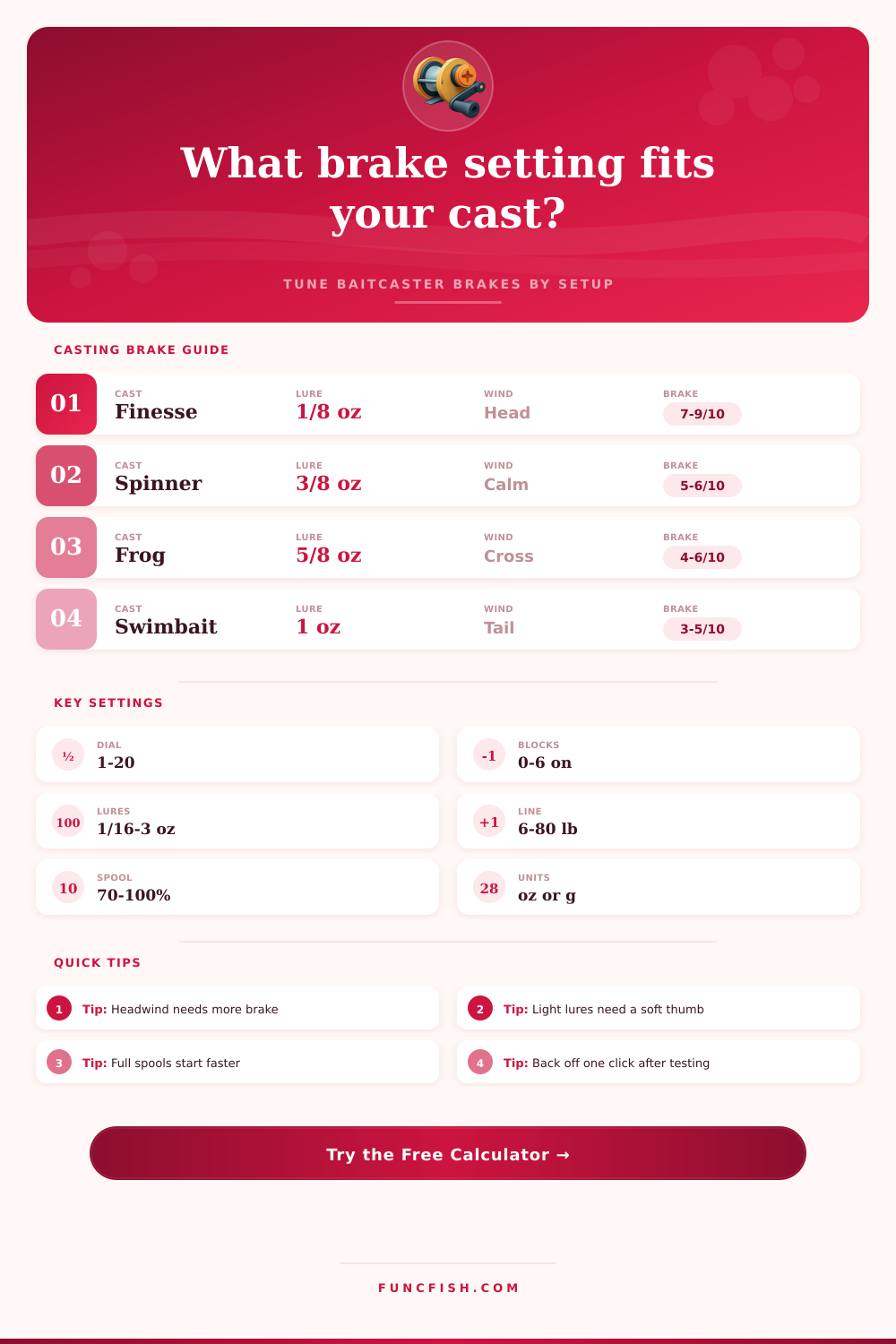
| Light finesse plug | 1/16-1/8 oz / 2-4 g | Very high | 7-9 of 10 | Use more spool tension and a short test cast. |
| Weightless soft plastic | 3/16-5/16 oz / 5-9 g | High | 6-8 of 10 | Low airspeed at the end of the cast needs braking. |
| Squarebill or jerkbait | 3/8-1/2 oz / 11-14 g | Medium high | 5-7 of 10 | Flat sides catch wind and slow suddenly. |
| Spinnerbait or bladed jig | 3/8-3/4 oz / 11-21 g | Medium high | 5-7 of 10 | Blades add drag, especially on crosswind casts. |
| Compact jig or spoon | 1/2-1 oz / 14-28 g | Medium low | 3-5 of 10 | Dense shapes tolerate lower brake if thumb timing is steady. |
| Frog or bulky topwater | 1/2-3/4 oz / 14-21 g | Medium | 4-6 of 10 | Hollow bodies fly well until they plane or wobble. |
| Large swimbait | 1-3 oz / 28-85 g | Low medium | 3-5 of 10 | Heavy lure loads the rod, but spool startup is strong. |
| Skipping jig | 3/8-1/2 oz / 11-14 g | Very high | 7-10 of 10 | Water contact and low trajectory can stop the lure instantly. |
| Line setup | Startup behavior | Overrun tendency | Brake adjustment | Best match |
|---|---|---|---|---|
| Monofilament | Moderate stretch | Forgiving | Baseline | Learning, crankbaits, topwater |
| Copolymer | Moderate stretch | Forgiving | Baseline to +0.2 | General purpose casting |
| Fluorocarbon | Stiffer coil memory | Medium | +0.4 to +0.8 | Jigs, worms, jerkbaits |
| 4-strand braid | Fast pickup, coarse | Medium | +0.2 to +0.5 | Grass, frogs, power fishing |
| 8-strand braid | Very fast, slick | Medium high | +0.4 to +0.7 | Long casts, compact lures |
| Braid to leader | Knot passes guides | Medium high | +0.5 to +0.9 | Clear water and mixed cover |
| Heavy frog braid | Large diameter | Low medium | -0.1 to +0.4 | Close heavy-cover targets |
| Angler situation | Thumb skill | Spool tension gap | Drop test | Dial habit |
|---|---|---|---|---|
| First baitcaster practice | New | 0.20-0.30 mm | Lure drops slowly | Start high and reduce after clean casts |
| Weekend bass fishing | Steady | 0.10-0.18 mm | Lure drops with slight control | Use wind as the main adjustment |
| Skipping docks | Skilled | 0.12-0.20 mm | Lure drops slower than normal | High brake protects water contact |
| Distance practice | Expert | 0.03-0.10 mm | Lure drops freely | Lower brake and use thumb at splashdown |
| Heavy swimbait casting | Skilled | 0.08-0.16 mm | Lure drops steady | Control the launch, not just the end |
| Gusty bank casting | Any | 0.14-0.24 mm | Lure drops slowly | Add 1-2 dial points for gusts |
💡Brake tuning notes
Brake change rule: Change one thing at a time. If the spool fluffs early, add centrifugal brake or spool tension; if it overruns at splashdown, add magnetic dial or thumb earlier.
Wind rule: A compact lure in a tailwind can often drop one setting, but a flat lure into a headwind may need two extra settings even at the same weight.
Casting a baitcaster requires that you understands how the brake system on the baitcasting reel works. The brake system is necessary because the baitcasting reel dont know how much line to cast out of the reel automatically. If the brake system is not releasing the line at the appropriate rate, the fishing line will tangle into a bird’s nest.
To avoid this situation, there is several variables that you must consider when adjusting the brake settings on your baitcasting reel. These variables include the weight of the baits, the conditions of the wind, the type of fishing line that is being used, the amount of line on the spool, and the action of the rod that is being used. Additionally, your skill level with the baitcasting reel and your strength with your thumb will plays a role in the adjustment of the brake settings on your reel.
How to Adjust the Brake on a Baitcasting Reel
The weight of the bait that is being used is one of the first variables to consider. The heavier the bait, the more momentum that the bait will have during a cast. Bait that is compact will have more momentum then bait that is lighter in weight.
Therefore, compact baits will require less adjustment of the brake settings on the reel compared to lighter baits. Another variable to consider is the condition of the wind. If the wind is such that it will slow down the bait but the baitcasting reel continue to spin, the bait will overrun the reel.
Therefore, your brake settings should take into consideration the weight of the bait that will be used and the conditions of the wind. The type of line that is being used is another variable that will affect the adjustment of the brake settings. If the line that is being used is monofilament, there will be friction on the surface of the line that will naturaly slow the baitcasting reel.
Fluorocarbon lines are stiffer and denser than the monofilament lines so they will leave the reel more aggressive. Braided lines will allow the bait to go further out in the cast but can cause overruns when the lure stops moving. Since the baitcasting reel spin the fastest in the first few feet of the cast, there are definite difference between the types of lines that can be used and how they will affect the adjustment of the brake settings on the reel.
The amount of line on the baitcasting reel and the action of the rod that is being used are also variable that will affect the adjustment of the brake settings. If the line on the reel is full, it will have more mass on the reel and more inertia. This will require less effort from the brake system to move the line.
If there is less line on the reel, there will be less mass on the reel and it will be easier for the line to start moving but it can cause overruns if the brake settings are to low. The action of the rod that is being used will also affect the baitcasting reel. If the rod has a fast action to it, it will allow the energy create from the rod to be released quickly which adds to the speed of the cast with the baitcasting reel.
A rod with a moderate action will allow the energy to be released more gradual which will make it easier for the brake system to maintain the rate at which the line is being cast. Your skill level and your control with your thumb are the last variables to consider. If you are an experienced baitcaster, you can use your thumb to control overruns of the line.
This will allow for lower brake settings which will create more distance with the cast of the baitcasting reel. With your skill level and experience with baitcasting, you have more control with your thumb. New baitcasters should use higher settings on the brake system so that they has more time to learn how to use their thumb to control overruns of the line.
You should use the reference tables to find the proper starting point for your brake settings but you should never follow the settings blindly. Variables in the fishing environment can change throughout the day of fishing so your brake settings will have to be adjusted accordingly. If you experience overruns of the fishing line, you should increase the brake settings.
If your overruns are occurring at the end of the cast, you will have to use more thumb control or increase the brake settings. Make small adjustments to the brake settings of your baitcasting reel as opposed to trying to find that more perfect setting for every fishing situation.