Braid to Mono Diameter Equivalent Calculator
Convert braided line diameter into a mono-equivalent diameter, mono pound class, spool capacity estimate, and leader-knot diameter balance using fishing line chart interpolation.
📌Scenario presets
⚙Line and spool inputs
Diameter-equivalence results
Full calculation breakdown
📊Diameter material grid
4-carrier braid
8-carrier braid
12-carrier braid
Coated braid
📐Common braid diameter equivalents
| Braid rating | Typical braid diameter | Closest nylon mono diameter | Approx mono class | Fishing use |
|---|---|---|---|---|
| 6 lb braid | 0.10 mm / 0.004 in | 0.10-0.12 mm | 2 lb mono | Trout and panfish finesse |
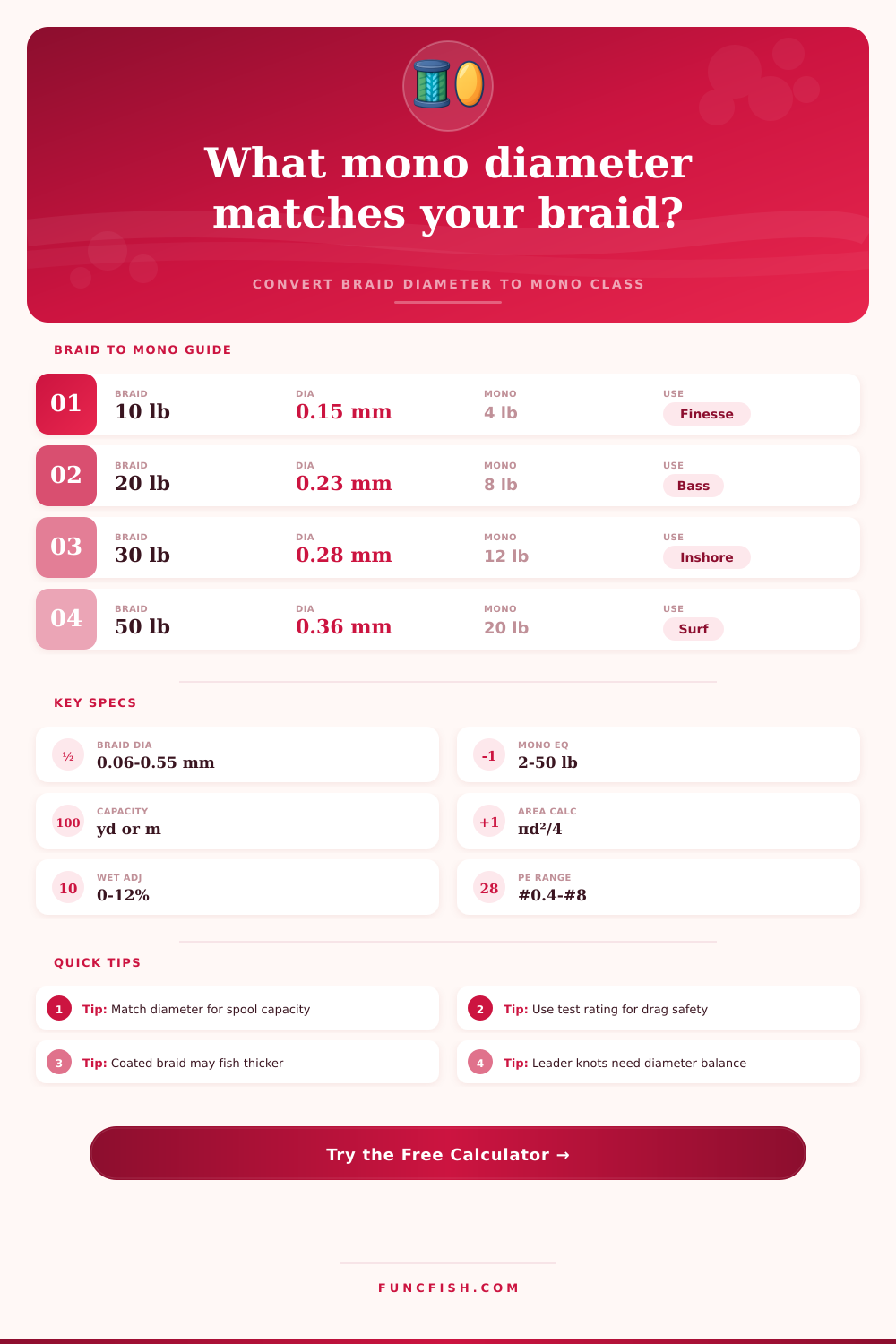
| 10 lb braid | 0.15 mm / 0.006 in | 0.15-0.16 mm | 4 lb mono | Light spinning and dropshot |
| 15 lb braid | 0.19 mm / 0.008 in | 0.18-0.20 mm | 6 lb mono | Finesse bass and walleye |
| 20 lb braid | 0.23 mm / 0.009 in | 0.23-0.25 mm | 8 lb mono | General bass and inshore |
| 30 lb braid | 0.28 mm / 0.011 in | 0.28-0.31 mm | 12 lb mono | Surf plugs and kayak saltwater |
| 50 lb braid | 0.36 mm / 0.014 in | 0.35-0.38 mm | 20 lb mono | Frogs, cover, pike |
| 65 lb braid | 0.41 mm / 0.016 in | 0.40-0.43 mm | 25 lb mono | Catfish and heavy cover |
| 80 lb braid | 0.48 mm / 0.019 in | 0.47-0.50 mm | 30-35 lb mono | Offshore jigging |
📏Mono and leader diameter chart
| Rated class | Nylon mono diameter | Copoly diameter | Fluoro diameter | Closest braid use |
|---|---|---|---|---|
| 2 lb | 0.10 mm / 0.004 in | 0.11 mm / 0.004 in | 0.12 mm / 0.005 in | 4-6 lb braid |
| 4 lb | 0.16 mm / 0.006 in | 0.17 mm / 0.007 in | 0.18 mm / 0.007 in | 8-10 lb braid |
| 6 lb | 0.20 mm / 0.008 in | 0.21 mm / 0.008 in | 0.23 mm / 0.009 in | 12-15 lb braid |
| 8 lb | 0.25 mm / 0.010 in | 0.26 mm / 0.010 in | 0.28 mm / 0.011 in | 20 lb braid |
| 12 lb | 0.30 mm / 0.012 in | 0.32 mm / 0.013 in | 0.33 mm / 0.013 in | 30 lb braid |
| 20 lb | 0.38 mm / 0.015 in | 0.40 mm / 0.016 in | 0.43 mm / 0.017 in | 50 lb braid |
| 30 lb | 0.50 mm / 0.020 in | 0.52 mm / 0.020 in | 0.55 mm / 0.022 in | 80 lb braid |
| 50 lb | 0.70 mm / 0.028 in | 0.74 mm / 0.029 in | 0.80 mm / 0.031 in | 130 lb braid |
🎯Species and technique reference
| Scenario | Common braid | Mono diameter equivalent | Leader diameter range | Capacity priority |
|---|---|---|---|---|
| Trout stream spinning | 6-8 lb | 2-3 lb mono | 0.12-0.18 mm | Low memory, fine knots |
| Bass finesse spinning | 10-15 lb | 4-6 lb mono | 0.20-0.26 mm | Long casts, small spool |
| Walleye jigging | 10-15 lb | 4-6 lb mono | 0.22-0.28 mm | Sensitivity and depth |
| Kayak inshore | 15-30 lb | 6-12 lb mono | 0.28-0.45 mm | Balanced capacity |
| Frog bass cover | 40-65 lb | 17-25 lb mono | Often no leader | Abrasion and control |
| Surf plugs | 30-50 lb | 12-20 lb mono | 0.40-0.70 mm shock | Cast distance and backing |
| Catfish bottom rig | 50-80 lb | 20-35 lb mono | 0.50-0.80 mm | Durability over finesse |
| Offshore jigging | 50-100 lb | 20-40 lb mono | 0.60-1.00 mm | Depth and line angle |
🔀Diameter comparison grid
Same diameter
Capacity matchUse this when replacing mono with braid on a reel and you want similar fill behavior or line-counter calibration.
Same strength
Not equivalentA 20 lb braid is often near 8 lb mono diameter, so same-strength swaps can greatly change spool fill.
Same area
πd2/4Capacity estimates are based on cross-section area; doubling diameter takes roughly four times the spool volume.
Knot balance
1.2x-2.5xMany braid-to-leader knots behave best when the leader diameter is thicker but not wildly larger than braid.
🧮Formula reference table
| Calculation | Formula | Why it matters | Calculator output |
|---|---|---|---|
| Adjusted braid diameter | Published diameter x construction factor x condition factor | Coatings, flat braid, and fuzz change how thick braid fishes on a spool | Mono diameter equivalent |
| Cross-section area | π x diameter2 / 4 | Line volume on a spool scales with area, not pound test | Area ratio and capacity |
| Capacity conversion | Reference capacity x (reference diameter / braid diameter)2 x packing factor | Estimates how many yards or meters of braid fit on a reel | Estimated braid capacity |
| Mono class interpolation | Linearly interpolate between chart diameters and rated strengths | Returns a practical mono pound class instead of a rough guess | Estimated mono class |
| Leader balance | Leader diameter / adjusted braid diameter | Helps assess knot bulk and connection behavior | Diameter balance ratio |
💡Diameter calculation notes
Spool-capacity tip: match braid to mono by diameter when the goal is reel fill, backing amount, line-counter consistency, or lure running depth. Match by pound test when the goal is drag strength.
Leader-knot tip: if the leader diameter is more than about three times the adjusted braid diameter, compact knots like the FG usually seat cleaner than bulky doubled-line connections.
It is a sickening moment when you rip on a snagged hook in some underwater cover and suddenly feel that dreaded line parting. It’s happened to us all when we move to braid and don’t grasp what realy happens to diameter on a spool. Braid has less diameter (that’s the appeal) than mono for the same breaking strength, but it also tie differently and packs differently too.
Where many folks get tripped up is they attempt to equate thickness with pound test. An eight-pound monofilament line may have same diameter as a twenty-pound braid. If you base loading your spool solely on strength, you’ll end up leaving it far short of full capacity. Or, you might rip the whole spool in two casts by failing to account for the volume difference at all.
How to Fill Your Reel with Braid Line
This allows you to save yourself the guesswork of matching your own braid’s characteristics against a nylon reference chart; instead, calculator does all the math when you enter your unique braid specifications. The only required starting information is the true published diameter of your line (i.e., not its pound test as listed on the package).
Because every manufacturer builds braids differently, some braid types will fish much larger than others with the same nominal width. For instance, a four carrier braid will have a lot more “texture” and resulting friction compared to an eight or even a twelve carrier version. This makes it actualy fish “thicker.”
Then add coated line to the mix. Its polymer or wax shell adds thickness to prevent knots from slipping and to stop moisture absorption, and now things is getting complicated!
Enter the tool: It includes adjustment factors based off the details of line construction that represent how each line actually takes up space on your reel arbor. The fun part about all of this geometry is that spools are filled by cross-sectional area (not linear strength). So, doubling the diameter of your line roughly quadruples its spooled volume. That’s why going from mono to braid typically lets you double or even triple your yardage count while using the same reels.
The calculator takes into account packing density and uses your reel’s rated mono capacity as a starting point to estimate how many yards of braid will fit. Loose, wet-packed braids has different behavior than firm hand-wound lines that may compress with time. Knowing this ratio gives you some insight into planning your spool strategy and prevents running dry on a long fight with a heavy fish.
Another variable not covered in pure strength charts is leader knots. You must get the connection between braid and mono or fluorocarbon just right for it to work reliably, so the diameters of these line types needs to match well when you tie them together. If the leader is too thin relative to the braid, the knot might slip under pressure. Too thick a leader diameter will result in a bulked up transition that catches on structure. The tool will give you a balance ratio so you can see how this relationship look before you tie your first loop.
For most FG knots, the leader size should of be about one and a half to two times the braid core size. This gives you a nice smooth taper and lessens any friction in rod guides.
Different line types also change drag settings because braid stretches much less than mono. So when a fish makes a sudden run, it’s not the line stretching to absorb some of the shock… It’s your drag system. That’s why the calculator will help approximate a proper percentage drag for the converted mono class equivalent so you’re not overloading the line on an explosive strike.
It is more a matter of managing the mechanical load and less a matter of faith in the breaking strength number based off the spool. Friction coefficient The diameters are equivalent. It is about physicality.