Knot Strength by Line Type Calculator
Estimate the real weak-link strength of a knot after line type, knot family, wraps, line condition, shock loading, and drag target are all accounted for.
📌Scenario presets
⚙Knot and line inputs
Knot strength estimate
Full breakdown
📋Line type reference grid
Monofilament
Fluorocarbon
Braid
Wire
📐Knot and line tables
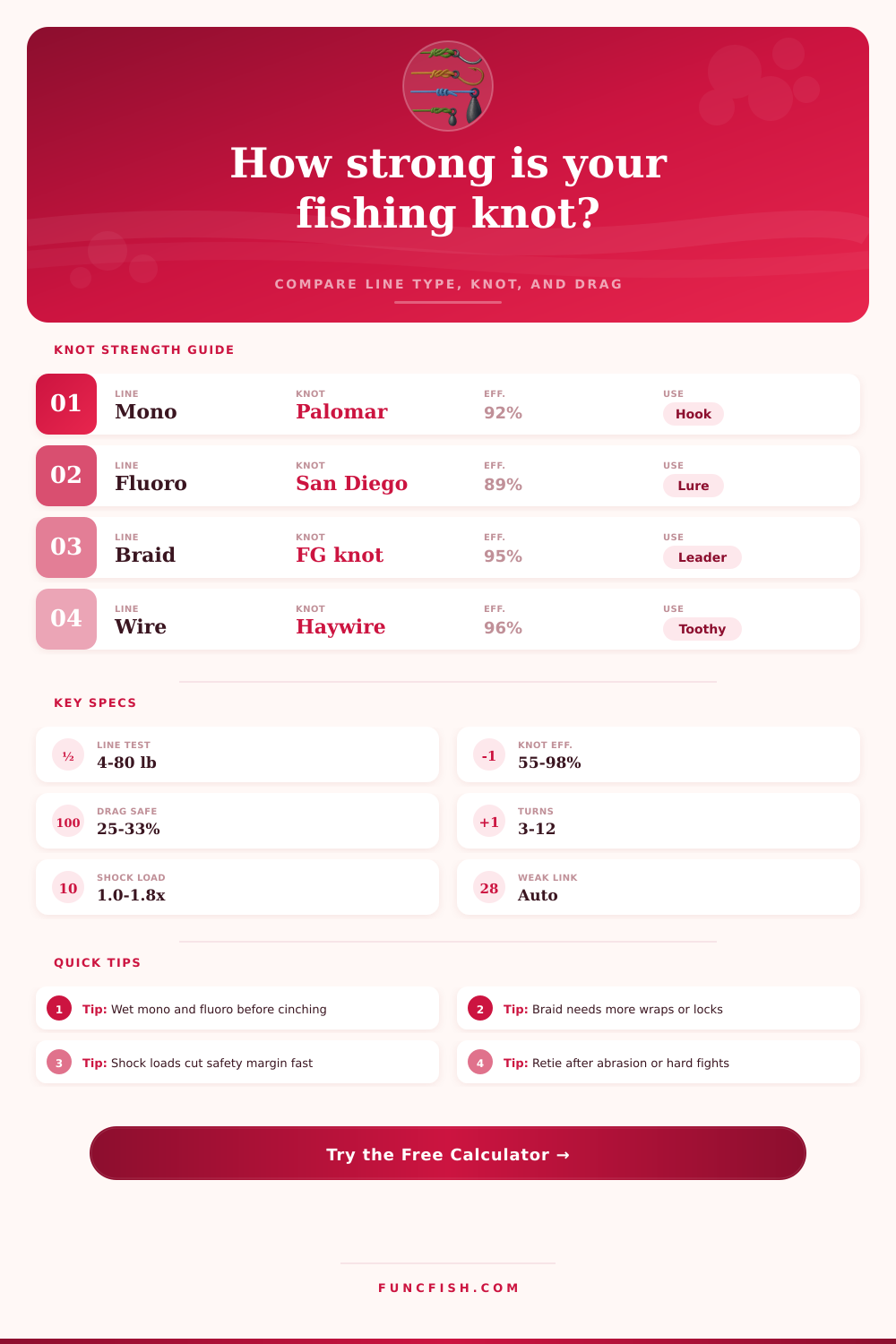
| Knot | Best line type | Typical efficiency | Wrap target | Use case |
|---|---|---|---|---|
| Palomar | Mono, braid, fluoro | 82-95% | Folded loop | Hooks and lures |
| Improved clinch | Mono, light fluoro | 62-84% | 5-7 turns | Light terminal tackle |
| Uni knot | Mono, fluoro, braid | 76-89% | 5-8 turns | Terminal and loopable |
| San Diego jam | Fluoro, mono | 82-92% | 5-7 turns | Jigs and hard baits |
| FG knot | Braid to leader | 88-97% | 16-24 wraps | Leader connection |
| Haywire twist | Single-strand wire | 92-98% | 4-6 barrel | Toothy fish leaders |
| Line type | Diameter model | Knot caution | Shock behavior | Retie trigger |
|---|---|---|---|---|
| Monofilament | Medium diameter | Heat from dry cinch | Stretch cushions load | Memory curl or nick |
| Fluorocarbon | Stiffer, dense | Burn and crossing wraps | Less stretch than mono | Cloudy or flattened line |
| Braided PE | Thin for test | Slippage under shock | Low stretch spike loads | Fuzzy or faded section |
| Copolymer | Mono-like | Moderate heat risk | Moderate stretch | Rough leader knot contact |
| Fly tippet | Fine diameter | Overtightened knots | Light shock reserve | After several fish |
| Wire leader | Wire gauge based | Do not use soft-line knots | Kinks weaken fast | Any sharp kink |
| Species setup | Common line | Knot choice | Safe drag range | Shock factor |
|---|---|---|---|---|
| Panfish ultralight | 2-6 lb mono | Improved clinch | 20-30% | 1.05-1.20x |
| Trout stream | 4-8 lb fluoro | Uni or surgeon | 20-28% | 1.15-1.35x |
| Bass braid leader | 20-50 lb braid | FG or Alberto | 25-33% | 1.25-1.60x |
| Catfish bottom | 20-40 lb mono | Snell or Palomar | 28-35% | 1.15-1.45x |
| Pike casting | 30-65 lb braid | FG plus wire twist | 22-30% | 1.30-1.70x |
| Offshore trolling | 50-100 lb braid | PR or FG | 22-30% | 1.40-1.90x |
💡Practical checks
Tip: The weakest point is usually the lower of the main-line knot strength, leader-line knot strength, and straight leader rating. A strong braid knot still loses if the leader is nicked.
Tip: If your measured drag plus shock factor is within 1.2x of the estimated knot strength, retie, lower drag, or move to a higher-efficiency connection.
Knot failure can occur at a connection point of a fishing rig. Furthermore, knot failure can occur due to the lines, the knot, and the conditions in which the fishing rig is exposed to physical load. A person may experience knot failure when the fish pulls on the fishing line.
The variables in this situation can be dificult to manage when the fish puts a heavy pull on the line. To avoid having the knot fail under these condition, a person must understand the effect that the type of fishing line, the number of wraps on the knot, and the drag on the line can have on the strength of the knot. The type of fishing line that is used will impact the amount of stretch and the amount of heat that is placed onto the knots on the fishing line.
Why Fishing Knots Fail and How to Prevent Them
For instance, monofilament lines has the advantage that they will stretch, which makes them more forgiving of the knots on the line. Fluorocarbon lines are stiffer, however, which means they will transfer more of the shock from the fish onto the knots on the fishing line. Braided lines are thin and strong, but they do not stretch; therefore, any sudden pull on the line will have a more greater impact on the knots on the line.
Lastly, wire leaders require different techniques than the placement of knots on lines, as opposed to the soft lines of monofilament or fluorocarbon lines. For these variables, a fishing line calculator can help a person to determine the strength that a given knot will have under these conditions. The number of wraps of the fishing line that are incorporated into the knot impact the strength of that knot.
Using too few wraps on a knot may result in the knot slip when the fish pulls on the line; however, using too many wraps on a knot can lead to the heating of the line and the weakening of the line itself. For instance, a certain knot may work well on a braided fishing line, but the same knot may fail on a monofilament line. This is due to the tendency of braided lines to slide on the knots; the more the knot is cinched, the more friction is created along the line and the stronger the line will be; however, if the person cinches the knot quick and while the line is dry, the friction and heat created can weaken the fishing line.
The condition of the fishing line can also impact the strength of the knots on that line. Using a fresh line will allow for the knots on the line to behave in a more predictably way; however, using a used fishing line may mean that the line has already lost some of its strength. Furthermore, if the fishing line is nicked, flattened or cloudy near the point at which the line is tied together, the line is likely to fail at that weak point.
However, if a person uses a fishing line calculator, the calculator can take into account the condition of the fishing line and the potential loss of strength of the line. The drag on the fishing line impacts how much strength that the knots on the line will experience. Using a steady drag on the fishing line will allow the line to function in its optimal range; however, if there is a sudden heavy pull on the fishing line due to the hooking of a fish, the knots on the line may not be able to dissipate that strength.
In these instances, either the person can lower the drag on the line, the person can retie the knot, or the person must accept that the fishing line is in a range that may lead to the failure of the knots on the line. A third factor that can impact the strength of a fishing line is the leader of the line. For instance, if the main fishing line is braided and the leader line is fluorocarbon, the weaker of the two lines will determine the strength of that line.
Additionally, if the lines are of different diameters, the efficiency of the knots will be reduced. A person can reference a table to determine which knots will work best along which types of fishing lines. Fishing line and knot conditions are rarely perfect.
The fishing conditions include mistake in the tying of the knots or in the drag settings of the line. A fishing line and knot calculator can help a person to anticipate the conditions of the line before they enter the fishing water. A person can make a calculation of the strength of the knots and the line before fishing begins.
Furthermore, if a fish ever pulls the line, that knot should be inspected. If any part of the fishing line is damaged, that line should be cut back to the point where the abrasion of the environment no longer weakens it. By understanding these variables, a person can more easily find the weakest link in their fishing rig.
With the knowledge of the weakest link in there fishing rig, a person can effectively manage the margin of safety that they use when fishing.