Leader Stiffness Ratio Calculator
Compare how stiff a leader feels against the main line using material modulus, diameter, leader length, line strength, knot hinge effect, lure weight, and water temperature.
📌Scenario presets
⚙Leader stiffness inputs
Leader stiffness results
Calculated stiffness comparison appears here.
Calculation breakdown
📊Material stiffness data
Soft Nylon Mono
Fluorocarbon
Hard Mono
Stainless Wire
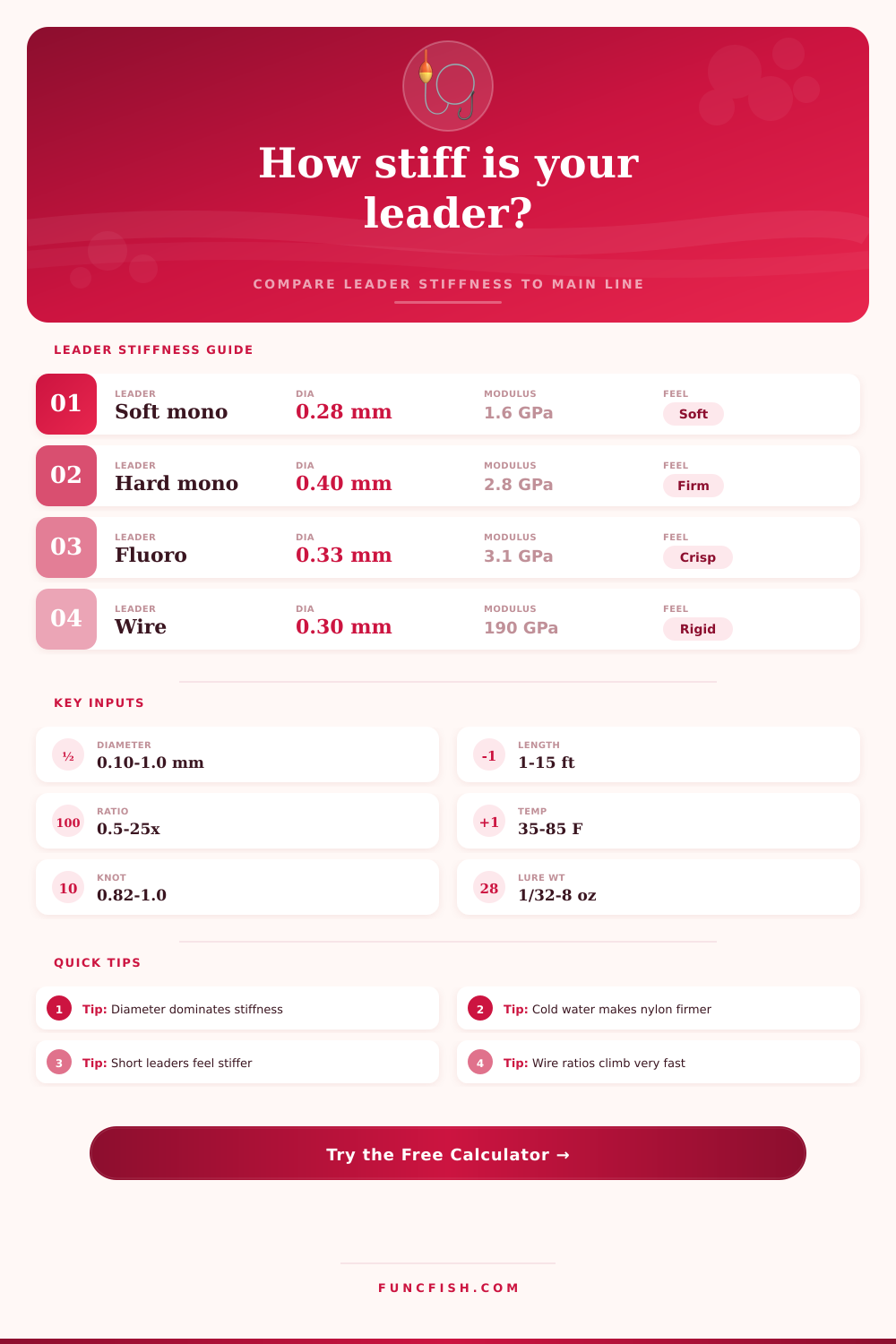
Modulus values are practical calculator approximations for comparing fishing leader behavior. Because bending stiffness scales with diameter to the fourth power, a small diameter change can outweigh material choice.
📏Reference tables
| Material | Approx modulus | Density feel | Memory tendency | Typical leader role |
|---|---|---|---|---|
| Soft nylon monofilament | 1.4-1.8 GPa | Buoyant to neutral | Low to medium | Natural drift, topwater, light bait |
| Copolymer leader | 1.7-2.1 GPa | Neutral | Medium | General casting and small crankbaits |
| Hard nylon mono | 2.5-3.0 GPa | Neutral | Medium-high | Turnover, shock leaders, fly butt sections |
| Fluorocarbon | 2.8-3.4 GPa | Sinking, crisp | High | Abrasion, jigs, clear-water leaders |
| Fly tippet nylon | 1.5-1.9 GPa | Neutral | Low | Small flies and fine presentations |
| Single strand wire | 180-200 GPa | Rigid | Very high | Pike, musky, wahoo, mackerel teeth |
| Knotable titanium wire | 100-120 GPa | Springy rigid | Low for wire | Toothy fish with better lure action |
| Effective ratio band | Leader feel | Best fit | Watch for | Common adjustment |
|---|---|---|---|---|
| Under 0.75x | Softer than main line | Dry flies, live bait, panfish, finicky trout | Poor turnover, abrasion weakness | Increase diameter one step or shorten leader |
| 0.75-1.50x | Balanced and natural | Bass finesse, walleye jigs, inshore plastics | May lack bite protection | Use fluorocarbon or a heavier tippet |
| 1.50-4.00x | Firm but castable | Jerkbaits, surf bait, rocks, shell, heavy cover | Reduced lure freedom | Add a loop knot or lengthen leader |
| 4.00-10.00x | Very firm | Shock leaders, trolling, large swimbaits | Coiling and hinge feel at knot | Use softer mono or longer leader |
| Over 10.00x | Rigid protection | Wire leaders and toothy fish rigs | Visible hardware and damped action | Shorten wire trace or switch to titanium |
| Species or technique | Typical main line | Typical leader | Useful ratio range | Practical note |
|---|---|---|---|---|
| Panfish ultralight | 2-6 lb mono or braid | 2-4 lb soft mono | 0.5-1.2x | Keep stiffness low so tiny jigs hang naturally. |
| Trout stream | Fly line or 4-6 lb mono | 4X-6X nylon or fluoro | 0.6-1.6x | Small flies need supple tippet with enough turnover. |
| Bass finesse | 10-20 lb braid | 6-12 lb fluoro | 1.0-3.0x | Balanced stiffness keeps dropshots and shaky heads responsive. |
| Walleye jigging | 8-12 lb braid | 8-12 lb fluoro | 1.2-3.5x | Crisp leader improves jig feel without excessive coil. |
| Inshore snook or redfish | 10-30 lb braid | 20-40 lb fluoro | 2.0-6.0x | Abrasion pushes diameter upward around oysters and docks. |
| Surf casting | 15-30 lb braid or mono | 30-60 lb shock mono | 2.5-8.0x | Shock loading matters more than subtle lure motion. |
| Pike casting | 30-65 lb braid | 30-60 lb wire or fluoro | 8.0x+ | Wire is intentionally rigid for bite protection. |
| Offshore trolling | 30-80 lb braid or mono | 60-200 lb fluoro | 4.0-12.0x | Leader stiffness can help keep large lures tracking. |
| Connection | Hinge factor | Stiffness effect | Good match | Less ideal with |
|---|---|---|---|---|
| FG or PR connection | 0.98 | Very smooth transition | Braid to fluoro, long cast leaders | Very short heavy shock sections |
| Alberto or Albright | 0.94 | Small hinge and knot bulk | Everyday braid-to-leader rigs | Micro guides with thick leaders |
| Double uni | 0.90 | More hinge and larger knot | Mono-to-mono or quick field ties | Heavy fluoro through small guides |
| Small swivel | 0.82 | Mechanical hinge at connection | Live bait, trolling, twist control | Subtle lure action close to swivel |
| Loop knot at lure | 0.88 | Frees lure despite stiff leader | Jerkbaits, plugs, streamers | Heavy vegetation or snag-prone rigs |
| Direct tie | 1.00 | Full leader stiffness at lure | Jigs, worm hooks, single hooks | Hard baits needing side-to-side swing |
🔀Comparison grid
Diameter change
A leader that is 20% thicker is about 2.1x stiffer before material is considered, because stiffness follows diameter to the fourth power.
Material change
Fluorocarbon often feels roughly 1.5-2.0x stiffer than soft nylon at the same diameter, while hard mono sits between them.
Length change
A short 18 inch leader transmits stiffness more directly to the lure than an 8 foot leader, even when diameter and material are unchanged.
Connection change
A swivel or loop can lower effective stiffness at the lure by adding a hinge, while direct knots preserve the leader's full feel.
💡Calculation tips
Published pound test is helpful for strength, but stiffness is driven mainly by actual diameter and material. When a calculator result feels surprising, check the diameter values before changing the leader test.
Soft natural presentations usually work best near the low end of the range. Abrasion, tooth protection, surf shock loads, and large trolling lures often justify a much higher ratio.
There’s nothing like the disconnection you’ve experienced between the lure on the bottom and your rod tip. You’re fishing a hard plastic for bass, and you don’t feel those pebbles rattling underneath the bait. Rather, there’s some sort of vague resistance. Then the strike happens, and it surprise you instead of signaling itself.
Is it the drag setting? What about knot strength? Rarely. It is almost exclusively the stiffness ratio. Pound test has a number on the spool, so most of us obsess over it. But there’s no such number on stiffness. That lives in the geometry of your rig, specifically in how the leader bend relative to your main line.
Why Stiffness Ratio Matters More Than Line Strength
The calculator above run the numbers for you. Convert diameter and material modulus into a single stiffness ratio. This predicts exactly what your rig will feel like when current strikes. The basic physics won’t let you escape. The fourth power of the diameter means if the diameter increase by a small amount, the bendiness decrease dramatically. To give an example, if you swap a 0.013 inch leader for one that is just 20% thicker, it’s over twice as rigid already. It’s over twice as rigid already. And that’s without taking into account what it’s made off.
That’s where folks miss the boat. They see the same pound test on two different spools and think they’ll behave identically. They aren’t. One could be a pliable nylon that floats around like seaweed, while the other is a dense fluorocarbon that stand its ground in hard current. The tool rates those natural characteristics so you can match performance to your desired abrasion resistance based off whether you want to fight toothy fish or rock-hard bottom.
The other key element in how we perceive length is exactly that: length. With an eighteen inch leader, everything you get is straight from the bait to your hand. Even though that line may be fairly flexible, it will feel stiff where hook goes through it. With an eight foot leader, however, much of that rigidity are absorbed by the natural flex of the line. This allow the terminal tackle to move freely away from your heavy braided mainline. That’s one reason you often see finesse guys extend their leader length in winter time when fish are known to be spooky. Not only are they concealing that shiny green line but they’re also using length as a shock absorber to the stiffness. The calculator adjust the effective ratio based on your leader length, giving you a true sense of how the bait will feel compared than what the raw materials suggest.
But you know what? Once you hit the water, temperature is everything. In cold water nylon gets very firm and actualy loses some of its flexible memory. Fluoro stays pretty true, but will definitely stiffen up a bunch as well if the water temps is less than forty degrees out. You tied a rig in your house where it was seventy degrees outside and now you hit the water fishing in thirty degree lake water and something is different. The tool accounts for that change in temp so what you figured out before you left matches up with how it behave in deep winter pools or on the ice.
It also accounts for how a knot hitches things up. A seamless FG knot makes the leader look almost invisible as it flows from the braid. A mechanical swivel is a hard stop that make it even stiffer at the hitch point. That’s why having the correct connection is just as important as selecting the proper line type
That’s why it boils down to a combination of engineering and experience: how do you weigh the trade-offs? How much do you want something stiff to fight pike teeth or help a heavy jerkbait turn over? But how much you avoid making it so stiff that you kill the finesse worm’s slight vibration? The page has a reference table that shows the range of ratios you’d want for each scenario. So if you’re fishing small jigs, like for panfish, you want a ratio below 1.0 to keep them hanging naturaly. If you’re far out trolling big baits, you may need a ratio above 4.0 to have it track straight in strong currents. There’s no single magic number. You just need the appropriate balance for your water conditions and target species.
To conclude. Knowing this stuff takes you out of guesswork and puts you in design mode for creating rigs with intent. Knowing stiffness ratio accounts for why a heavier line is sometimes more sensitive than a lighter one. It also explains why switching knot styles change your bite detection. It removes mystery strikes and places you in the driver’s seat of controlling the fish/lure interaction. It stops you from buying line based only on color because now you know diameter is what matter most. And it helps you make the presentations you want. That hazy chatter down there becomes clear and actionable.