FG Knot Wrap Count Calculator
Estimate total FG wraps, alternating wrap pairs, bite length, and finishing hitches for braid-to-fluoro or braid-to-mono leaders using line diameter, line test, drag load, and fishing conditions.
🎣 Fishing Presets
⚙ Knot Inputs
FG Knot Calculation
Full Breakdown
🧵 Braid and Leader Data
4-Carrier Braid
8-Carrier Braid
Hard Fluoro
Heavy Mono
📏 Diameter Ratio Wrap Table
| Leader-to-braid diameter ratio | Starting wraps | Typical bite length | Best-fit fishing use |
|---|---|---|---|
| 1.5x to 2.4x | 14-18 wraps | Short, compact FG | Light fluoro, bass leaders, finesse casting |
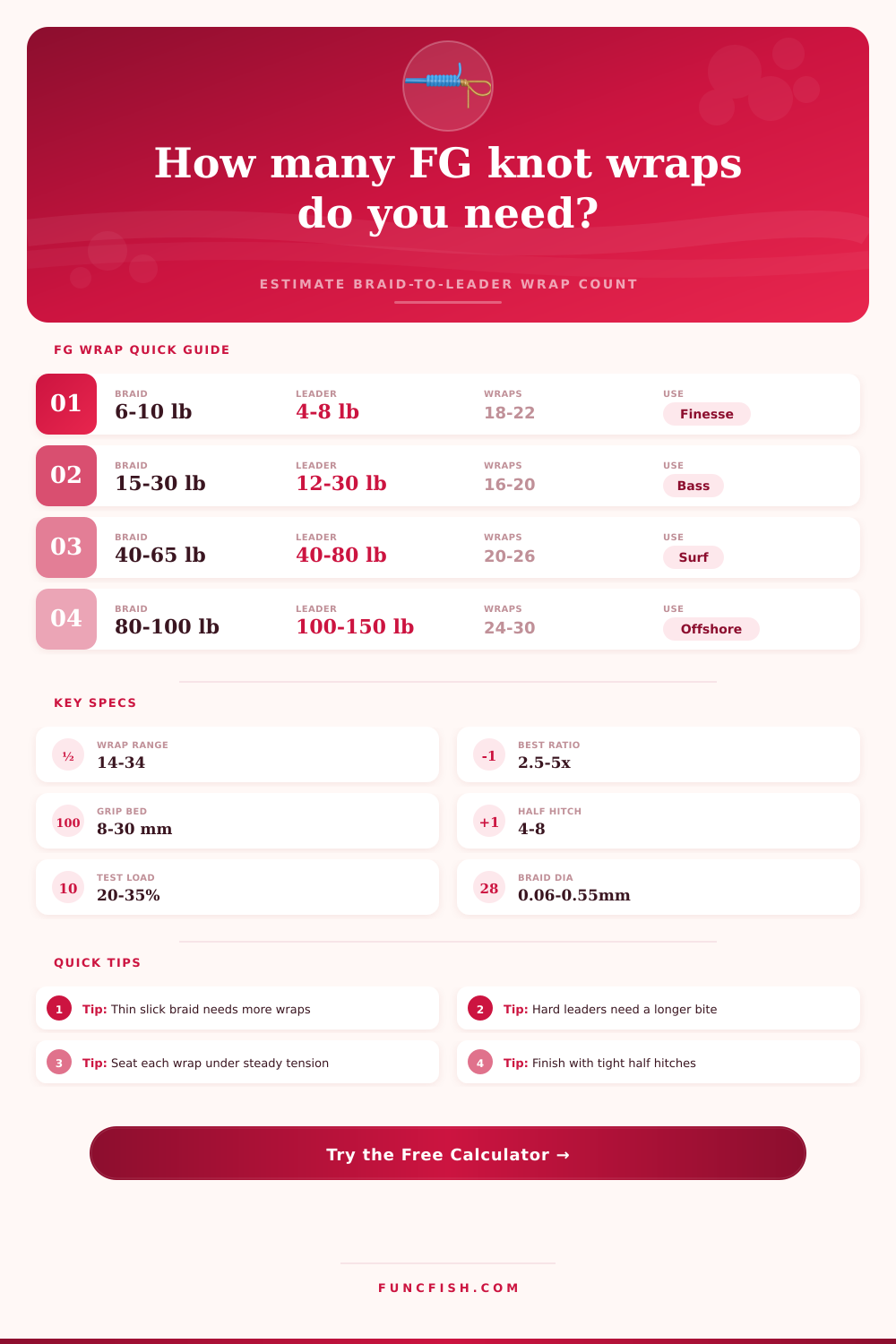
| 2.5x to 3.9x | 16-22 wraps | Medium FG bed | Common braid-to-fluoro spinning and baitcasting leaders |
| 4.0x to 5.9x | 20-26 wraps | Longer compression bed | Surf leaders, inshore shock leaders, heavy cover rigs |
| 6.0x to 8.0x | 24-32 wraps | Extended bite bed | Offshore, heavy mono, tuna casting, abrasion-heavy leaders |
🐠 Species and Gear Comparison Grid
Panfish / Trout
18-22Fine braid on 4-8 lb leaders; extra wraps help thin PE bite without slipping.
Bass / Walleye
16-20Balanced 10-30 lb braid and 8-20 lb fluoro usually seats with a compact FG.
Inshore / Surf
20-26Leader abrasion and hard casting loads call for more bite and tighter hitches.
Offshore / Jigging
24-30Heavy shock leaders need a longer compression bed and a durable finish.
📊 Species Reference Table
| Target species | Common braid class | Common leader class | FG wrap note |
|---|---|---|---|
| Crappie, perch, bluegill | 4-8 lb / 1.8-3.6 kg | 2-6 lb / 0.9-2.7 kg | Use more wraps for hair-thin braid. |
| Trout in clear streams | 6-10 lb / 2.7-4.5 kg | 4-8 lb / 1.8-3.6 kg | Keep the finish slim for small guides. |
| Bass and walleye | 10-30 lb / 4.5-13.6 kg | 8-20 lb / 3.6-9.1 kg | Usually the cleanest FG match. |
| Redfish, snook, sea trout | 15-40 lb / 6.8-18.1 kg | 20-40 lb / 9.1-18.1 kg | Add wraps for abrasion and sudden runs. |
| Striped bass and surf fish | 30-50 lb / 13.6-22.7 kg | 30-60 lb / 13.6-27.2 kg | Longer leaders and sand favor extra wraps. |
| Tuna, amberjack, kingfish | 50-100 lb / 22.7-45.4 kg | 60-150 lb / 27.2-68 kg | Long bite length beats a short bulky knot. |
⚖ Condition Adjustment Table
| Adjustment | Wrap change | Finish change | Reason |
|---|---|---|---|
| Smooth 8-carrier or 12-carrier braid | +1 to +3 | No change | Slick surfaces need more compression area. |
| Hard fluorocarbon shock leader | +2 | +1 hitch | Stiff leader resists the braid biting down. |
| Surf, sand, or rough structure | +2 to +3 | +1 hitch | Abrasion and impact loads punish short knots. |
| Cold hands or night tying | +2 | +1 hitch | More wraps offset less precise tension. |
| Very small guide opening | 0 | Slim finish | Wrap count can stay high; finish bulk should stay low. |
🔧 Finish Style Reference
| Finish style | Half hitches | Rizzuto turns | When to use |
|---|---|---|---|
| Half hitches only | 5-7 | 0 | Quick freshwater knots and moderate leaders. |
| Half hitches plus Rizzuto | 4-6 | 3-5 | General-purpose finish that stays slim and secure. |
| Slim long-cast finish | 3-5 | 4-6 | Small guides and repeated casting through rod tips. |
| Heavy shock-leader finish | 6-8 | 4-6 | Surf, offshore, or high-drag leaders over 60 lb. |
💡 Knot Calculation Notes
Seat the coils before judging the count. A good FG knot works because each braid wrap bites the leader under tension. If the wraps cross, gap, or spring open after cinching, add two wraps and retie with steadier tension.
Diameter ratio matters more than pound test. A 20 lb braid can be much thinner than another 20 lb braid. When the leader is more than four times the braid diameter, a longer wrap bed is usually more reliable.
This knot can be tricky if you’re just learning, particularly if you don’t have steady hands. To form the FG knot, wrap braid onto leader to create some friction. Let go before it creates a bulge that will jam inside your reel guides. Tutorials may show a series of 20 wraps; many anglers do, since they work most of the time. But they never realy work best.
Here’s the deal: there isn’t a magic number for wraps. That number depends off the physics of the interaction between the two very different materials. Thin slick braid against stiff fluorocarbon versus thicker textured braid grabbing hold of softer mono. Knowing this help you get a good knot and avoids a big wad of braid as well.
Why The FG Knot Calculator Works Better Than Guessing
Once you input your conditions and diameters of your line, the math is done for you on calculator above. No more guessing how many finish hitches to add or how long to make the coil bed. The key factor here are the relative leader size compared to your braided mainline. Everything else flows from there.
If you’re tying a big shock leader like you would for tuna or snook, the increased surface area allow the braid to have much more contact with something to dig teeth into. So you’ll need more wraps to generate enough “friction” down that extended tube. If you’re tying on some light pound test fluoro for bass fishing, the leader will be small and floppy. Too many wraps can start to choke life out of the leader and a knot can become too long and flex under load.
When you input your intended drag setting percentage, the knot will factor this into equation. Running your drag 35% of the line’s rated strength puts more instantaneous pressure onto the knot when a fish strikes. It will calculate number of extra wraps needed or recommend a particular finish type to accommodate the shock load without slippage.
Many anglers never even consider the texture of their braid. Moddern eight- or twelve-carrier braids are very smooth. They’re designed to have low friction on the guides but that slickness also can cause them to slide on a leader if you don’t have enough wraps. A four carrier textured braid has more bumps on its surface and therefore has some sort of built-in mechanical advantage.
The calculator accounts for this by allowing you to select your braid type. Basically, it applies extra grip to the equation when you go with a rougher line and requires more physical wraps when you go with ultra-thin smooth variants. That’s why you’ll see two anglers fishing the same pound test who will tie knots that look very different but are equally successful. The printed strength rating is less important then how the material works.
It turns out knot strength and integrity has much more to do with the environment than we think. Cold fingers on a frigid lake, abrasive surf fishing sand, or saltwater corrosion will all cause damage to the cinch. Tension consistency decline when you’re tying in less-than-ideal conditions. When it’s too dark to see or your fingers are too numb, the tool helps correct our human flaws by recommending additional wraps. A little redundancy acts as a safety buffer against imperfect technique. You don’t have to be perfect. Add a little redundancy. It is a smart way to tie knots.
Finally, there is the finished product. While a few half hitches might be fine for beefy leaders, you’ll want to add a Rizzuto (or something similar) to help spread the stress over a greater area and avoid the braid unravelling when a fish strikes. As they say, it’s all in the details. Their handy reference table on the page shows how the drag loads and leader stiffness determines the finish style. Don’t get lazy with those final turns because “hey it will only take me thirty seconds to tie”. The last thing you should of want to do after a long fight is have your knot fail.
If there’s anything to know about learning how to master the FG knot, it has little to do with following a recipe and everything to do with physics of friction, matching the resistance of the leader to the bite of the braid. Get it down to conditions and ratios as opposed to fixed numbers, and your knot strength increase dramatically. Fewer overall knots is tied because the ones that are tied actualy hold. That tight little secure loop makes all the difference between catching a fish and losing them on the initial hard run.