Alberto Knot Wrap Calculator
Estimate the best Alberto knot wrap count, return wraps, coil bed length, and retained connection strength for braid-to-leader fishing rigs.
📌Scenario presets
⚙Knot and line inputs
Alberto knot wrap results
Calculation breakdown
🧵Braid and leader grip data
4-Carrier Braid
8-Carrier Braid
Slick Coated PE
Stiff Fluoro
📊Alberto wrap reference table
| Braid to leader match | Diameter ratio | Forward wraps | Return wraps | Use case |
|---|---|---|---|---|
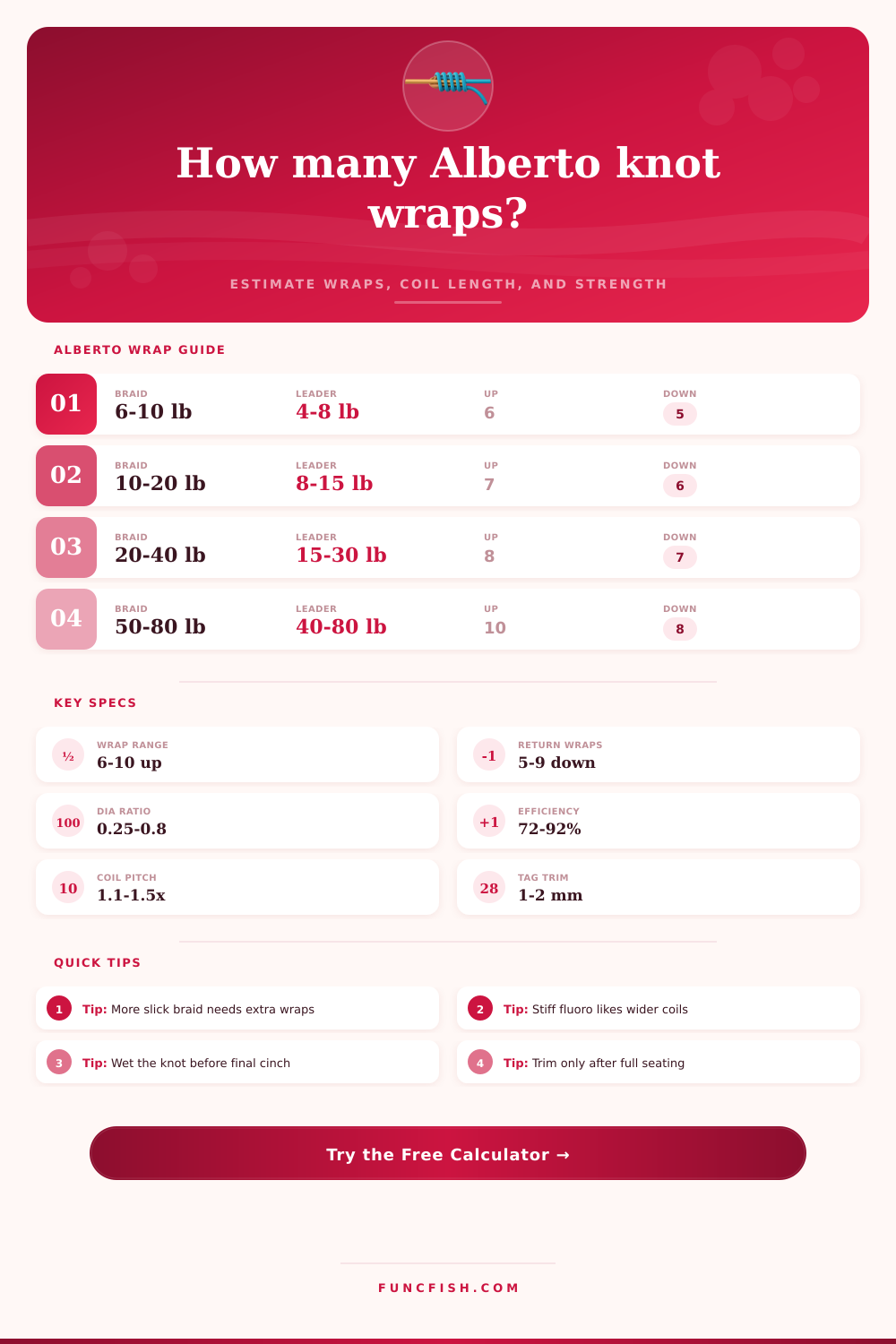
| 6 to 8 lb braid with 4 to 6 lb leader | 0.55 to 0.80 | 6 | 5 | Trout, panfish, finesse |
| 10 to 20 lb braid with 8 to 15 lb leader | 0.45 to 0.70 | 7 | 6 | Bass, walleye, light inshore |
| 20 to 40 lb braid with 15 to 30 lb leader | 0.35 to 0.60 | 8 | 7 | Redfish, snook, surf plugs |
| 50 to 80 lb braid with 40 to 80 lb leader | 0.25 to 0.50 | 9 to 10 | 8 to 9 | Heavy surf and offshore casting |
| Slick braid with stiff fluorocarbon | Any ratio | Add 1 | Add 1 | When wraps slide during cinch |
📏Diameter and strength table
| Connection class | Typical braid diameter | Typical leader diameter | Ratio target | Expected efficiency |
|---|---|---|---|---|
| Ultralight stream | 0.003 to 0.005 in / 0.08 to 0.13 mm | 0.006 to 0.008 in / 0.15 to 0.20 mm | 55% to 75% | 84% to 90% |
| Freshwater all-round | 0.006 to 0.009 in / 0.15 to 0.23 mm | 0.009 to 0.013 in / 0.23 to 0.33 mm | 45% to 70% | 82% to 89% |
| Inshore abrasion | 0.009 to 0.014 in / 0.23 to 0.36 mm | 0.016 to 0.024 in / 0.41 to 0.61 mm | 35% to 60% | 78% to 86% |
| Surf shock leader | 0.012 to 0.018 in / 0.30 to 0.46 mm | 0.026 to 0.035 in / 0.66 to 0.89 mm | 30% to 50% | 74% to 83% |
| Offshore heavy | 0.015 to 0.024 in / 0.38 to 0.61 mm | 0.030 to 0.047 in / 0.76 to 1.19 mm | 25% to 45% | 72% to 82% |
🐟Species and gear comparison grid
Trout and Panfish
6 / 5Best with 4 to 10 lb braid and soft 4 to 8 lb mono or fluoro leader for small guides.
Bass and Walleye
7 / 6Works well for 10 to 20 lb braid tied to 8 to 15 lb fluoro around jigs, rigs, and finesse plastics.
Inshore Saltwater
8 / 7Use extra grip for 20 to 40 lb braid with 20 to 40 lb abrasion leader around docks or shell.
Surf and Offshore
10 / 8Heavy casting shock and large leader diameter usually need a longer barrel and careful seating.
🔧Knot build comparison table
| Connection knot | Guide size | Best diameter gap | Typical efficiency | When to choose |
|---|---|---|---|---|
| Alberto | Medium | Moderate to large | 78% to 90% | Fast braid-to-leader tying in the field |
| Albright | Medium | Large | 72% to 84% | Mono shock leader with a doubled loop |
| Double Uni | Large | Small to moderate | 76% to 88% | Similar diameters and simple freshwater rigs |
| FG Knot | Small | Moderate to large | 86% to 95% | Highest guide clearance when there is time to tie |
| Yucatan | Medium | Moderate | 78% to 88% | Doubled braid main line to leader |
📝Field adjustment table
| Observed knot behavior | Likely cause | Wrap correction | Strength correction | Check before trimming |
|---|---|---|---|---|
| Wraps slide before locking | Slick braid or too few coils | Add 1 to 2 return wraps | Improve 3% to 6% | Pull both main lines slowly |
| Coils bunch on one side | Uneven return path | Keep same count, rebuild evenly | Improve 4% to 8% | Coils should stack like a barrel |
| Knot catches in micro guides | Too long or bulky barrel | Remove 1 wrap each way | Lose 1% to 3% | Cast test under light load |
| Leader kinks near knot | Stiff fluoro overheated by cinch | Wet more, widen coils | Improve 3% to 5% | Leader should leave straight |
| Braid breaks at knot | Shock load exceeds weak line | Add wraps and lower drag | Improve margin | Check drag against result |
💡Calculation notes
Wrap count: The calculator starts from a 7-up and 6-down Alberto pattern, then adds wraps for slick braid, stiff or thick leader, low braid-to-leader diameter ratio, and high casting shock.
Strength estimate: Retained strength is capped by the weaker line, then reduced for difficult material pairs, seating quality, shock load, and very short or overly bulky coil geometry.
An Alberto knot are a simple way to connect your leader to braid that lacks bulk of an FG knot or complexity of a Double Uni. When it fails, it’s not because your line snaps…it’s because you guessed wrong on amount of wraps. And now there’s no need to guess how many (seven? Ten?) is right for your line size because the calculator above will do it for you.
The one thing that makes this go wrong are the diameter relationship between your leader and your main braid. Your thinner braids don’t have surface area to hold a thick fluorocarbon leader well. An 18-pound fluoro over a six-pound braid is big size discrepancy. If you don’t wrap it several times, that thin line will slide easy against thicker leader.
How to Tie the Alberto Knot Correctly
Also, the rating system for strength of the line doesn’t necessarily relate to its actual thickness. In fact sometimes a lighter pound rated line like twenty-pound braid can actually be thicker in diameter than say a forty-pound mono leader. That’s why the tool asks for both sizes; because if you make a bunch more wraps to add friction, then you’re making a big fat barrel that gets caught on your guides, cuts down on distance casting and just generaly sucks.
The number of wraps the tool suggest is based off those two values. Too few and you get the knot sliding down when you set the hook or even at the beginning of the cast. Too much and you’ll end up with a big fat barrel that catch on your guides and again shortens casting distance.
The other part of the equation are material texture. Waxy, four-carrier braided line acts different when pulled tight than an eight-carrier smooth braid. A slicker surface slide more readily, so it needs a greater number of return wraps to ensure security. Fluorocarbon leaders can be very stiff and won’t bend as readily. If you don’t take care to seat the leader, they will kink right at the knot. The slick braid and the rigid leader push against each other, which undoes your knot.
Because the calculator knows this, it increases the number of recommended wraps for stiffer leaders or slicker lines. With some material combinations, a normal seven-wraps might prove insufficient when exposed to higher shock loads. In theory, this make sense but is true only with proper seating. Even a mathematically correct number of wraps won’t hold up if not seated properly.
You must wet the knot well before tightening it. Dry fluorocarbon or nylon heats up when tightened and begin to melt, softening the fiber structure around the stress point. This can be counteracted by dunking your fingers into the water while tightening, or simply spitting on the knot prior to final pulls. When pulling the last few wraps together, do so firmly yet gradually. Harsh tugs cause uneven tension and bunch line coils on one side. For best results, let the line cool after tightening (water serves as an effective lubricant for tightening).
The tool indicate that if the knot is not seated well, it can ruin a good mathematical setup, since holding enough strength depend on how well the knot is wrapped.
The catch: Casting vs. Strength Every extra turn extend the barrel of the knot. As the barrel gets longer, it creates resistance through your rod guides. This is more noticeable with smaller micro-guides or during long casts like surfcasting. How many wraps do you require? You need enough to hold the fish but not so many that you cannot cast effectivey.
The beauty of the calculator is its ability to predict length of coils based off number of wraps while showing potential strength estimates. It’ll give you an idea of how much bigger the knot will get with extra turns for added security. Only your hook will keep your confidence up if your connections aren’t solid.
Rig up new combos on something that doesn’t move. Tie a good knot, pull hard and see where it let go. Tighten down, but not to much. Add a few more wraps if needed. Don’t overdo the coil on that combination either.
The Alberto knot takes time and finesse. There’s no room for hurry with this one. Feed it the right ingredients and let the laws of friction do their thing. When done correctly, there is no better connection. Believe the science and get that bait in the water.