Uni Knot Turns by Line Calculator
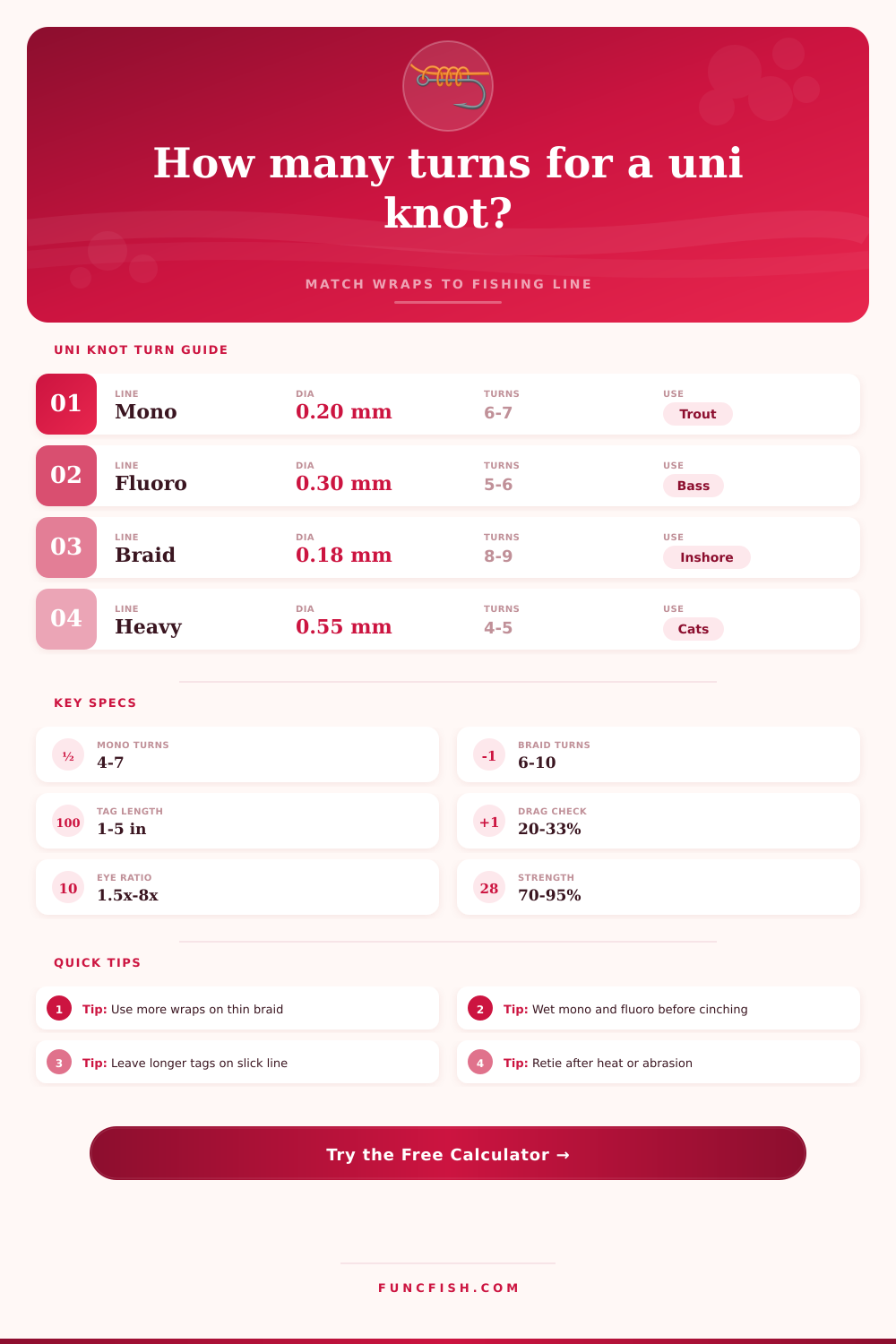
Estimate the number of uni knot wraps for mono, fluorocarbon, braid, and fly tippet using line diameter, material slickness, drag load, terminal diameter, and knot style.
📌Scenario presets
⚙Line and knot inputs
Uni knot turn recommendation
Calculation breakdown
🧵Line material turn behavior
Nylon Mono
Fluorocarbon
8-Carrier Braid
Heavy Shock Mono
📊Diameter-based uni turn table
| Line diameter | Mono or copoly | Fluorocarbon | Braid or fused line | Typical fishing use |
|---|---|---|---|---|
| 0.10-0.17 mm / .004-.007 in | 7 turns | 7-8 turns | 9-10 turns | Ultralight, fly tippet, ice fishing |
| 0.18-0.25 mm / .007-.010 in | 6-7 turns | 6-7 turns | 8-9 turns | Trout, panfish, finesse bass |
| 0.26-0.36 mm / .010-.014 in | 5-6 turns | 6 turns | 7-8 turns | Bass, walleye, inshore light tackle |
| 0.37-0.55 mm / .015-.022 in | 4-5 turns | 5 turns | 6-7 turns | Catfish, surf, heavy inshore |
| 0.56-0.90 mm / .022-.035 in | 4 turns | 4-5 turns | 5-6 turns | Shock leaders, offshore leaders |
🎣Species and setup comparison grid
Trout
6-8 turnsUse higher counts for 5X-7X tippet and tiny hook eyes because thin line needs more surface contact.
Bass
5-7 turnsMono and fluorocarbon usually seat well at 5 or 6 wraps; braid to terminal hardware often needs 8.
Inshore
6-9 turnsSlick braid, snaps, and ringed hooks raise the wrap count, especially with sudden boat-side runs.
Catfish
4-6 turnsThick mono and heavy leaders build bulk quickly, so dressed coils matter more than extra wraps.
📏Hook eye and leader diameter matching
| Eye or other-line ratio | What it means | Turn adjustment | Tag reserve |
|---|---|---|---|
| Under 1.5x line diameter | Tight eye or similar leader diameter | Add 1 turn | Add 0.5 in / 12 mm |
| 1.5x to 3x line diameter | Normal hook eye or swivel wire | No change | Standard reserve |
| 3x to 6x line diameter | Large snap, ring, or lure eye | No change | Add eye allowance |
| Over 6x line diameter | Oversize ring or large plug eye | Add 1 turn for braid | Add 0.75 in / 19 mm |
⚖Drag load and retained strength table
| Drag as percent of line rating | Normal knot target | When to add wraps | Field note |
|---|---|---|---|
| 15-25% | Standard wrap count | Only for braid or cold hands | Typical finesse and open-water drag |
| 26-33% | Standard plus inspection | Add 1 wrap on slick or stiff line | Common bass and inshore setting |
| 34-45% | High-security wrap count | Add 1-2 wraps if bulk allows | Heavy cover, surf, locked hooksets |
| Over 45% | Retie and test carefully | Use max hold setting | Knot quality controls the outcome |
🔗Uni knot variant comparison
| Variant | Best line types | Calculator adjustment | Practical limit |
|---|---|---|---|
| Single uni to terminal tackle | Mono, fluoro, braid | Baseline turns | Most hook, swivel, lure eyes |
| Improved uni, twice through eye | Braid and thin mono | Minus 0 to 1 turn if bulky | Small eyes may not pass twice |
| Uni loop knot | Mono and fluoro | Add tag reserve | Use fewer wraps on heavy leader |
| Double uni line-to-line | Braid to leader, mono joins | Add 1 turn on slick side | Bulky through small guides |
| Back-to-back uni heavy side | Shock leaders | Reduce if diameter is high | Dress coils before pull-down |
💡Calculator notes
Coil count tip: Extra wraps help slick or thin line only when the coils dress cleanly. If coils cross, reduce one turn and retie more slowly.
Tag length tip: Cut braid and fluorocarbon tags slightly longer after seating. Short tags can creep when knots see repeated shock loads.
Tying a uni knot is something we probably all do by feel. Maybe you’ve seen it done a certain way in a video years ago and now you wrap line six times just because that’s how you learned it. Or maybe you’re dealing with something hazardous and need a little more insurance, so you’ll go to seven wraps.
But most of the time, the real science behind amount of friction needed to hold your knot together has nothing to do with any instinctual behavior. Sometimes, we’ll over-wind thick mono and end up with a big ol’ clunky mess that won’t hold on the hookeye. Other times, we’ll under-wind thinner braid because there’s not enough surface area to create friction and it will slip off under pressure.
How to Tie a Uni Knot Correctly
The line diameter/line type calculator above runs the numbers for you after you input the size of your line. It eliminates need to worry about knots and lets you get back to fishing.
Slickness is nearly universal variable. Mono is textured and grabs onto its own surface as you pull it tight, so less wraps is necessary to be sure of security. Fluoro is slightly slicker, denser and therefore requires some extra grab to avoid slipping around. Braid, however, is where it gets hairy. It’s designed to slip easily across your guides, which makes it great for casting. However, it doesn’t have much coil-on-coil grip, which make it awful at being held by any kind of knot relying strictly on friction.
With braid, you must go way up on the number of wraps because every single wrap add virtually no keeping power. So if you tie a loop with as many wraps as you would with mono, you’re wishing more than trusting.
It’s also important to remember that line diameter matter quite a bit; though not necessarily its thickness. Because the circumference of each coil is so small, thinner lines don’t have enough of a base of friction for a solid wrap. Conversely, if your shock leader is really thick, something like four or five turns will give good retention because there is a lot of material pressing into eye of hook.
The table above on the page shows this nicely; moving from ultra light tippet to a beefy offshore leader changes how many turns are necessary. This might seem backward at first. Consider surface area. There needs to be a certain amount of contact zone to prevent knot from sliding. A thin line just doesn’t have much surface area in only three or four loop.
This section covers terminal hardware. Aside from the line type itself, the other half of the equation is the terminal hardware. While there’s not too much for those line coils to squeeze up against with a tiny hook eye like we get on a trout fly, you’ll frequently notice that anglers adds more wraps when fly fishing than say with a jig for bass. That concentration of pressure into such a small space drastically increases your chances of having the knot slip out altogether or crush down on the line.
On the flip side, you have a big ol’ swivel ring that gives the knot a wide surface to sit against and distributes the friction more equally. If you’re tying to an eye that’s substantially larger or smaller than what would be ideal, the calculator takes this line to eye ratio into account and will adjust its suggestion accordingly. You won’t be adding extra wraps where they don’t need to be and you wouldn’t go without them where they do.
The most neglected aspect of the whole deal is conditioning the knot itself. Tightening a dry knot won’t be helped by a thousand wraps. Wetting the coils first prevents excessive heating of the knot interior. This heat causes the polymer fibers to cook and weaken for good. Sounds like some ancient lore, but when your knot explodes at the first bit of pressure even though it appeared fine…you’ve been there. That’s usually melted line lurking deep within the coils. Keeping the knot moist with a gradual, slow tug will allow the fibers to compress instead of shredding.
Balance, not overkill, is what creates security. Ten more wraps won’t make a mono knot stronger. They’ll make it larger, adding potential points of failure around the line’s exit from the coils’ bend. You want just enough friction to secure against whatever drag you expect but no more than necessary bulk. That’s why the tool shows you a target zone where both considerations reach balance. It identifies how much line is too little and what too much looks like for your individual rig.
What length tag should of been left before snipping? How many wraps can you get away with? Then let the dress, pull-tight-and-wet routine take over. If you treat the materials with proper respect, the knot will stick.