Loop Knot Diameter Calculator
Estimate finished loop opening, outside loop diameter, knot profile, tag use, and retained strength for lure, fly, and live-bait loop knots.
📌Scenario presets
⚙Knot and tackle inputs
Loop knot sizing results
Calculation breakdown
📊Leader material data
Soft mono
Hard mono
Soft fluoro
Stiff fluoro
Copolymer
Coated wire
Single wire
Heavy mono
🎣Gear and species comparison grid
Trout dry fly
3-6 mm2-6 lb tippet, Davy or perfection loop, light action and tiny eye clearance.
Crappie micro jig
4-8 mm4-8 lb mono or fluoro, short loop to stop tiny jigs from fouling.
Bass crankbait
8-14 mm10-17 lb mono, Kreh loop, enough swing without clipping front trebles.
Walleye jig
6-12 mm6-12 lb fluoro, non-slip loop, controlled fall for minnow and hair jigs.
Redfish paddle tail
10-18 mm15-30 lb fluoro, Kreh loop, room for thump and head roll.
Surf striper plug
18-35 mm30-60 lb shock leader, Rapala loop, long enough for plug sweep.
Pike wire trace
14-28 mmWire or coated wire, figure-eight loop, wide bend radius prevents kinks.
Offshore popper
30-55 mm80-150 lb mono, Homer Rhodes or figure-eight, large eye clearance.
📏Loop diameter reference table
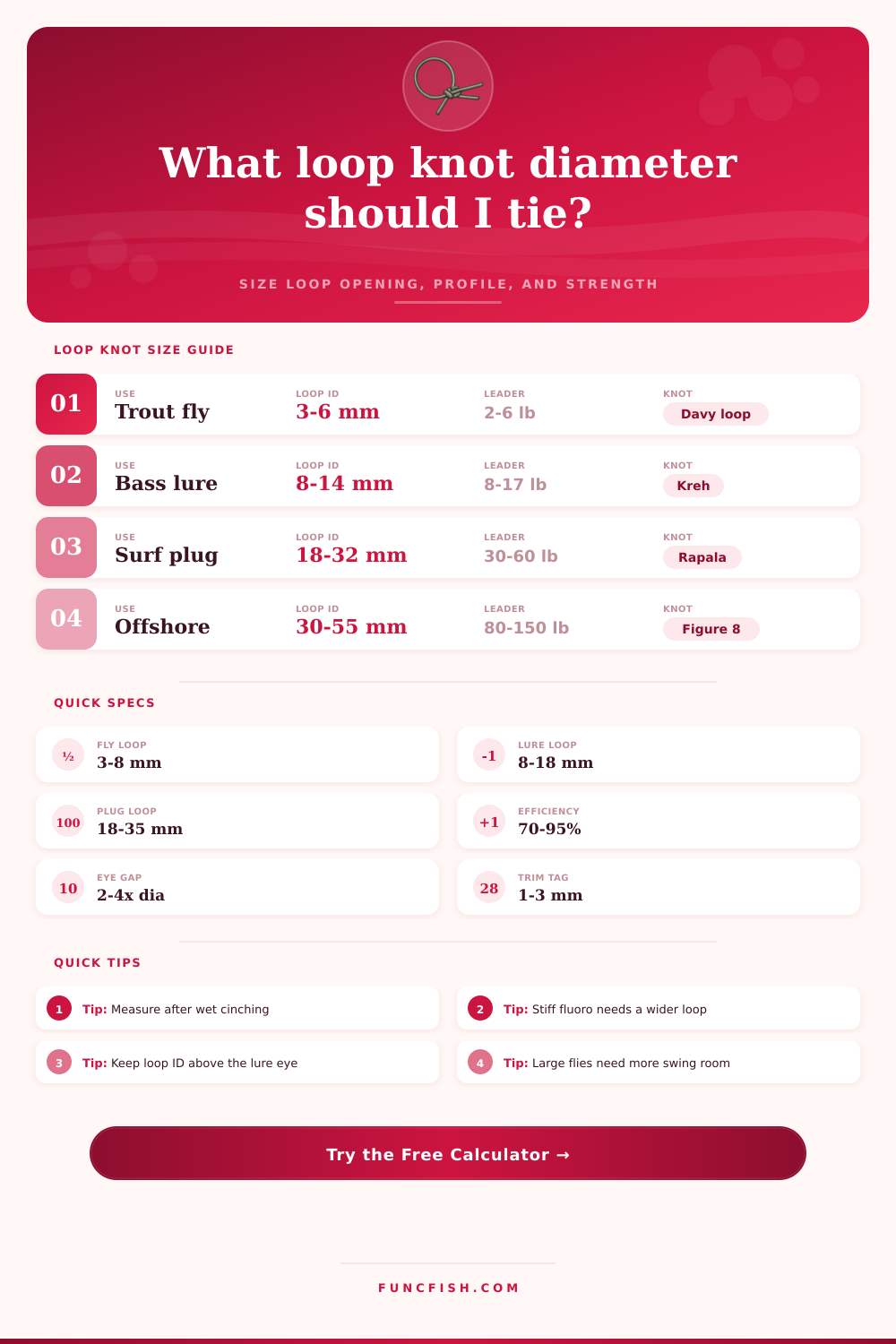
| Presentation | Typical loop ID | Outside loop diameter | Leader range | Why it fits |
|---|---|---|---|---|
| Midge, dry fly, nymph | 3-6 mm / 0.12-0.24 in | 4-7 mm / 0.16-0.28 in | 2-6 lb / 0.9-2.7 kg | Small loop keeps light flies from hinging too far. |
| Micro jig or small spoon | 4-8 mm / 0.16-0.31 in | 5-9 mm / 0.20-0.35 in | 4-8 lb / 1.8-3.6 kg | Enough swing without the loop catching the hook bend. |
| Bass crankbait or jerkbait | 8-14 mm / 0.31-0.55 in | 9-16 mm / 0.35-0.63 in | 8-17 lb / 3.6-7.7 kg | Medium loop lets plugs hunt while staying compact. |
| Inshore jighead or swimbait | 10-18 mm / 0.39-0.71 in | 12-21 mm / 0.47-0.83 in | 15-30 lb / 6.8-13.6 kg | Wider loop clears larger eyes and stiff fluorocarbon. |
| Surf plug and shock leader | 18-35 mm / 0.71-1.38 in | 21-40 mm / 0.83-1.57 in | 30-60 lb / 13.6-27.2 kg | Large loop helps big plugs sweep through current. |
| Offshore popper or jig | 30-55 mm / 1.18-2.17 in | 35-65 mm / 1.38-2.56 in | 80-150 lb / 36-68 kg | Heavy leader and big tow points need generous clearance. |
🔗Knot style comparison table
| Loop knot | Efficiency range | Profile factor | Loop control | Best application |
|---|---|---|---|---|
| Non-slip mono loop | 82-92% | 4.6x leader dia | Very consistent | Fluoro jigs, live bait, plugs. |
| Kreh / Lefty loop | 80-90% | 4.2x leader dia | Compact | Bass, redfish, trout streamers. |
| Rapala loop knot | 78-88% | 4.8x leader dia | Wide and stable | Hard baits and surf plugs. |
| Perfection loop | 70-82% | 3.8x leader dia | Clean standing loop | Fly tippets and small loops. |
| Figure-eight loop | 74-86% | 5.2x leader dia | Strong on heavy line | Wire, heavy mono, offshore leaders. |
| Homer Rhodes loop | 82-94% | 5.5x leader dia | Large loop friendly | Tarpon, tuna, heavy shock leaders. |
| Davy loop | 72-84% | 3.1x leader dia | Very small profile | Small flies and light tippets. |
🧪Formula factor table
| Factor | How calculator uses it | Lower value means | Higher value means | Practical check |
|---|---|---|---|---|
| Eye clearance | Eye inside diameter × clearance multiplier | Snug loop around tiny fly eye | Free swing around thick tow point | Loop should not bind at full side angle. |
| Bend radius | Leader diameter × material bend multiplier | Supple mono can turn tightly | Wire and stiff fluoro need a wider arc | No whitening, kinking, or flat spots after cinch. |
| Action span | Lure length × action percentage | Controlled jig tracking | Wide walking plug or big fly movement | Lure should swing without hanging on the knot. |
| Profile diameter | Leader diameter × knot bulk × material factor | Small guide-friendly knot | Bulkier heavy leader knot | Knot should clear lure eye and hardware. |
| Strength margin | Retained strength divided by peak drag load | Close to overload | More room for shock and surges | Target 2.0x or higher for harsh casting. |
💡Loop sizing tips
Measure after seating: Loop knots usually shrink while wet-cinched. Tie slightly large, seat the knot slowly, then measure the inside opening from leader edge to leader edge.
Match stiffness to swing: Fluorocarbon and wire resist tight turns. If the calculator flags a bend-radius limit, use the larger diameter even when the lure eye looks small.
Knots are often blamed on bad luck when a lure won’t run true or sink well due to a chunky knot. That’s not bad luck; it’s physics colliding with geometry. A knot is both an attachment point and a hinge point for your bait. When the hinge is sloppy or stiff the entire presentation fall short of expectations.
Knots are mostly tied by feel and we guess at whether to pull them tight, how much slack to allow. But there’s math here. It depends on lure size and line stiffness, and you won’t notice the math until you throw it. That’s where calculator comes in; after entering your lure sizes and leaders, the calculator takes care of the math so you don’t have to guess at the clearance or bend radius. Understanding what the numbers mean also helps when you are tying them.
Why Knot Math Matters for Better Fishing
The first thing is material selection. Stiff fluorocarbon reacts very different than soft nylon. Big fluoro doesn’t like bending around corners. Fluoros resist kinking and compressing when bent too tightly. So if you’re tying a big loop on your fly with a thick diameter line, you’re trying to overcome the naturaly memory of the material. This is reflected in the tool which change the minimum bend radius according to its stiffness factor rating for the line.
So you may think you want a super tiny loop for a little dry fly, but if your tippet is stiff, then that snug little circle would of introducing stress points that will weaken the knot and mess up the swing. The other side of that coin is lure size. Offshore poppers require some breathing room. Too small of a loop prevent the bait from pivoting freely on the eye. Instead of diving or walking, it hangs straight up.
So the eye diameter (and lure length) are inputs in this calculation. But the calculator isn’t simply measuring the hole. Rather, it’s measuring how much space the lure require as it moves, allowing the knot body to clear the hardware. It’s a matter of clearance. You want the knot profile to sit below the tie point so the bait has maximum freedom. What the results provide are both outer and inner loop diameters so you know your target size before picking up the line.
Then it gets technical yet critical: strength retention. Knots diminish the breaking strength of the line. They can even be twenty percent or more less efficient due to sloppy cinches or crossed wraps. From there the tool figure your margin of retained strength below expected drag loads. Are you at risk of breaking? Is your knot worth fixing by improving the seat or widening the loop, or should you simply use a heavier line? Sometimes the math suggests using a thinner line rather than a thicker one, because a thicker line usually makes the knot bulkier and stiffer. And we’re back around again with hinge issue.
It is a balance between action and durability. It is a balance. Loop Knot Calculator
Knot seat quality is important, but folks don’t think so. No doubt about it; you must wet the knot before pulling. Dry nylon heats up, which melts the polymer and makes a weak spot where you can’t find it. The calculator assumes you are using good seating practice. Pulling too quickly will give you poorer results than expected in the real world. Slow down. Apply even tension. Allow the fibers to fall into place naturaly.
After pulling the knot fully tight, measure the final loop (because they shrinks when compressed). You may have been thinking “this thing is huge” while holding it with your fingers, only to find out it is tight on the hook eye once compressed. If you don’t know where to begin, use the reference tables provided for various species as a quick sanity check. A surf plug needs a wide opening for dive and sweep. Small loops on trout flies make delicate presentations easier. But those are only guidelines; they’re starting points, not rules.
Above all, it is the combination of line and lure. You want to match the shape of the knot to the mechanics of the bait. When you get the size right, the knot blends in to the action. When you get it wrong, the fish gets an awkward, stiff target that won’t hunt. Measure after tying, tie with intent, and let the math guide your hand, not your hunch.