Ballyhoo Rig Wire Length Calculator
Estimate cut wire for ballyhoo trolling rigs from bait size, hook setback, bill wraps, head wraps, haywire twists, tag allowance, and rig style.
📌Scenario presets
⚙Ballyhoo rig inputs
Calculated ballyhoo rig wire
Calculation breakdown
🛠Wire material reference
Soft Copper #9
Soft Copper #8
Monel #8
Single Strand #6
📊Ballyhoo size and rigging table
| Ballyhoo size | Fork length | Common hook | Hook setback | Bill wraps | Starting wire cut |
|---|---|---|---|---|---|
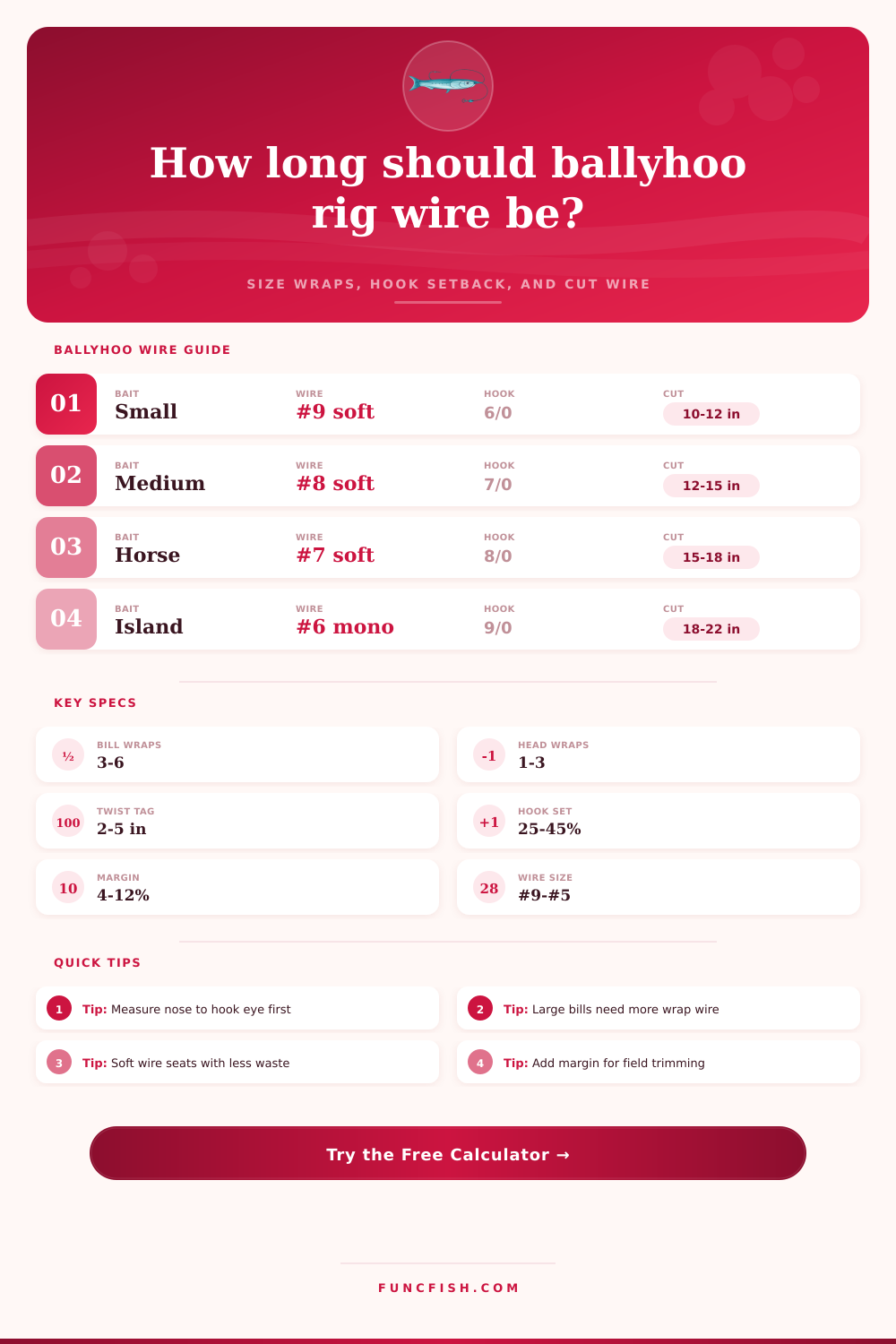
| Small or dink | 6-8 in / 15-20 cm | 5/0 to 6/0 | 28-34% | 3-4 turns | 10-12 in / 25-30 cm |
| Medium select | 8-10 in / 20-25 cm | 6/0 to 7/0 | 32-38% | 4-5 turns | 12-15 in / 30-38 cm |
| Large select | 10-12 in / 25-30 cm | 7/0 to 8/0 | 35-42% | 4-6 turns | 14-17 in / 36-43 cm |
| Horse ballyhoo | 12-15 in / 30-38 cm | 8/0 to 10/0 | 38-48% | 5-6 turns | 17-22 in / 43-56 cm |
| Dredge bait | 7-10 in / 18-25 cm | Pin or teaser | 22-32% | 3-5 turns | 11-15 in / 28-38 cm |
🎣Species and rig comparison grid
Dolphin and Tuna
12-16 inMedium ballyhoo, #8 soft wire, 6/0 to 8/0 hook, normal margin for skirted pin rigs.
Sailfish
10-14 inSmall to medium ballyhoo, light soft wire or bridle wire, short nose offset, circle-hook setback.
Wahoo
18-24 inLarge bait, stainless or cable bite section, extra twists, and higher margin for stiff wire.
Marlin
18-26 inHorse ballyhoo, 8/0 to 10/0 hook, lure-head offset, longer hook setback and heavier finish.
📐Rig style allowance table
| Rig style | Added nose offset | Twist allowance | Wire behavior | Best use |
|---|---|---|---|---|
| Naked J-hook pin rig | 0.3-0.8 in / 1-2 cm | 2-4 in / 5-10 cm | Soft wraps seat tight | Clean swimming baits |
| Circle-hook bridle rig | 0.8-1.4 in / 2-4 cm | 2-3 in / 5-8 cm | Light wire preferred | Sailfish and release fishing |
| Skirted pin rig | 0.7-1.3 in / 2-3 cm | 3-5 in / 8-13 cm | More trim room helpful | Dolphin, tuna, mixed spread |
| Wahoo single-strand | 1.0-2.0 in / 3-5 cm | 4-7 in / 10-18 cm | Stiff wire needs margin | Fast trolling and bite protection |
| Island lure or chugger | 1.2-2.4 in / 3-6 cm | 4-6 in / 10-15 cm | Head length changes cut | Large skirted ballyhoo |
🧮Hook setback and wrap formulas
| Formula piece | Calculator method | Why it matters | Typical range |
|---|---|---|---|
| Nose-to-hook span | Bait length x setback percent + nose offset | Places hook near belly exit or bridle point | 3-7 in / 8-18 cm |
| Bill wrap allowance | Bill turns x (bill length x 0.55 + wire bend radius) | Accounts for spiral wraps around bill and pin | 2-6 in / 5-15 cm |
| Head saddle allowance | Head turns x diameter x pi x 0.72 | Estimates wrap path across head and gill plate | 1-4 in / 3-10 cm |
| Twist allowance | Turns x (wire diameter factor + hook eye factor) | Allows haywire, barrel, or locking twists | 1.5-7 in / 4-18 cm |
| Final cut length | Subtotal x stiffness factor x margin + tag | Converts measured rig path into cut wire | 10-26 in / 25-66 cm |
💡Rigging calculation notes
Measure the bait, not the package. Two ballyhoo from the same tray can differ enough to change hook setback and bill-wrap wire by more than an inch.
Use margin where stiffness increases. Stainless single strand, cable, and lure-head rigs need more trim room than soft copper because bends consume more length.
Hook setback determines how the bait swims. The length of your ballyhoo rig wire is key to how it swims in the water. The right calculation mean the bait will hold up on a hard hit from a big fish coming by at top speed, and it also presents fish correctly for predatory eyes. Straightening out the line isn’t all there is to it; you want a rig that works as intended even under load.
It calculates it out for you like this: Now you don’t have to guess while your hands is freezing. Even though you’re guessing at these values in the field, understanding what goes into them will help you rig better.
How to Rig Your Bait Correctly
How far back does the hook come out of belly? This affects action of the bait. Too far back and you get tail-heavy dragging and fish look sick for other predators. Too far forward and your bait pitches nose-down. This creates excess drag that slows down your trolling spread. For typical rigs, the tool measures the right location as a percentage of length of the bait, typically between 30-40%
A lot of folks overlook variables in wire material until their leader kinks up or their hook bend out. Soft copper wraps nicely; it conforms well to the bait flesh and has low friction loss along the bait as you wrap. It’s easy to get good bends too because it’s softer than stiffer wires such as monel or stainless steel. Because those are rigid, they takes up more length each time you make a bend (they have a bigger radius). The tool takes that into account automatically. So if you use soft copper but change to stiff stainless steel, the tool will calculate a longer cut length estimate because the wire isn’t wrapping nearly as well. That can be critical when rationing scarce supplies on a long trip.
The more wrap, the longer/bulkier the head, which adds up fast. There must be enough turns around the bill to maintain hook on axis with the bait’s body. To prevent flopping in water you want the bait locked into shape by the head wraps. Different scenarios calls for varying amounts of twist, as indicated in the table below. For example, a minimalist sailfish rig with a naked pin calls for less twist then a marlin bait rigged with skirts and other gear.
Allowance for a tag is necessary. The additional wire needed to make clean cuts during trimming and the final twists to secure it. If no allowance exists, fraying will eventualy saw through your leader or pull free under high loads. How far you can go wrong depends off materials. If you’re using soft wire you can pull it really tight with little wastage and it doesn’t matter if it’s close. With stiffer cable you want to have a heavier margin setting because more large knots and bends uses up more length. In cold weather when you are starting all over again it is best to leave a bit too long for stiffness or tag allowance as you can always cut down rather than ending up short. You should of left extra just in case.
There’s an art and a science to rigging ballyhoo. The science is that it has to fit physically, and the art is thinking about how well it will perform under pressure. You don’t have to guess where to make the first cut anymore. The calculator lets you focus on the most important parts: presentation and hooking efficiency. Having the wire land in place on the first try makes the remainder of the trip easier.
You’re not constantly thinking about making sure the rig stays together and concentrating on what the birds are doing. If one flies over you’re already prepared and you don’t have to dig out the pliers again. Naturaly, it will be much more comfortabley for everyone.