Skirted Lure Leader Length Calculator
Estimate finished leader length, hook setback, leader class, and rule margin for skirted trolling lures across offshore, inshore, and bluewater spreads.
📌Skirted lure presets
⚙Leader and lure inputs
Leader estimates are practical rigging targets for skirted trolling lures. Tournament and record fishing should be checked against current event and IGFA rules before fishing.
Leader length results
🧵Leader material data
📏Leader length by spread position
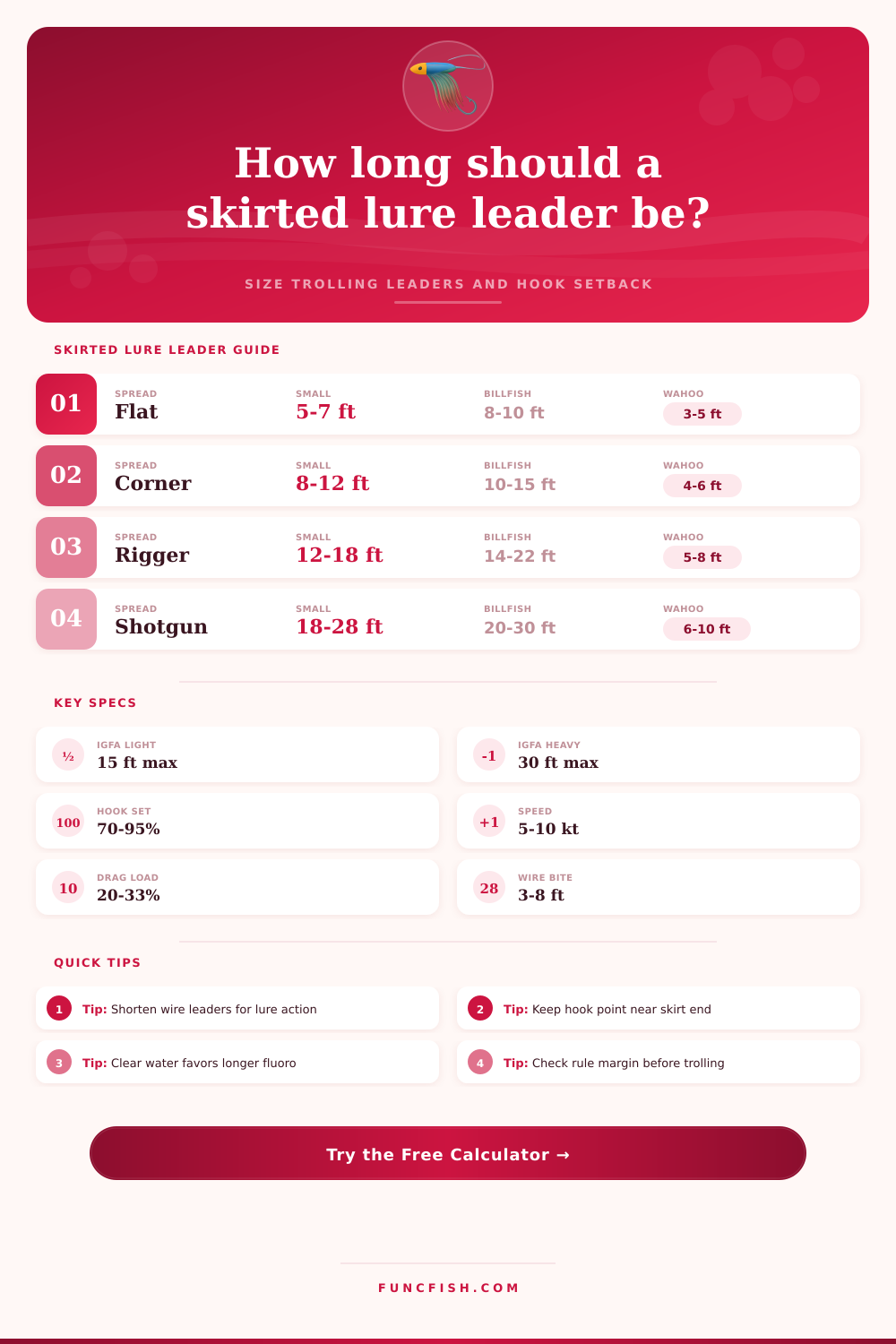
| Spread position | Small tuna / mahi | Billfish skirted lure | Wahoo / kingfish wire | Rigging note |
|---|---|---|---|---|
| Flat line | 5-7 ft / 1.5-2.1 m | 8-10 ft / 2.4-3.0 m | 3-5 ft / 0.9-1.5 m | Short leader keeps lure tight in prop wash. |
| Short corner | 8-10 ft / 2.4-3.0 m | 10-15 ft / 3.0-4.6 m | 4-6 ft / 1.2-1.8 m | Good handling length for close fish. |
| Long corner | 10-14 ft / 3.0-4.3 m | 12-18 ft / 3.7-5.5 m | 5-7 ft / 1.5-2.1 m | Balances wake distance and leader control. |
| Short rigger | 12-16 ft / 3.7-4.9 m | 14-22 ft / 4.3-6.7 m | 5-8 ft / 1.5-2.4 m | Common place for clean-running skirted lures. |
| Long rigger | 14-20 ft / 4.3-6.1 m | 18-26 ft / 5.5-7.9 m | 6-9 ft / 1.8-2.7 m | Longer leaders help in clear water. |
| Shotgun | 18-28 ft / 5.5-8.5 m | 22-30 ft / 6.7-9.1 m | 6-10 ft / 1.8-3.0 m | Watch rule maximums on heavy leaders. |
🎣Species and leader class grid
| Target | Typical leader class | Skirted lure size | Hook placement | Leader length tendency |
|---|---|---|---|---|
| Mahi / dorado | 80-150 lb / 36-68 kg | 5-9 in / 13-23 cm | Point near tail | Medium, action focused. |
| Small tuna | 80-200 lb / 36-91 kg | 5-8 in / 13-20 cm | Point at tail | Short to medium for clean turns. |
| Yellowfin tuna | 150-300 lb / 68-136 kg | 7-11 in / 18-28 cm | Tail or slightly proud | Medium, longer in clear water. |
| Bigeye tuna | 200-400 lb / 91-181 kg | 9-13 in / 23-33 cm | Proud or double hook | Medium-long shotgun leaders. |
| Sailfish | 100-200 lb / 45-91 kg | 5-8 in / 13-20 cm | Fine hook at tail | Longer, low-visibility leaders. |
| Blue marlin | 300-600 lb / 136-272 kg | 10-16 in / 25-41 cm | Double or proud single | Long enough for leadering control. |
| Wahoo | 175-400 lb wire / 79-181 kg | 6-12 in / 15-30 cm | Point proud | Short wire to keep lure action. |
| King mackerel | 60-175 lb wire / 27-79 kg | 4-8 in / 10-20 cm | Point proud | Short wire with bite clearance. |
⚖Gear and species comparison
Mahi / Small Tuna
8-16 ftSoft mono or fluoro leaders. Keep hook point near skirt tail so smaller fish find the hook quickly.
Billfish Spread
14-30 ftHard mono or wind-on leaders. Longer leaders improve leadering control and reduce visible terminal hardware.
Wahoo / Kingfish
3-10 ftWire or cable bite leaders. Shorter length keeps jet heads and bullet skirts tracking properly.
Clear Water Tuna
16-28 ftFluoro or hard mono with longer rigger placement. Watch tournament maximums when line class is light.
📚Rule and rigging reference
| Reference item | Common value | Metric equivalent | Calculator use |
|---|---|---|---|
| IGFA light line leader | 15 ft max | 4.57 m max | Used when line class is 20 lb or less. |
| IGFA heavy line leader | 30 ft max | 9.14 m max | Used when line class is over 20 lb. |
| Drag at strike | 20-33% of line | Same ratio | Raises leader class when drag is heavy. |
| Skirt trail ratio | 70-95% | Same ratio | Sets hook point within or just behind skirt. |
| Leadering grip span | 2-4 ft | 0.6-1.2 m | Added as cockpit handling allowance. |
| Wire bite clearance | 3-8 ft | 0.9-2.4 m | Caps toothy-fish leaders to protect action. |
🔧Hook setback table
| Hook target | Setback formula | Best use | Rigging caution |
|---|---|---|---|
| Hidden inside skirt | Head + 70% skirt trail | Small tuna, mahi, picky bites | Too deep can miss short strikes. |
| Point at skirt tail | Head + 85% skirt trail | Most single-hook skirted lures | Check the skirt after speed changes. |
| Point proud | Head + 95% skirt trail | Wahoo, big tuna, aggressive bites | A proud hook can foul in soft skirts. |
| Double hook rear | Head + 105% skirt trail | Large plungers and marlin lures | Keep hook angle aligned with lure face. |
💡Calculation tips
For instance, when fish heads for deep cover and your rod tip stiffens, leader length is critical. Will you hang on for 20 minutes or reach boat side in short order? It is your lifeline rather than a tech spec. But here’s where rigging mechanics collide with how the species behave. That’s what the above calculator sizes for you. This spares you any guesswork on game day, when it matters most.
What makes this tool unique is that most of us think of leader length as some random number memorized years ago. We forget things like how drag settings change pressure on our knots or how water clarity change fish confidence levels. So I may have used 15′ for tuna, so then I use 15′ again, forgetting all about the rest of the system. What if your target species is way out there? How do you handle your boat to get them back? How much stretch are in your line? It considers all these variables to come up with a final length. The length depends on your target species, spread position, handling allowance in cockpit, and material stretch.
How to Choose the Right Leader Length
Keep those hooks buried and those lures running right. The single greatest factor is water clarity. Shy billfish or wary yellowfin will reject a lure positioned too near the sound of boat. You want longer leaders to separate your bait from the commotion. Conversely, if it’s muddy, you want short leaders as they gets tangled in the chaos of chasing mahi or king mackerel, and lack feel. So, the long leader is an option when the water is super clear, pulling that rig out to thirty feet with some line classes. Shorter in murky water to keep action tight and responsive. It is a balance of control versus stealth based off how clear the water is up top.
The physics of line engagement differ by material, too. A lighter main line will absorbs shock waves from head shakes or a sudden run better than hard mono, and it also softens initial hook set pressure. While soft mono can dampen these forces to protect lighter main lines, it absorb more of the shock wave in the first place. Fluorocarbon stays largely invisible in water and sinks, which is good for trolling clear water. But it has no forgiving stretch, and so isn’t as good for lures where action depends on flex (like some swimbaits). For toothy predators such as wahoo, monofilament is out: They’ll chew up your skirted soft plastics like an appetizer before attacking the wire.
The calculator includes your material choice in its class targets so you don’t mismatch a stiff wire leader with a dainty lure action that needs flex to swim right. Another overlooked aspect of hooking up is hook setback. If it is set back too far into the skirt, fish won’t touch head; if it is set back too far behind the skirt, you’ll lose the natural profile and risk fouling at high speeds. This tool calculates the setback amount based off your lure’s size and how far back you would of like it positioned. For most general trolling purposes, aim for hook point to be parallel with the end of the skirt’s trail, as this provides a good mix of penetration angle and natural look. Go deeper if you’re targeting an unusually wary species that realy checks out each inch of bait.
Keep in mind that rigging is all about managing risk. You need enough leader to give you control and cover, but not so much as to cause drag problems or snagging on structure. Compare your setup to the standard practice table in the reference tables above to make sure your position matches your intended spreads. A direct line of attack, like on flat lines, requires a shorter connection. A longer run, like shotgun runs, allow the leader to sit farther away without being bothered by prop wash interference.
Print off results to take with you and have a clear idea of what you will do on each spread. Preparation makes it consistent different than lucky when boat stops and birds begin diving. Don’t be out there trying to measure line with one hand while holding the rod in the other.