Trolling Lure Spacing by Boat Speed Calculator
Calculate lure-to-lure drop-back spacing, total spread length, set timer, and turn clearance from boat speed, line count, lure drag, sea state, and spread geometry.
📌Preset trolling spreads
⚙Speed, spread, and lure inputs
Calculated trolling spread
Formula breakdown
📊Quick speed-to-spacing reference
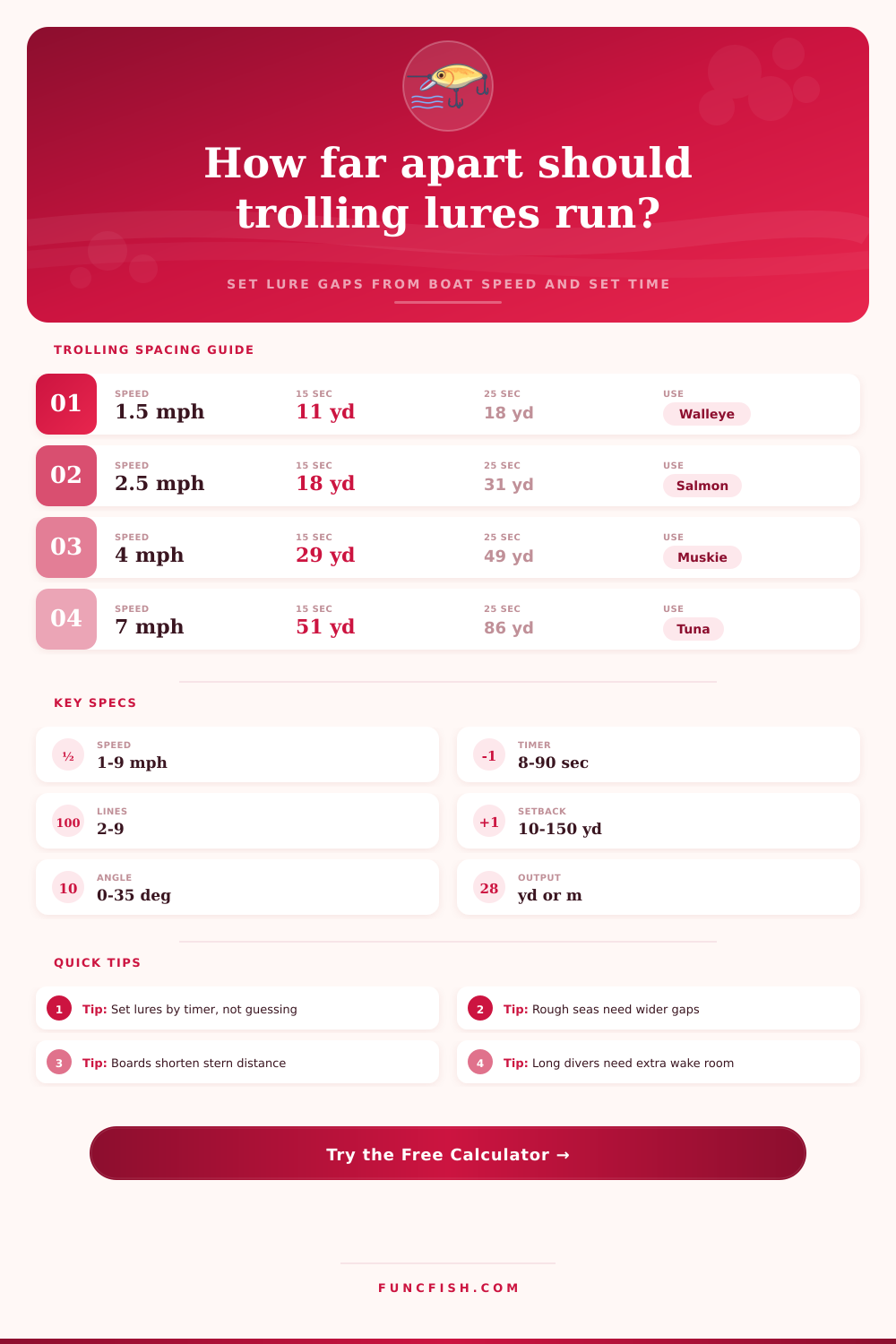
| Boat speed | 15 sec set gap | 25 sec set gap | 40 sec set gap | Typical use |
|---|---|---|---|---|
| 1.2 mph / 1.0 kn | 9 yd / 8 m | 15 yd / 14 m | 23 yd / 21 m | Crappie, live bait, cold-water walleye |
| 1.8 mph / 1.6 kn | 13 yd / 12 m | 22 yd / 20 m | 35 yd / 32 m | Planer boards, slow spoons, king live bait |
| 2.5 mph / 2.2 kn | 18 yd / 16 m | 31 yd / 28 m | 49 yd / 45 m | Salmon, trout, striper umbrella rigs |
| 4.0 mph / 3.5 kn | 29 yd / 27 m | 49 yd / 45 m | 78 yd / 71 m | Muskie plugs, fast inshore lures |
| 6.5 mph / 5.6 kn | 48 yd / 44 m | 79 yd / 73 m | 127 yd / 116 m | Tuna feathers, mahi lures, cedar plugs |
| 8.0 mph / 7.0 kn | 59 yd / 54 m | 98 yd / 89 m | 156 yd / 143 m | Marlin, wahoo, high-speed offshore work |
🎣Lure action and wake recovery data
Small Spoon
Diving Plug
Umbrella Rig
Skirted Lure
| Lure type | Spacing factor | Wake buffer | Line angle note | Common species |
|---|---|---|---|---|
| Small spoon / thin minnow | 0.94 | 10 yd / 9 m | Handles moderate board angle | Trout, walleye, salmon |
| Diving crankbait or plug | 1.08 | 16 yd / 15 m | Wider gap when plugs hunt outward | Muskie, striper, lake trout |
| Deep diver / magnum plug | 1.18 | 24 yd / 22 m | Keep inside turns slower and wider | Wahoo, pike, kingfish |
| Umbrella rig / spreader bar | 1.24 | 30 yd / 27 m | Needs clean water and outside lanes | Striper, tuna, bluefish |
| Skirted trolling lure | 1.14 | 34 yd / 31 m | Long corners need extra turn room | Tuna, mahi, billfish |
| Live bait slow troll | 1.02 | 18 yd / 16 m | Avoid fast turns that swing baits | King mackerel, sailfish |
📏Species and gear comparison grid
Walleye Boards
1.2-2.0 mphUse 15-25 second set intervals, 4-8 lines, and moderate board separation so outside lines stay clean during turns.
Salmon Riggers
2.0-3.0 mphStagger riggers, divers, and boards by 25-45 seconds when spoons and flashers are mixed in the same pass.
Inshore Plugs
2.5-4.5 mphDiving plugs wander and surge, so use wider longitudinal gaps than a pure speed-times-time calculation suggests.
Offshore Lures
5.5-8.5 mphHigh speed spreads grow quickly; plan turn clearance before adding extra long lines or bird chains.
| Target group | Typical speed | Common line count | Starter setback | Spacing priority |
|---|---|---|---|---|
| Crappie / white bass | 0.8-1.4 mph / 0.7-1.2 kn | 4-12 lines | 25-60 yd / 23-55 m | Prevent tight fan tangles |
| Walleye / sauger | 1.2-2.2 mph / 1.0-1.9 kn | 4-8 lines | 35-90 yd / 32-82 m | Board side separation |
| Salmon / trout | 2.0-3.0 mph / 1.7-2.6 kn | 4-10 lines | 20-80 yd / 18-73 m | Flasher and diver clearance |
| Striper / bluefish | 2.5-4.0 mph / 2.2-3.5 kn | 2-6 lines | 40-120 yd / 37-110 m | Umbrella rig wake room |
| Mahi / tuna | 5.5-7.5 mph / 4.8-6.5 kn | 4-9 lines | 20-130 yd / 18-119 m | Clean wake lanes |
| Billfish / wahoo | 6.5-9.0 mph / 5.6-7.8 kn | 4-8 lines | 30-180 yd / 27-165 m | Long turn clearance |
🧭Spread layout reference
| Layout | Stagger factor | Best line count | Lateral gap | When to widen spacing |
|---|---|---|---|---|
| Single centerline lane | 1.00 | 2-3 | 0-6 ft / 0-2 m | Only when lure styles differ sharply |
| Two flat lines | 1.05 | 2-4 | 6-16 ft / 2-5 m | Crosswind or tight inside turns |
| Four diver / rigger lanes | 1.10 | 4-8 | 10-24 ft / 3-7 m | Flashers, divers, or mixed depths |
| Planer boards both sides | 1.16 | 4-10 | 30-100 ft / 9-30 m | Outside boards lag on turns |
| Outriggers and flat lines | 1.12 | 4-9 | 18-60 ft / 5-18 m | Long corners cross the center wake |
| Longline fan spread | 1.22 | 6-12 | 12-40 ft / 4-12 m | Many lines share similar lure depth |
✅Calculator tips
Use speed over ground: Trolling spacing is a distance-along-track calculation. GPS speed over ground gives a better drop-back gap than throttle setting when current, tide, or wind changes the lure path.
Match the widest lure: If one line uses an umbrella rig, bird chain, deep diver, or large plug, use that lure as the minimum gap for the whole side of the spread.
When fishing with multiple baits behind boat, if you don’t know exactly how far apart they are, things get crazy. One casts his bait out, waits, then casts again only for the fish start biting and the rods becomes a tangled mess of lines. It’s because we are guessing at spacing rather than figuring it out.
The lure isn’t right behind you. The water is pushing on the bow. The wind is blowing on the bow. When you set the time in between lines and your speed over ground, it crunches numbers for you. So you don’t have to bounce on a lake with a current fighting against you trying to guess how far 25 seconds are in yards.
Why You Need a Trolling Spacing Calculator
Most of us do this because we trust our gut. That’s great for a ballpark number but terrible when you’re trying to run an exact spread in several different lane without getting them tangled up. The key factor here isn’t your boat’s throttle reading but its speed over ground. Your GPS speed will indicate how quickly the water is passing by your lures. This happen whether it’s wind pushing you along or current pushing back on you. And that’s how many feet of water are being gained per second you wait to set down the next line.
If you go a little faster, the space you need to leave between each lure to prevent interference double. Moving from one point five knots to two point five nearly doubles the space you’ll want to leave between each lure. Keep in mind your lure size as well. While small, clean cutting spoons can go through water easily and take up little space, big umbrella rigs or diving plugs kicks out huge wakes disrupting the current behind them. The tool accounts for this as well.
So if you’re throwing a thin spoon on one side and a bulky musky plug on the other, base your spacing on the widest of the two lures. Better to be slightly ahead than with a wrapped line after a fish smacks it into your rod handle.
And then there’s the sea state. Lures track in a straight line on glass water. They’ll meander up and down left-right-left when fishing in some chop as they ride up and over each wave. That left-right action require a little more distance between lines so they don’t cross paths. When conditions get rougher, the calculator accounts for that with a little extra buffer around your suggested spacing. It is a small detail but it makes a difference when you cover water efficiently without losing any gear.
Until it’s too late, many anglers don’t think about turn clearance. When fishing a long spread, you need wide enough arc to turn properly. This prevents your outside lines from tangling with your inside lines or dragging across top of your wake. The calculator will tell you how much space you should of had available to make those turns successfully.
Are you fishing in crowded waters or around structures? You may want less line so that you can turn tighter and still maintain some degree of control. You must choose between control and coverage.
The reference tables on this page outline standard patterns for high-speed trolling for tuna or walleyes on boards. These tables provides a quick snapshot of typical situations. It lets you know whether your intended set up matches what has proven successful for other anglers. However, no two situation are ever alike. Your boat length, rod placement, and reel drag settings all affect how your line behave behind you.
Trolling spacing can be thought of as moving geometry. It’s a wide but orderly net that covers as much water as possible. It must work within the limits of how far your boat turns and what you can do with your lines. Understanding the correlation between speed and distance removes the guess work. Instead of fighting your own lines, you’re able to focus on the fish. Taking an extra minute before launch to calculate that clean, orderly spread behind your stern is worth every second.