Drift Sock Size By Boat Calculator
Estimate drift sock diameter, drag load, line scope, and twin-sock alternatives from boat length, beam, wind, current, freeboard, and target drift speed.
⚓Fishing Drift Presets
📏Boat And Condition Inputs
Drift Sock Size Results
Calculation Breakdown
🧰Drift Sock Construction Data
Coated Nylon Cone
Mesh River Sock
Heavy Offshore Cone
Parachute Drogue
🎣Gear And Species Comparison Grid
Walleye Jigging
0.4-0.8 mphUse a bow or side sock to hold a slow vertical line over breaks and wind lanes.
Catfish Drifting
0.5-1.0 mphRode load climbs in current; a bridle keeps baits tracking behind the boat.
Fluke And Flounder
0.8-1.4 mphBay drifts usually need fast retrieval and enough diameter for tide plus wind.
Salmon Trolling
1.2-2.0 mphUse paired socks to trim speed without pulling the stern out of the spread.
📊Reference Tables
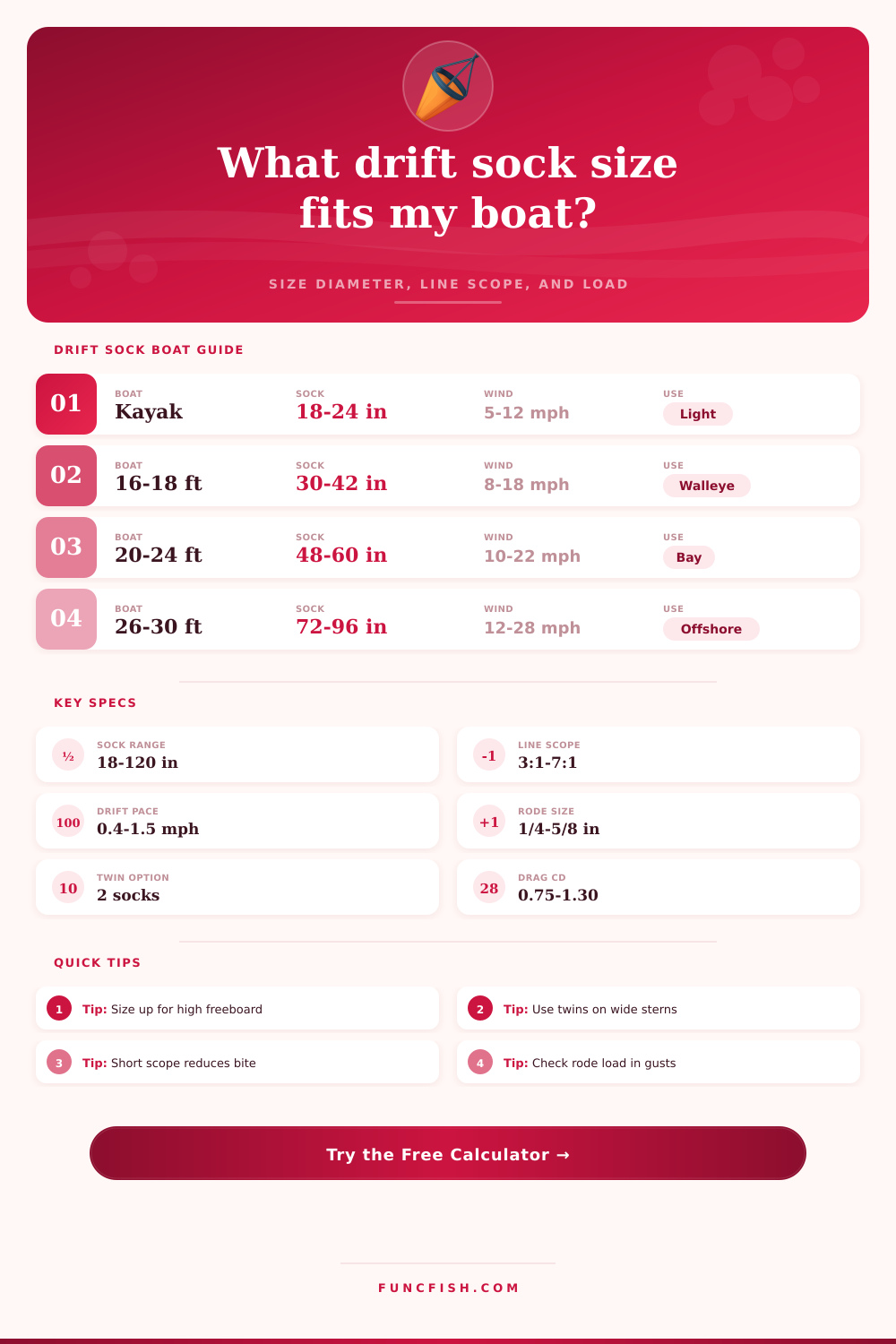
| Boat class | Length range | Common sock diameter | Best use |
|---|---|---|---|
| Kayak, canoe, small skiff | 9-14 ft / 2.7-4.3 m | 18-24 in / 46-61 cm | Light wind drift, inshore current seams |
| Jon boat or small aluminum | 14-17 ft / 4.3-5.2 m | 24-36 in / 61-91 cm | Panfish, crappie, protected lakes |
| Bass boat or flats skiff | 17-20 ft / 5.2-6.1 m | 36-48 in / 91-122 cm | Bass wind drifts, flats positioning |
| Deep-V multispecies | 18-22 ft / 5.5-6.7 m | 42-60 in / 107-152 cm | Walleye, salmon, rough lake chop |
| Bay boat or walkaround | 21-25 ft / 6.4-7.6 m | 54-72 in / 137-183 cm | Fluke, striper, nearshore bottom drift |
| Center console offshore | 25-32 ft / 7.6-9.8 m | 72-96 in / 183-244 cm | Offshore bottom fishing and speed trim |
| Condition factor | Low setting | Medium setting | High setting |
|---|---|---|---|
| Wind speed | 0-8 mph: reduce 8% | 9-18 mph: baseline | 19-30 mph: add 10-22% |
| Current or tide | 0-0.4 mph: small effect | 0.5-1.2 mph: add 3-7% | 1.3+ mph: add 8-18% |
| Freeboard | Under 1.5 ft: reduce 4% | 1.5-2.5 ft: baseline | Over 2.5 ft: add 4-16% |
| Target drift | 1.2+ mph: smaller sock | 0.7-1.1 mph: baseline | Under 0.7 mph: size up |
| Species or method | Typical drift speed | Rigging point | Sizing note |
|---|---|---|---|
| Walleye jigging | 0.4-0.8 mph / 0.6-1.3 kph | Bow or side cleat | Size for the gust, not the calm average. |
| Crappie spider rigging | 0.3-0.7 mph / 0.5-1.1 kph | Bow bridle | Small speed changes matter, so choose the slower control priority. |
| Catfish drifting | 0.5-1.0 mph / 0.8-1.6 kph | Stern or bridle | Current load raises rode tension even when wind is mild. |
| Fluke or flounder | 0.8-1.4 mph / 1.3-2.3 kph | Bow or stern | Use faster retrieval hardware when weeds or tide lines are common. |
| Great Lakes salmon | 1.2-2.0 mph / 1.9-3.2 kph | Twin side socks | Paired socks keep trolling spread tracking straighter. |
| Offshore bottom drift | 0.6-1.5 mph / 1.0-2.4 kph | Bow bridle | Open-water swell increases shock load and line scope. |
| Peak rode load | Suggested rope diameter | Scope ratio | Hardware note |
|---|---|---|---|
| Under 100 lb / 45 kg | 1/4 in / 6 mm | 3:1 to 4:1 | Kayak clips or light cleats with quick release. |
| 100-250 lb / 45-113 kg | 3/8 in / 10 mm | 4:1 to 5:1 | Freshwater cleat, swivel, and retrieval float. |
| 250-500 lb / 113-227 kg | 1/2 in / 13 mm | 5:1 to 7:1 | Use chafe sleeve where the rode crosses the gunwale. |
| 500-900 lb / 227-408 kg | 5/8 in / 16 mm | 7:1 or more | Prefer bridle legs and rated shackles for shock loads. |
💡Calculation Tips
Windage tip: two boats of the same length can need different socks. High freeboard, canvas, hard tops, and pontoon rails raise projected wind area, so this calculator weights beam and freeboard instead of using length alone.
Load tip: rode tension changes with the square of water speed through the sock. A small increase in slip speed can produce a much larger pull on the cleat, bridle, swivel, and retrieval line.
When it’s calm in the morning and the wind picks up, it seems like your boat always floats off a good spot. You can’t afford to spook fish or burn fuel trying to control the motor; you’ve got to be able to sit still. That’s where a drift sock come into play. It allows you to maintain precise control while working a jig or lure, but finding the proper size require more than a blind guess. Too big and the sock will be hard to recover and too small and you’ll never hold your position.
Let the above calculator do math on boat wind and drag and let you do what you do best, fish. Many folks makes the mistake of thinking length alone paints the full picture. For instance, a 16′ low-profile bass boat doesn’t move as much air as a 16′ pontoon. You have height, rails, and canvas to turn the pontoon into a sail. You must also consider beam and freeboard, not just the overall length. Greater freeboard result in increased high side surface area, grabbing more wind. To overcome that wind lift, you’ll require an even bigger diameter sock.
How to Pick the Right Drift Sock Size
Instead of using generic averages, the tool considers how much area will be projected based off your specific dimensions. This difference determine if you have a controlled drift or if you are battling a tangle-filled mess throughout the entire day. Current also tip the scale by adding weight that wind couldn’t add. Flat calm may have a perfect setting for a sock, but when the tide moves at a knot or more they won’t maintain their place.
Here’s where choosing your best speed of drift really matters. For walleye it is typically a slow crawl across the structure. For fluke you typically want to be crawling along a little quicker to keep bait fresh in water column. Adjusting this variable tell the system whether to prioritize braking power or steady tracking. One sock might let you slip along at a mile an hour, while another might cause you to drop your speed to zero point five miles per hour. This can mean the difference between getting a bite and missing strike zone altogether.
It’s also not just about size; construction plays an important role too: A heavier, coated nylon cone can has similar drag as a lighter-weight mesh sock in same size. Similarly, vinyl drogues may be stiffer to manage, but they’ll hold up better in rough chop. The tool then breaks these materials into their efficiency ratings, allowing you to see how many pounds of actual pulling force each is generating. You might discover that a bigger mesh sock has less pull power than a smaller vinyl one. This is because it doesn’t push water as well. It comes down to how much resistance meets the surface area.
“Scope ratio is important too; it will affect how far down the sock goes as well as how stable the pull is. If the line isn’t long enough, then the sock bobs up and down, creating sudden shock loads that break lines or cleats. Typically people think a longer scope is more stable; however shallow water may put you into tight spaces where you have no other option then to compromise and find the right balance for your situation. Keeping the boat straight with a bridle set up versus one at the stern allow you to pivot but alters the load distribution around the hull.
Tides change, wind gusts occur, and gear is only as good as how well you can read the conditions. You may find it working great at nine o’clock in the morning then struggling at two in the afternoon with a stiffening breeze. Start with the recommended diameter, fill in the gaps with experience, and use the calculator to give you a solid starting point based on information you have. Consider using twin socks if the boat isn’t tracking well enough while avoiding overloading the single-point load.
A perfect fit keeps you in the strike zone longer and makes the difference between an angler sitting there spinning his wheels and making accurate casts to the right targets. Control the day (not mother nature). Every trip gets just that little bit smarter as you learn exactly what works best on each outing when you pull out of the lake. That repetition is what turns a few fun days into a serious catch.