Casting Weight Aerodynamics Calculator
Estimate sinker or lure casting distance, aerodynamic drag loss, side-wind drift, and stability from weight, shape, diameter, rod speed, launch angle, line drag, and wind.
🎯 Fishing Presets
⚙ Aerodynamic Inputs
Casting Flight Results
Formula Breakdown
📊 Shape Drag Data
📐 Casting Weight Aerodynamics Reference
| Weight or lure shape | Typical Cd range | Frontal area note | Flight behavior |
|---|---|---|---|
| Bullet / teardrop sinker | 0.28-0.38 | Round nose, narrow shoulder | Low drag and stable when line exits cleanly |
| Aero tournament lead | 0.38-0.48 | Long body, moderate nose | High retained speed on power casts |
| Round jig head with hook | 0.55-0.75 | Hook and skirt add exposed drag | Good mass density, moderate flutter |
| Casting spoon | 0.70-1.10 | Wide concave face | Can plane, wobble, or helicopter in wind |
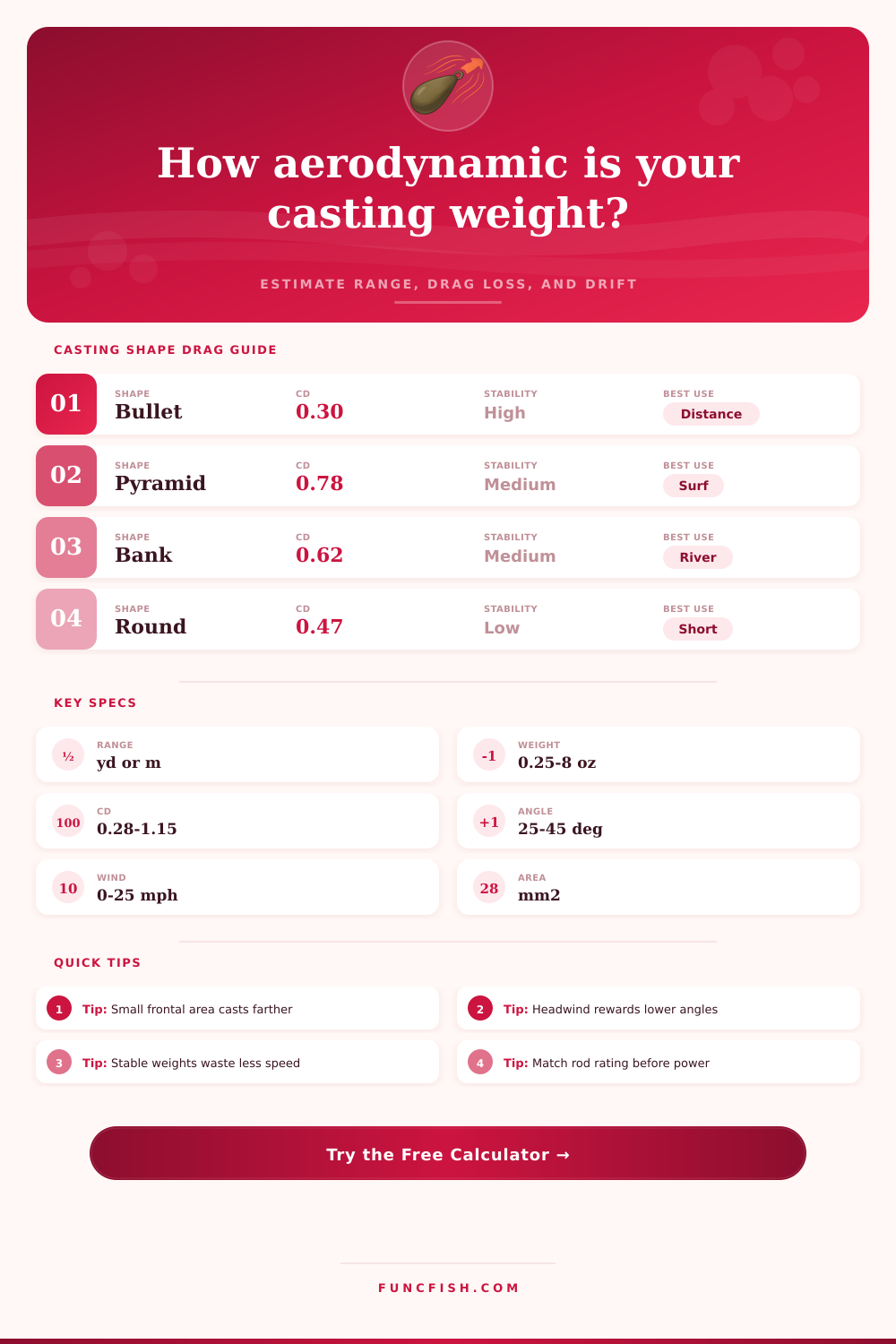
| Pyramid surf sinker | 0.70-0.88 | Flat faces and corners | Distance loss traded for bottom grip |
| Bank or egg sinker | 0.55-0.68 | Oval body, fair mass density | Reliable for moderate casts and current rigs |
| Split shot or round shot | 0.45-0.50 | Spherical frontal area | Predictable but low mass limits momentum |
| Method feeder cage | 0.95-1.20 | Open cage plus bait profile | Highest drift and fastest speed decay |
🎣 Gear and Species Comparison Grid
Bass
1/4-1 ozCompact bullet or jig heads cast well on medium to medium-heavy rods with low line drag.
Surf Species
2-6 ozAero leads go farthest; pyramid sinkers lose distance but hold sand better.
Catfish
1-5 ozBank sinkers carry well; bait profile often matters more than lead shape.
Pike
1/2-2 ozWide spoons and wire leaders need extra speed to offset flutter and side drift.
📋 Rod Rating and Release Speed Table
| Rod class | Useful weight window | Typical release speed | Aerodynamic caution |
|---|---|---|---|
| Ultralight spinning | 1/64-1/4 oz (0.4-7 g) | 55-85 ft/s (17-26 m/s) | Small weights slow quickly in headwind |
| Light spinning | 1/16-3/8 oz (2-11 g) | 65-95 ft/s (20-29 m/s) | Line diameter can dominate total drag |
| Medium bass rod | 1/4-3/4 oz (7-21 g) | 85-120 ft/s (26-37 m/s) | Compact shapes reward smooth release |
| Medium-heavy rod | 3/8-1 1/2 oz (11-43 g) | 95-130 ft/s (29-40 m/s) | Trailer and skirt drag reduce range |
| Surf rod | 2-6 oz (57-170 g) | 115-155 ft/s (35-47 m/s) | Headwind often favors a 30-36 degree angle |
| Heavy offshore rod | 4-12 oz (113-340 g) | 80-125 ft/s (24-38 m/s) | Large bucktails drift despite high mass |
🌬 Wind and Air Density Reference
| Condition | Air density used | Range effect | Best adjustment |
|---|---|---|---|
| Hot humid air | 1.16 kg/m³ | Slightly less drag | Normal launch angle works well |
| Standard sea-level air | 1.225 kg/m³ | Baseline drag model | Use measured wind direction |
| Cold dense air | 1.30 kg/m³ | More speed loss | Favor compact weight shapes |
| High elevation air | 1.05 kg/m³ | Less drag and drift | Line drag still matters on light rigs |
🧮 Practical Formula Notes
| Calculated term | Formula | What raises it | Fishing meaning |
|---|---|---|---|
| Frontal area | A = pi d² / 4 | Larger diameter or wide lure face | Higher area creates faster speed decay |
| Drag force | Fd = 0.5 rho Cd A v² | Speed, air density, Cd, area | Drag rises with the square of speed |
| Vacuum range | R = v cos a × flight time | Speed, height, efficient angle | Upper bound before real air loss |
| Aero quality | mass / (Cd × A) | Heavy compact weights | Higher value resists wind better |
💡 Casting Aerodynamics Tips
Drag check: If two rigs weigh the same, the one with smaller frontal area and steadier nose-first flight usually keeps more speed after release.
Wind check: In a headwind, a lower launch angle often beats a high lob because the weight spends less time in high drag air.
The calculator models airborne flight only. It does not judge fishability after splashdown, bottom grip, snag resistance, regulations, or casting safety.
There’s nothing better than being on the bank with a great cast in your head. Then the wind blows and despite your best efforts, the lure darts and stops and falls short of its mark. Whether you are a weekend warrior or tournament professional, we have all been there as angler. Most of us tend to fault ourselves or power rating of our rods for these misses, when truth be told the problem lies most of the time right out in the open on our rigs.
Here is a little physics lesson on how aerodynamic forces affects how your tackle travels through air and how it falls due to gravity. Once we get our heads around this we can choose shapes that don’t fight the air but slice through it. Suddenly you start thinking differently about both accuracy and distance.
How to Cast Further and More Accurately
The calculator computes wind drift, drag loss, range, and shape efficiency. This lets an angler model a feeder, spoon, jig, or sinker against others to determine which rig work best.
“Heavier is always better,” most folks think for distance. Yes, more mass means less air resistance, but in reality, both size and shape are equally important. A large pyramid sinker might weigh two ounces yet lose half its speed due to flat faces catching the wind, while a compact bullet weight of similar mass will punch through the air with minimal disturbance.
The drag coefficient is the whole story. The thing most anglers don’t understand is how much shape stability count in difficult conditions. Because the teardrop form lets air slip over a bullet sinker easily, its drag coefficient is roughly 0.30. By contrast, a method feeder cage’s coefficient approach 1.05. That means long range casting demands some type of geometry.
Why? It’s all about frontal area, which is the wide face pushing against the air. Even small reductions in diameter will translate into yards of additional distance. And that’s especially true when long casts to distant cover are needed while avoiding spooking wary fish.
That all flips on a dime with a change of wind. Headwinds punish high-arcing casts because the lure takes longer to reach the water while fighting the wind. Lowering your launch angle keeps the weight moving low and fast through areas with less resistance.
A crosswind creates lateral drift which throws off pinpoint accuracy. Adjusting for this means pointing just ahead of the wind a bit. But it is easier if you know how far it will be drifting. That’s what the tool does too. It simulates a flight path based off weather conditions. It helps you see what happens once it comes off the end of the line.
The other element that many overlook is line drag. Braided lines are thinner and create less resistance than monofilament or fluorocarbon of equivalent strength. Since braided lines create less resistance than monofilament or fluorocarbon, your tackle retains more energy and has more “oomph” during the cast.
And then there’s rod release speed. Generally speaking, a quicker load is better, and sometimes using a faster load can throw a lighter weight further then a heavier one. But this comes at a cost. As power casts increase so does loss of accuracy. Wobble is more difficult to control, too.
Weather is also an environmental variable that will affect how far your lure will cast. The resistance of cold dense air is greater than warm moist air. This means your winter casts may not throw as far as they would in the middle of summer with same equipment. Thinner high altitude air makes it easier for your lures to go further with less effort. These can be small factors but they add up and become repeatable if you know what to look for.
Understanding these things helps account for why something that was absolutely dynamite last month seem slow today. You won’t have to guess at the variables because the math does it for you.
So how do we decide? It’s about mass, profile and surface area for a given task. For the longest distance, you should of think about a compact profile and a low drag coefficient for open water. To hold the bottom best, think more about sticking to the ground rather than being aerodynamically perfect. Pyramid sinkers grip sand well, but they don’t fly very well. Bank sinkers strike a happy medium between staying put and having some range. Understanding which characteristic is most important to what you’re trying to do can save trial-and-error time on the water.
And lastly, cast management: Casting is about managing energy transfer from your rod to your bait through air resistance. When you extend past visible range or get hit by a little breeze, every ounce matters. The smaller tweaks in shape selection produce bigger gains in consistency.
There’s no need for complex equations to get the benefits of these principles. Simply know that smooth releases trump brute force and clean lines outperform bulky shapes each and every time. The next time a few gusts throw you a curveball, examine what you’re throwing instead of how you swing it. That subtle change in focus transforms frustrating misses into satisfying hits.