Overhead Cast Distance Calculator
Estimate overhead casting distance from release speed, release angle, rod loading, lure aerodynamics, line diameter, spool fill, and wind.
📌Scenario presets
⚙Cast and tackle inputs
Cast distance estimate
Calculation breakdown
📊Rod and line data grid
Medium Bass
Surf Rod
Finesse Trout
Offshore Popper
🎯Gear and species comparison grid
Largemouth Bass
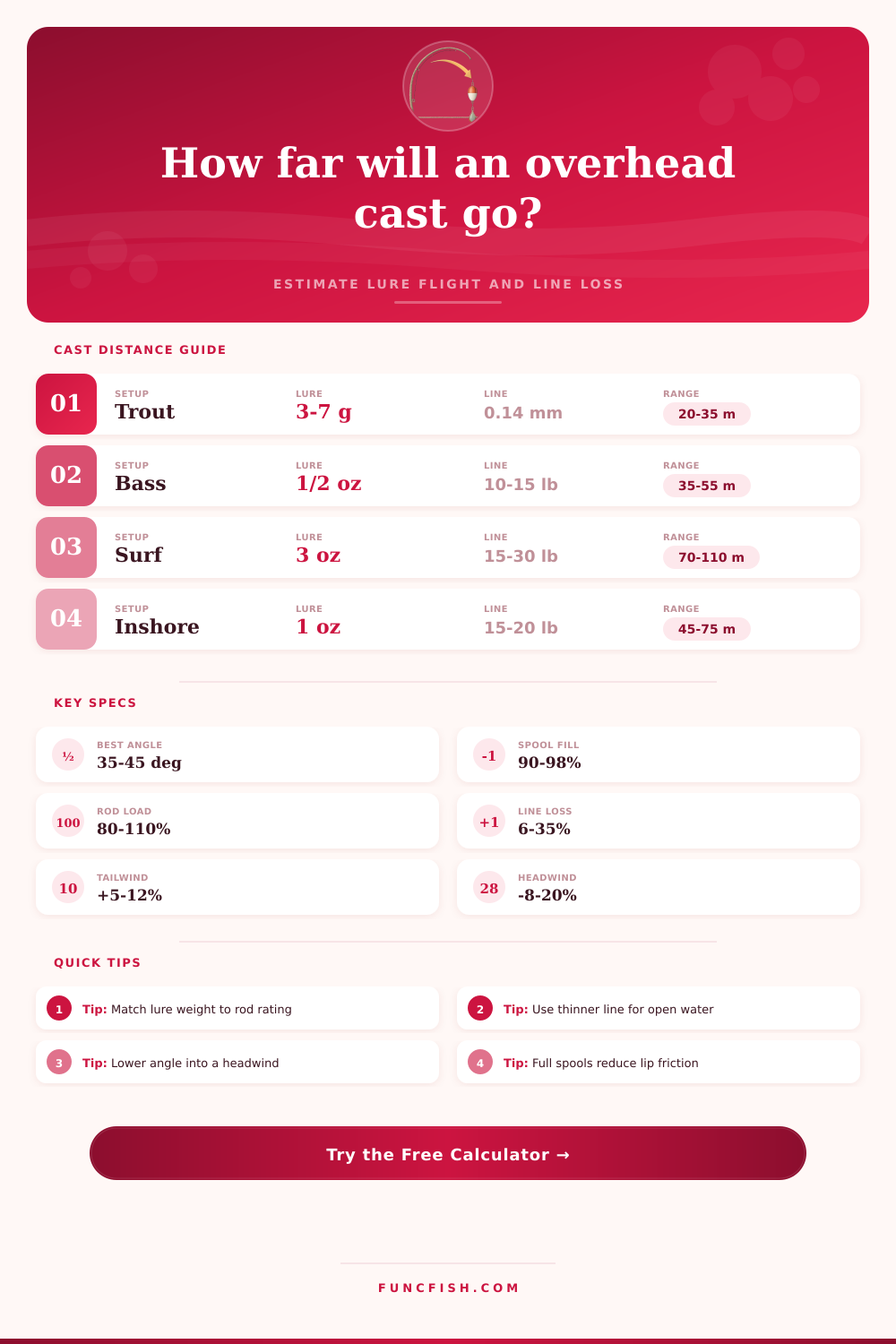
35-55 mMedium to medium-heavy rods, 3/8-3/4 oz lures, and braid or mono in the 0.20-0.30 mm range.
Pompano or Whiting
70-110 mSurf rod, aerodynamic sinker, shock leader, and a clean high stop help reach outside bars.
Redfish or Snook
45-75 mInshore braid and compact spoons cast farther than bulky bait rigs around wind and current.
Trout or Panfish
20-35 mLight rods need a smooth overhead stroke because tiny lures lose speed quickly in the air.
📐Reference tables
| Release situation | Useful angle | Distance effect | Best adjustment |
|---|---|---|---|
| Calm air, compact lure | 40-45° | Best ballistic carry | Smooth acceleration and crisp stop |
| Light tailwind | 42-48° | Adds carry time | Let the lure climb slightly higher |
| Strong headwind | 28-35° | Reduces stall and blowback | Flatten trajectory and use compact weight |
| Bulky lure or bait rig | 32-38° | Limits drag exposure | Avoid high floating arcs |
| Rod class | Rated range | Sweet spot | Distance note |
|---|---|---|---|
| Ultralight | 1/32-1/8 oz (1-4 g) | 2-3.5 g | Needs thin line and clean lure shape |
| Medium | 1/4-3/4 oz (7-21 g) | 12-17 g | Common bass and walleye distance range |
| Heavy | 1/2-2 oz (14-57 g) | 28-45 g | Works for large swimbaits and bank sinkers |
| Surf | 2-6 oz (57-170 g) | 85-135 g | Designed for long overhead loading arcs |
| Line type | Typical diameter | Drag behavior | Cast-distance role |
|---|---|---|---|
| Thin 8-carrier braid | 0.10-0.24 mm | Low air drag | Best for open-water distance |
| 4-carrier braid | 0.16-0.32 mm | Moderate surface texture | Durable but slightly louder through guides |
| Nylon mono | 0.20-0.45 mm | More coil memory | Good shock stretch with shorter carry |
| Fluorocarbon main line | 0.18-0.40 mm | Stiffer and heavier | Accurate, but not usually longest |
| Species or use | Common flying weight | Main line | Practical distance target |
|---|---|---|---|
| Creek trout | 1/16-1/8 oz (2-4 g) | 2-6 lb mono or braid | 65-110 ft (20-34 m) |
| Bass bank fishing | 3/8-3/4 oz (11-21 g) | 10-30 lb braid or mono | 115-180 ft (35-55 m) |
| Inshore redfish | 1/2-1 oz (14-28 g) | 10-20 lb braid | 150-245 ft (46-75 m) |
| Surf bait casting | 2-5 oz (57-142 g) | 15-30 lb plus shock | 230-360 ft (70-110 m) |
💡Calculation tips
Rod-load tip: If the lure is below the rod range, release speed can look high but stored rod energy stays low. Move toward the rod sweet spot before chasing more force.
Line-loss tip: Thick line, low spool fill, and leader knots through guides stack together. Fixing one may add only a little; fixing all three can add a noticeable cast length.
Every time you make an overhead cast, there’s one point where physics win out. That’s when you load up the rod, speed past the sweet spot, and see the line begin to spool off as a compact loop that sticks close to that promising piece of structure or coils around the next oak tree instead. Raw muscle power rarely makes much difference. More often it’s about timing, and aerodynamics, and the hidden drag created by friction of your own tackle system. Most folks think they get more distance if they just swing harder. They’re mistaken. It is not necessarily about speed, but rather about efficiency.
This combine all those elements into a rough approximation. You can test it on your back deck to learn which factors matter most in actual flight path. For example: What about the shape of the lure? There’s no frontal area for the wind to catch onto a bullet sinker, so it cuts through air. A big cork, or a float rig, is more like a parachute; so is a bulky swimbait. That shape difference gets included in the calculator, and you need to feel it in your hands as well.
How to Cast Further: The Real Secrets
A light trout spoon on an ultralight rod won’t get out of the hole if you’re trying to throw it twenty meters because the air resistance is going to eat half your speed before lure even hits its apex. Matching rod rating to lure weight isn’t just “advice” in a book. It’s a mechanical necessity for storing energy in the blank and cleanly moving it to the line.
The other thieves of casting distance are things we can’t see: line diameter and the spool’s geometry. A thinner line take up less room on the reel, resulting in less friction as the coils ride off the lip. When your spool is only half-full, each loop has to rise over a higher stack of loops already on the reel before leaving. This cause big drag. Fill that spool up with braid or mono until it’s practically touching the lip and you’ll immediately increase cast length without altering your stroke. Check out the graph of reference data on this page; it shows just how much distance gets lost at those friction points. And most folks don’t realize it’s more than they think.
But where the wind comes into play is everything, as it throws a wild card into the mix that no static chart could account for. A headwind will require a flatter trajectory with less elevation to cut through air resistance, whereas a tailwind allow you to throw higher and trust the breeze to blow the lure out even farther. Pushing too hard into a stiff wind results in broken tips and backlashes. Reduce your angle and count on the weight of the lure to blast its way through. The calculator lets you select the wind direction and adjusts the optimal release angle to help you visualize that trade-off, sometimes going lower is better because it’ll go farther.
And then there’s skill. Skill definitely has a role to play, but sometimes people overstate it as being the only variable behind long casts. Locking the guides is essential at the end of the forward cast so the rod tip can efficiently flick up and release the lure with maximum speed. Any following-through of your arm after releasing it slow the loop down and is basically pulling back on the line. Although it seems naturaly to continue to move along, it kills momentum. That reality shows itself in the input for casting form which penalizes late releases that rob energy out of the system.
Ultimately, casting is all about controlling your energy losses along the way. Whether you are dragging line through a guide or fighting air resistance, every millimeter reduce the distance you reach on your target. A tailwind can actualy help you throw further. But your release timing, your lure choice and how much line you put on your spool; those are things you can control. Master the mechanics of it before you start trying to swing harder. If your equipment is working for you instead of against you, then the distance will come naturaly. It is more about letting the loop go free than throwing hard.