Beach Gradient to Cast Distance Calculator
Estimate the surf casting distance needed to reach a target depth, trough, or bar edge from beach slope, tide change, wave setup, wading position, sinker hold, line belly, and angler accuracy.
🎯 Surf Fishing Presets
⚙ Beach Slope and Cast Inputs
Beach Gradient Cast Results
Full Calculation Breakdown
🧰 Beach Gradient Reference Cards
🐟 Gear and Species Comparison Grid
Pompano
2-5 ftOften inside the first trough on mild to flat beaches. Accuracy across a narrow food line matters more than maximum range.
Striped Bass
4-9 ftBar edges, bowls, and rip lanes often need a heavier reserve for sweep and plug swing.
Redfish
3-7 ftSteep wash cuts can be close; the calculator helps avoid casting over the feeding lane.
Surf Perch
1-4 ftShorter casts along the swash trough usually work when slope and tide put depth near shore.
📏 Beach Slope to Depth Distance Table
| Beach profile | Approx. gradient | Distance to 4 ft depth | Distance to 6 ft depth |
|---|---|---|---|
| Ultra-flat open sand | 1:90 to 1:120 | 120-160 yd (110-146 m) | 180-240 yd (165-219 m) |
| Flat barred beach | 1:65 to 1:85 | 87-113 yd (79-104 m) | 130-170 yd (119-155 m) |
| Mild surf slope | 1:40 to 1:60 | 53-80 yd (49-73 m) | 80-120 yd (73-110 m) |
| Steep wash face | 1:18 to 1:35 | 24-47 yd (22-43 m) | 36-70 yd (33-64 m) |
| Storm-cut lip | 1:10 to 1:18 | 13-24 yd (12-22 m) | 20-36 yd (18-33 m) |
🌊 Tide, Wave, and Setup Corrections
| Correction | Calculator treatment | Distance effect on flat beaches | Fishing interpretation |
|---|---|---|---|
| Rising tide | Subtracts water rise from target depth need | Shortens the required cast | The same depth line moves landward |
| Falling tide | Adds depth deficit if entered negative | Lengthens the required cast | Bars and troughs may become too shallow |
| Surf setup | Subtracts average piled water from target depth | Shortens geometry but adds reserve | Breaking surf deepens the wash zone briefly |
| Breaker height | Adds a percent reserve to final cast | Increases practical range | Line belly and bait drag move rigs shoreward |
| Wading | Subtracts stand depth and wade distance | Can reduce rod-tip cast sharply | Only use safe, stable wading positions |
🧵 Sinker and Line Reserve Table
| Tackle choice | Hold or drag factor | Typical reserve | Use in calculation |
|---|---|---|---|
| Sputnik or breakaway sinker | Strong bottom hold | Low to medium | Reduces sliding correction after splashdown |
| Pyramid sinker | Good hold in sand | Medium | Baseline bait-soak correction |
| Bank or egg sinker | Slides in sweep | Medium to high | Adds extra practical cast range |
| Plug or metal lure | No bottom hold | Retrieve based | Reserve covers line belly and wind swing |
| Heavy mono or wire leader | Higher air and water drag | High | Adds line-drag reserve to target range |
🧮 Formula Reference
| Term | Formula | Input source | What it means |
|---|---|---|---|
| Slope as decimal | s = drop / run | Ratio, percent, or degrees | Vertical depth gained per horizontal distance |
| Corrected depth | D = target - stand - tide - setup | Depth and water-level inputs | Extra depth needed beyond the angler position |
| Depth line range | X = D / s | Corrected depth and slope | Horizontal distance to the desired depth contour |
| Rod-tip cast | C = X - wade + backset + reserve | Position and tackle corrections | Practical distance the rig must travel |
| Reserve | R = Cbase x percent | Sweep, line, sinker, wave, caster | Extra range so the rig settles near the target |
💡 Beach Gradient Calculation Tips
Slope tip: On a flat beach, a 0.5 ft depth or tide error can move the target depth line by dozens of yards. Recheck slope near the section you actually plan to fish, especially after storms.
Rig tip: If sweep is strong, the calculated geometric distance is only the starting point. Use the reserve result to decide whether you need a firmer sinker hold, thinner line, or a closer depth lane.
This calculator estimates physical cast distance and water-depth geometry only. It does not evaluate access, wading safety, surf hazards, local rules, seasons, or fish movement.
So you’re standing on a sandy beach casting out as far as you can go. Your bait falls into deeper water but still no strikes because the fish is holding in a shallow trough closer to shore. You just made the mistake of casting out too far. By shortening your distance by about 20 yards, the bait might slide back up the slope or sit in water that is more shallow than your target species. But instead, this frustrating guessing game has you wondering how to figure it out.
Enter geometry. Feed it your particular set of circumstances and the calculator above give the answer for you instantly. No more guessing about where fish are; eliminate wasted time and get ’em!
How to Cast to the Right Depth
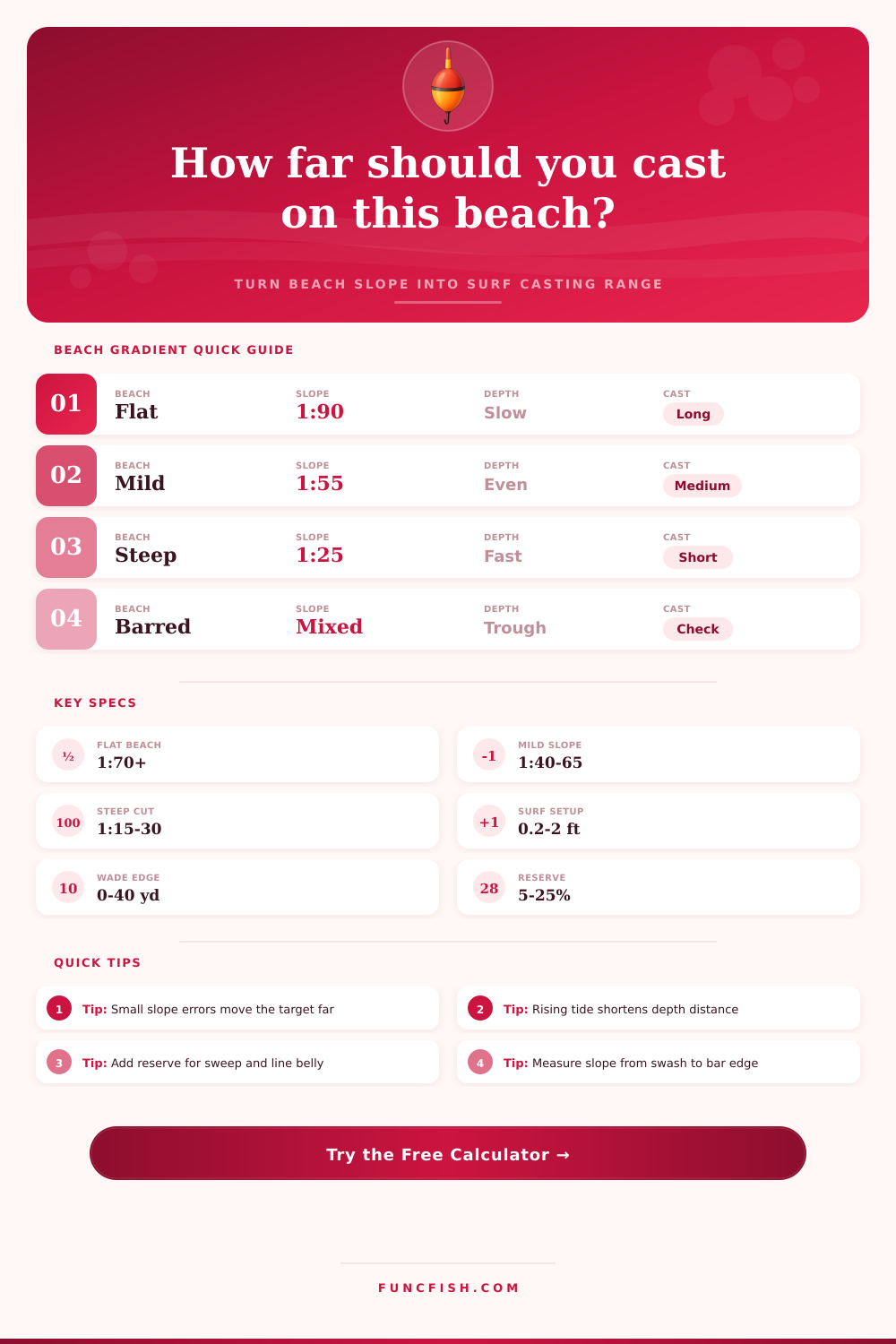
So what do you hit? Well it all comes down to how deep you’re going to fish them. It’s based off depth and then the beach slope. So if you want to fish 5ft of water back off the beach and the beach goes down a foot every fifty feet horizontally, you have to run out there from high mark along dry sand two-hundred and fifty feet.
Trigonometry for dummies, but folks don’t realize that some variables will move the start point and then mess you up. You seldom launch your bait from a true zero position. Your rod tip can be on the swash zone or maybe on top of the bank. Tides move, and wave pushes up on the beach as well. All those things changes where the bait hits the bottom compared to the depth shown on undersea map.
Tide matters a lot. Without you moving, a rising tide will pull depth lines inshore. Fish during high tide and your long-cast target may be at your feet. You calculated low tide but fished high. To compensate, this tool allows you to enter how much tide is changing while you’re setting up your cast. It’ll subtract that increase from your overall distance required to hit your depth goal. When a falling tide occur, those same contours move outwards, requiring you to add some yardage.
Wave setup is different but has a similar impact on the outcome. As waves break, they push water onto the beach, temporarily making wash zone deeper. While it’s more difficult for your rig to hold in turbulent water, this also means you need less distance to reach a given depth.
A lot of people don’t think about sinker selection, but it’s important. The pyramid sinker is heavy and stays in place on the bottom at the depth you calculate. By contrast, a simple plug or even a light egg sinker will slide down the current and upwave and downwave. Your bait go with it. And if you’ve got tackle that moves, then it’ll go shoreward of the line where geometry suggests it should of been.
So the calculator builds some reserve distance to account for that drag. That’s not penalizing, that’s insurance against your rig being pulled off target by line belly and longshore sweep. It’s the difference between a quick pull over a short distance on a steep beach versus a pull from a current that might move your bait dozens of yards on a flat beach before the bait digs into the sand and stops.
These figures can be verified by reading the beach visually. Look for breakers, the crash is typically a sign of a depth change or at least a bar. Rip or a distinct channel between two adult-sized sofa is another good landmark. Refer to the table on this page for distance to four-foot depth relative to a flat vs steep beach.
Huge range is needed to get into usable water on a 1:90 slope. A 1:25 gives you much closer access to deep water, which means shorter, more accurate, easier-to-control casts. On steep slopes accuracy is more important then distance; overshooting by only ten feet can drop you in fifteen feet of water where the fish aren’t feeding.
Another challenge with night casting is that visual cues are absent; you don’t get to see breakers or the swash line as well. That’s when trusting the number becomes critical. Measure it out before darkness, do the math and then bank on it when it gets dark. Here again, there is less of a reserve margin because you don’t know precisely where the bait will land in the dark.
Don’t guess where the deep water begins. Look at the beach like it was a map instead of a wall. Watch the tide movement and measure the depth. Consider how much weight your sinker can hold in place and compensate for wind. The more you match up your cast distance to what’s really going on underneath the surface, the less you’ll be fishing the air and the more you’ll be fishing the water where the fish actualy are.