Maggot Quantity Per Session Calculator
Plan how many live maggots, pinkies, squatts, casters, or dead maggots to take for a fishing session based on duration, lines in use, feeding rhythm, hookbait changes, water conditions, and reserve.
🎯Real Session Presets
⚙Calculator Inputs
Session Bait Estimate
Formula Breakdown
🧪Bait Grade Density Grid
📊Bait Grade Reference
| Bait grade | Estimated count per bait pint | Approx weight per pint | Best session use |
|---|---|---|---|
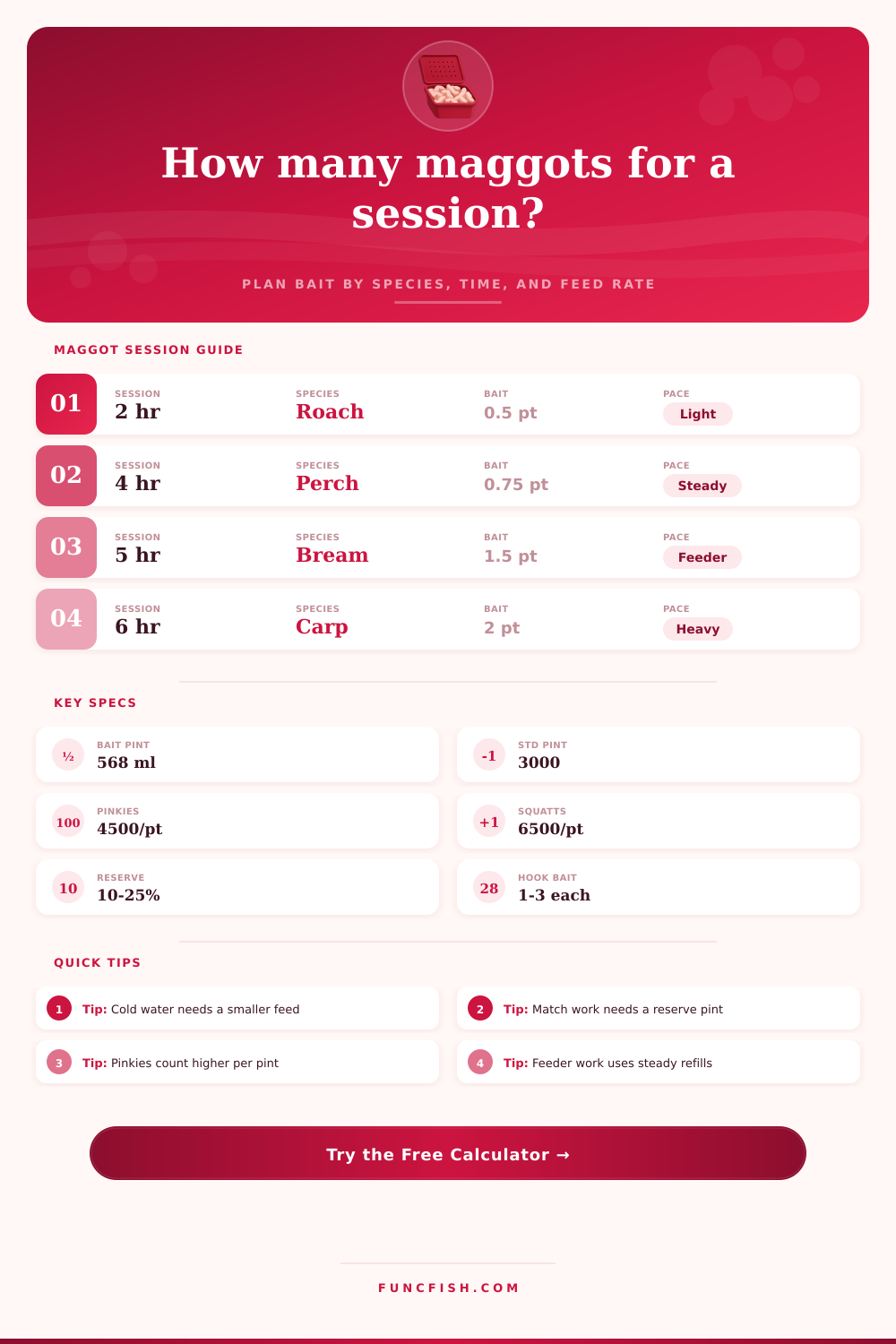
| Standard white maggots | 3000 | 340 g / 12.0 oz | All-round loose feed and hookbait |
| Red or bronze maggots | 2850 to 3000 | 340 to 345 g / 12.0 oz | Color change for roach, perch, tench, and bream |
| Pinkies | 4500 | 260 g / 9.2 oz | Fine winter feeding, canals, and cautious silverfish |
| Squatts | 6500 | 240 g / 8.5 oz | Very fine feed when fish need tiny particles |
| Casters | 2600 | 300 g / 10.6 oz | Selective feed for bigger roach, bream, and chub |
| Dead maggots | 2800 | 350 g / 12.3 oz | Feeder work, carp margins, and less wriggling in groundbait |
🐟Species Session Reference
| Target | Typical bait rhythm | Session appetite factor | Useful bait grades |
|---|---|---|---|
| Roach and rudd | Little and often, 15 to 40 maggots | 0.90 | Standard, pinkies, squatts, casters |
| Perch | Light feed, keep hookbait fresh | 0.80 | Red maggots, bronze maggots, lobworm mix |
| Bream and skimmers | Feeder refills or measured balls | 1.15 | Dead maggots, casters, mixed maggots |
| Tench | Small starter then steady top-ups | 1.25 | Red maggots, casters, dead maggots |
| Chub and dace | Constant trickle in flow | 1.00 | Bronze maggots, casters, pinkies |
| Carp and F1s | Heavier margins or feeder work | 1.30 to 1.45 | Dead maggots, mixed maggots, red maggots |
🌡Condition Adjustment Table
| Condition | Feed adjustment | Why it matters | Calculator use |
|---|---|---|---|
| Cold water below 43 F / 6 C | 0.55 | Fish digest slowly and overfeeding is easy | Use pinkies or small hookbait changes |
| Cool water 43 to 50 F / 6 to 10 C | 0.75 | Bites can be steady but cautious | Keep feed count small and regular |
| Mild water 50 to 64 F / 10 to 18 C | 1.00 | Normal coarse fishing baseline | Good for standard session planning |
| Warm water 64 to 75 F / 18 to 24 C | 1.20 | Fish often compete harder | Add reserve for faster feeding spells |
| Hot or low oxygen | 0.85 | Fish may feed in shorter windows | Pack reserve but start lightly |
| Flow, tow, or nuisance fish | 1.25 to 1.35 | Bait is lost faster or intercepted | Increase regular feed, not hookbait count |
🧰Gear And Species Comparison Grid
Canal Pole
0.25 to 1 ptSize 18 to 22 hooks, fine lines, pinkies or squatts, and tiny pot feeds for roach, perch, and gudgeon.
Waggler Silverfish
0.75 to 1.5 ptSize 16 to 20 hooks, catapult feeding, and 15 to 40 maggots every cast or every few minutes.
Cage Feeder Bream
1 to 2 ptSize 14 to 18 hooks, dead maggots in groundbait, plus live hookbait changes during bite windows.
Carp Margin
1.5 to 3 ptSize 10 to 16 hooks, dead or mixed maggots, heavier starter feed, and a larger reserve allowance.
📏Measure And Container Reference
| Measure | Volume | Standard maggot count | Typical use |
|---|---|---|---|
| Quarter bait pint | 142 ml / 4.8 fl oz | About 750 | Short winter session or hookbait top-up |
| Half bait pint | 284 ml / 9.6 fl oz | About 1500 | Light canal, perch, or cold-water roach trip |
| One bait pint | 568 ml / 19.2 fl oz | About 3000 | General float session or short feeder session |
| Two bait pints | 1.14 L / 38.4 fl oz | About 6000 | Long match, bream feeder, or commercial water |
| Three bait pints | 1.70 L / 57.6 fl oz | About 9000 | Heavy margin feed, multiple lines, or long session |
💡Practical Quantity Tips
Feed rhythm check: If the calculator asks for much more bait than expected, first check the interval and feed-per-drop values. A change from every 10 minutes to every 4 minutes more than doubles the regular feed total.
Bait grade check: Pinkies and squatts give many more individual baits per pint than standard maggots, so they can look like a huge count while still being a modest physical volume.
Counts are practical planning estimates. Real bait density varies with maggot size, sawdust, riddling, temperature, and how tightly the bait is measured.
If you find yourself in the middle of a tournament (or fishing day) when you realize you only have a few hours left and you’re out of bait, you’ll freak out. That often happens when you are on a hot bite on some bank or something similar and time is precious. You didn’t purchase too many maggots. That wasn’t the issue.
The issue is that you confused volume with count. In the world of live bait, they aren’t synonymous at all. Sure, a pint of regular white maggots might be 3,000 maggots strong but a pint of squatts can be upwards of 6,000 or even more. Then you either end up drowning your swim in food or starving it for lack of a better term.
Why You Should Use the Bait Calculator
That’s why the calculator above work. By allowing you to set details for your session, it translates those into real bait needs instead of loose estimate. Knowing what size grade you use helps determine how many baits you has to play with. Anglers frequently overlook this, as standard maggots is quite different than pinkies or squatts. Standard maggots are much larger, giving you a lot fewer baits per pint.
When you’re fishing gently in colder water, this makes all the difference in the world. Because fish digest things slower in winter, they also get picky faster; you want really minimal free offerings to maintain their attention while ensuring they don’t fill themselves. Your next bait doesn’t need to be too small a change either which is why the tool takes these factors into account when making its recommendations. Feeding carp during hot summer days will result in a heavier-handed suggestion compared to a light approach if you’re catching shy roach in clear water.
Perhaps the most overlooked variable when it comes to planning sessions is the feed. Lots of guys look at hookbait as being the only thing that matters and if they can change the bait every cast then they’re good to go. Big mistake! A little feed will keep fish in the swim until you locate them. It’ll also hold their attention between bites. On a waggler set-up or even a pole, for example, you may wish to drop a small handful of maggots every few minutes. These small amounts soon start to mount up over course of a five hour session.
Enter the calculator. Simply enter how many maggots you want to put out each feed and an interval in minutes. This will reveal the real cost of your approach. You might well discover that regular but light feeding uses far more overall bait than intermittent heavy shots, it adds up gradually over time.
Complicating the scenario are water conditions. High amounts of nuisance fish such as skimmers will rob your bait from the intended target fish, as will flowing water. If you can’t fish light, the smaller fish will win. You will need to feed them fast enough to get some bait down below the surface layer. Recognizing that the same thing doesn’t work when fishing a river with current versus a still day, the tool add variables for pressure, flow, and color of water. It also allows for a reserve percentage factor to accommodate unexpected delays, spillage and waste.
As a general guideline: Always bring a little more than you think you might need…but having an exact idea of ‘how much’ more keeps you from either over-packing bulky tubs or underestimating requirements for a lengthy commercial session. So how much do you plan for? That’s ultimately a balance between efficient use of baits vs. Confidence. How many baits will be eaten before they are full up but not so stuffed they won’t even take the hook? Do you need to feed them enough to keep them in the swim?
The calculator links to some reference tables shown below. These provide a quick check for different methods and species, from heavy bream feeder sessions to roach work on canals. These tell you what sort of bait grades makes sense and roughly what appetite factors to expect for any given situation. Combine those general rules with the specifics of the session you’re going on and suddenly the guesswork has gone out of your preparations.
You know exactly what baits you’ve got in the bag, and you know why you have them. When the tub gets down, you’re not panicking because you should of knew you had the reserve. You simply keep fishing and trust that you prepared for whatever the day might throw at you.