Styl Weight Pattern Calculator
Balance a pole or float rig by converting float capacity into target ballast, selected styl count, lower dropper layout, bulk position, and estimated fall time.
📌Styl pattern presets
⚙Rig inputs
Calculated styl weight pattern
Full calculation breakdown
🛠Styl and shot data grid
No 8 Styl
No 9 Styl
No 10 Styl
No 11 Styl
🎣Gear and species comparison
Roach / Perch
0.2-0.6gFine 0.08-0.12 mm lines, No 8 to No 10 styls, and 4-8 lower droppers suit tiny baits and shy bites.
Skimmers
0.4-1.0gBulk plus two or three styl droppers keeps bait controlled while still showing positive sail-away bites.
Crucian / F1
0.3-0.8gBalanced shirt-button or low bulk patterns help read lift bites without overloading a slim antenna.
Tench / Bream
0.8-2.5gUse a main bulk or olivette for most ballast, then finish trim with heavier styl droppers near the hook.
📊Continental styl and micro-shot weights
| Size | Nominal weight | Ounce equivalent | Typical use |
|---|---|---|---|
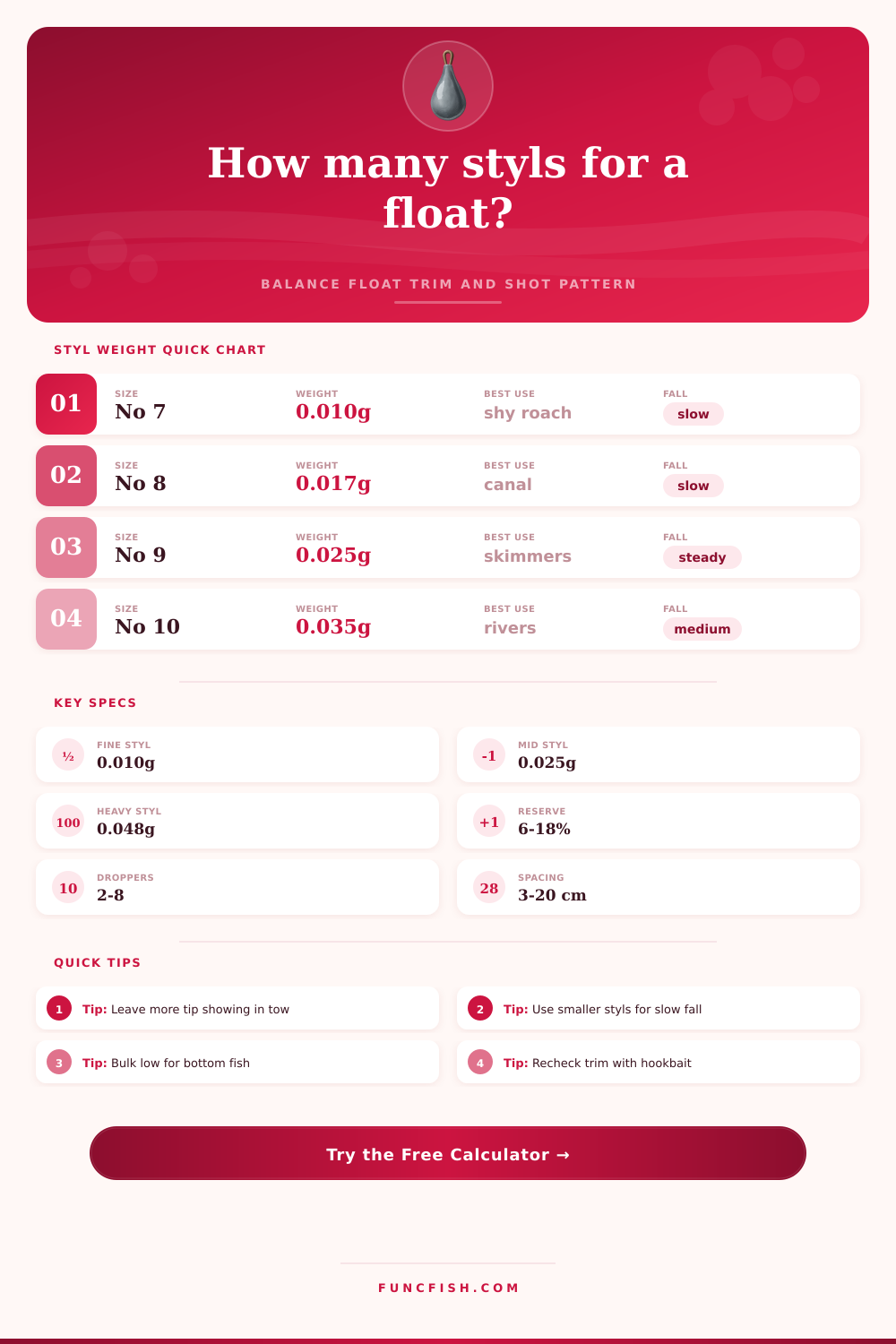
| No 7 styl | 0.010 g | 0.00035 oz | Ultra-fine trimming, tiny canal floats |
| No 8 styl | 0.017 g | 0.00060 oz | Fine droppers and shy roach rigs |
| No 9 styl | 0.025 g | 0.00088 oz | Balanced strung-out pole patterns |
| No 10 styl | 0.035 g | 0.00123 oz | General canal, lake, and light river droppers |
| No 11 styl | 0.048 g | 0.00169 oz | Positive rigs, tow, and deeper water |
| No 12 round shot | 0.020 g | 0.00071 oz | Round-shot alternative for fine trimming |
| No 11 round shot | 0.030 g | 0.00106 oz | Small droppers when styls are unavailable |
| No 10 round shot | 0.040 g | 0.00141 oz | Compact droppers below a small bulk |
📐Pattern selection table
| Pattern | Styl share | Lower droppers | Best fishing signal |
|---|---|---|---|
| Bulk plus droppers | 25-40% | 2-4 | Fast settle with a readable final fall |
| Strung-out styls | 80-95% | 6-12 | Slow fall through the feeding layer |
| Shirt-button | 65-85% | 5-9 | Even fall and clean lift indications |
| Tapered pattern | 55-75% | 4-7 | Natural drop, closer spacing near the hook |
| Olivette plus styls | 12-25% | 2-3 | Deep water speed with fine trim below |
| Positive low bulk | 18-32% | 1-3 | Bottom-hugging bait and stronger bites |
🐟Species and venue reference
| Target | Float range | Line diameter | Useful styl pattern |
|---|---|---|---|
| Canal roach | 0.2-0.5 g | 0.08-0.11 mm | No 8-No 10 strung-out or tapered |
| Winter perch | 0.3-0.7 g | 0.10-0.13 mm | Bulk plus two tiny droppers |
| Lake skimmers | 0.4-1.0 g | 0.11-0.14 mm | Shirt-button or bulk plus droppers |
| River dace | 0.4-1.5 g | 0.10-0.14 mm | Tapered No 9-No 11 styl line |
| Crucian / F1 | 0.3-0.8 g | 0.12-0.16 mm | Balanced shirt-button for lift bites |
| Tench and bream | 0.8-2.5 g | 0.14-0.20 mm | Main bulk with heavier styl trim |
📏Float trim and spacing reference
| Condition | Antenna reserve | Dropper spacing | Bulk position guide |
|---|---|---|---|
| Dead calm, shy bites | 6-10% | 3-7 cm | 18-30 cm above hook |
| Light tow | 9-14% | 5-10 cm | 25-45 cm above hook |
| Steady flow | 12-18% | 7-14 cm | 35-70 cm above hook |
| Deep water | 10-16% | 8-18 cm | Lower third of the rig |
| Lift-bite margin | 12-22% | 4-9 cm | Low bulk near bottom |
| Positive pellet fishing | 14-24% | 6-12 cm | Compact and controlled |
💡Pattern tips
Trim advice: The calculator subtracts hookbait weight before choosing styls. Recheck the float in water after changing bait size, because a double maggot or pellet can shift the last few hundredths of a gram.
Pattern advice: If the result calls for too many styls, move part of the ballast into a small bulk or olivette and keep the calculated droppers below it for bite registration.
The rig is too light for the fish to take the bait, even though float balances. Know your styl weights, Fill your keepnet with those shy roach and cautious skimmers. Matching the ballast to the bite style are about getting the trim right.
Most anglers choose their float according to wind conditions and depth. There is nothing wrong with that approach, but this is where real work begins below the surface. How will weight distribute itself along the main line?
How to Balance Your Fishing Rig
If it’s all in one heavy shot close to hook then there’s a fast sink rate which scare those bottom feeders. If you spread out the same total weight over dozens of tiny continental styls then it slows everything down, creating a natural fall which mimic dead insects drifting through water column.
After entering your intended shot spacing and float capacity, it does the math for you; no more guesswork about how many No 10 shots will perfectly balance your rig. We are visual creatures who connect to real numbers better than vague grams. It converts them for you so you know exactly what you’ll see when you add first weight to your lure.
How do you choose your pattern? Well, this partly depend on what the fish are doing. For example, if they’re wary roach on a canal that nip gently at maggots, then a strung-out pattern with No 8 or No 9 styls will keep terminal tackle light and reduce line tension as a fish lift the bait.
Other venues may require larger sizes. The table on the page make it clear which size suits which venue. Weighing practically nothing, a No 7 style is ideal for ultralight rigs fished in winter when even a gram seem like an anchor.
Conversely, fishing bream or tench deep often requires a weight of lead further up the line to get the bait down fast; then maybe one or two heavier droppers nearer the hook to control its final descent. That’s when water flow enters the picture. In a river with steady current, the water drags the float to one side. This forces the rig into an angle where the bottom causes more resistance.
This pins the bait down hard and buries it in silt which makes it look unnatural or even hides it completeley. More trim on hand allows you to overcome that drag, as the float now holds its own and doesn’t get pulled along, dragging the hookbait into dirt.
The tool factors in line diameter and tow speed, and adding the drag coefficients of those items you might easily overlook. Thick lines cause more underwater friction than thin lines. So a main 0.14 mm mainline needs a little more ballast than a fine 0.09 mm thread to keep same trim profile.
Another thing to consider is material. You can fit more weight into your vest with traditional lead shot due to its density and compaction. Heavier materials like tin or green options will take up more space and therefore add additional drag as your rig descend. That said, they may also be heavier per unit, which could of make this a difficult balance to strike.
Some anglers find that their rigs will sink slower despite having the exact same gram count. This is not a huge deal but it helps explain how the calculator allow you to switch from standard tub weights to heavier materials while staying accurate on estimated fall time.
Another snag that trips up anglers is hookbait weight. Adding a tiny maggot hardly makes a difference but a heavyweight worm or pellet will swing it by several gram. First, calculate your trim with nothing on the hook then attach a large hookbait. Overloading the reserves on a float will sink the antenna down too far where its less visible and alters the bite indication from a subtle dip to complete submergence. Always test your trim in the water with the bait intended to be fished.
The trick with styl weight patterns is not to be married to any specific set up but rather read what the fish will tell you. Use finesse when they want shy bites and go fast when they’re feeding goodly. The weight placement determine how the bait appears to the fish and you can adjust accordingly. It’s all about presenting something natural enough that the fish won’t think twice about taking it.
This works whether it’s perch on a pond or dace on a running river. Get it trimmed out so it falls correctly and when the bites come on they stay on.