Spade End Whipping Turns Calculator
Estimate the number of whipping turns for tying hooklength to a spade-end hook using line diameter, spade width, shank length, material stiffness, finish grip, and expected pull.
📌Real Rig Presets
⚙Hook, Line, and Whipping Inputs
Whipping Turn Result
Full Calculation Breakdown
🛠Material and Hook Grip Factors
Supple Mono
Pre-stretched Mono
Fluorocarbon
Fine Braid
📏Hook Size and Whipping Reference
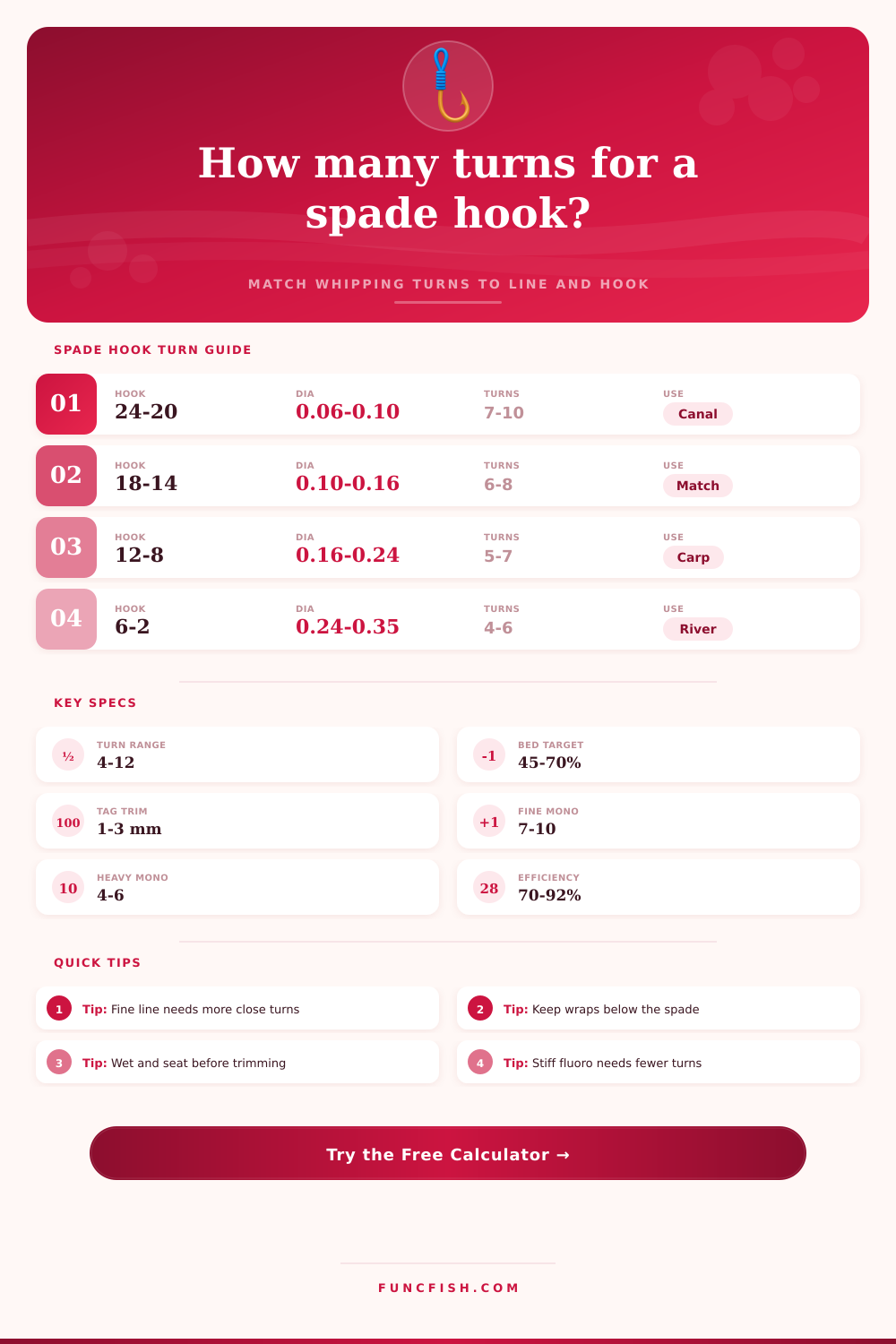
| Spade hook size | Typical shank below spade | Common hooklength diameter | Starting turn range |
|---|---|---|---|
| 24 to 22 micro spade | 3.0-4.2 mm / 0.12-0.17 in | 0.06-0.09 mm / .002-.004 in | 8-11 close turns |
| 20 to 18 fine match | 4.2-5.6 mm / 0.17-0.22 in | 0.08-0.12 mm / .003-.005 in | 7-10 turns |
| 16 to 14 pellet and caster | 5.6-7.4 mm / 0.22-0.29 in | 0.12-0.18 mm / .005-.007 in | 6-8 turns |
| 12 to 10 feeder and chub | 7.4-9.6 mm / 0.29-0.38 in | 0.16-0.22 mm / .006-.009 in | 5-7 turns |
| 8 to 6 strong spade | 9.6-12.8 mm / 0.38-0.50 in | 0.20-0.30 mm / .008-.012 in | 4-6 turns |
| 4 heavy spade | 12.8-15.5 mm / 0.50-0.61 in | 0.28-0.38 mm / .011-.015 in | 4-5 turns |
🧵Line Material Turn Adjustment Table
| Hooklength material | Grip behavior on shank | Turn adjustment | Tag allowance |
|---|---|---|---|
| Supple nylon mono | Bites well after wet seating | Base turns | 1.5-2.5 mm / .06-.10 in |
| Pre-stretched match mono | Slicker, less stretch cushion | Add 1 turn | 2.0-3.0 mm / .08-.12 in |
| Hard mono | Holds shape but can spring open | Add 0-1 turn | 2.5-3.5 mm / .10-.14 in |
| Soft fluorocarbon | Good abrasion resistance, firm seat | Base or minus 1 | 2.0-3.0 mm / .08-.12 in |
| Stiff fluorocarbon | Coils wide, dislikes crowding | Minus 1 turn | 3.0-4.0 mm / .12-.16 in |
| Fine braid hooklink | Very flexible and slip-prone | Add 2 turns | 3.0-5.0 mm / .12-.20 in |
🎣Species and Rig Pressure Reference
| Use case | Typical hook size | Peak pull estimate | Whipping priority |
|---|---|---|---|
| Canal roach, bleak, dace | 24-18 | 0.1-0.6 kg / 0.2-1.3 lb | Tiny bed, very neat close turns |
| Skimmers and winter bream | 20-16 | 0.3-1.0 kg / 0.7-2.2 lb | Fine diameter balance |
| F1s and small commercial carp | 18-14 | 0.8-2.0 kg / 1.8-4.4 lb | Elastic shock and spade shoulder |
| Method carp and margin fish | 14-8 | 1.5-4.0 kg / 3.3-8.8 lb | Power margin and abrasion |
| River chub and barbel | 12-6 | 2.0-5.5 kg / 4.4-12.1 lb | Strong wire and firm seating |
| Light sea flats or estuary | 8-4 | 1.5-5.0 kg / 3.3-11.0 lb | Salt grit and hook finish grip |
⚖Whipping Method Comparison
Outside-In Hand Whip
All-roundBest for normal spade hooks where the line exits neatly down the inside of the shank.
Inside-Out Match Whip
NeatestGood for small hooks and fine mono when presentation matters more than fast tying.
Hook Tyer Compact Whip
RepeatableProduces consistent pitch, but compact turns can crowd tiny shanks if overdone.
Locked Finish Whip
SecureUseful for smooth coatings, braid, or power rigs where one extra lock turn improves confidence.
💡Practical Whipping Notes
Turn spacing: A strong spade-end whipping should form a short, even bed behind the spade, with the hooklength exiting straight along the inside of the shank.
Result check: If the calculated bed covers more than about 70% of the usable shank, reduce turns only if the material is stiff and the spade shoulder is wide enough.
This calculator estimates practical rig-building targets from common match, coarse, fly, and light sea spade-hook proportions. Always test the tied hooklength before fishing.
The knot is bit and you’ve salivated it into place perfectly. It’s seated nice and snug and now you’ve got it tied to a flawless hooklength. The tag was removed with great care, and everything on the bench are lovely.
You hook a good fish, feel something pull against the drag and then you feel it, the weight of it resisting. You hear it, that unmistakable snap. But it wasn’t your line snapping while flying through the air. No, the whipping had slid off the spade end and you lost your money shot along with it.
How to Tie a Knot That Does Not Slip
So what happened? Most times, it comes down to just one variable… Not enough turns for type of material you’re working with. Now we all treat whipping as a repetitive mechanical exercise, wrapping our line seven or eight times out of habit without regard to the conditions. But friction dynamics change drastically between supple nylon monofilament and stiff fluorocarbon. What works great on smooth bronze may blow right off a chemically sharpened hook where there’s nothing for the line to grab onto except its own tension against wire.
There is no guessing with the friction coefficients; all you do is input your own specific gear information into calculator above and it does the sums for you. It requires some key inputs, such as line diameter (the actual thickness rather than the labeled breaking strain) and the usable shank length beneath the spade. These things is more important than most of us realize. Why? This is because they determines how many wraps will fit on hook shank.
Get too many turns packed onto a short micro-shank suitable for canal roach fishing and your knot bulges outwards, ready-made for snagging on some piece of debris or weed without ever getting near a fish. At the other end of the spectrum, using too few turns spread out along a carp shank result in a sloppy, insecure bed. This will often come undone with any sharp shock load when you’re fishing margins. To balance these requirements, it determines the ideal turn spacing given your chosen pull strength and how much security you want.
The single greatest variable here is material selection. Nylon monofilament has bite. When wet and cinched down, standard mono grabs onto itself like crazy, so much so that you can get away with fewer wraps than with a slicker line. That’s why we add some additional wraps for pre-stretched match mono. It slides more easily because it has less surface area for friction, but it otherwise follows the same formula.
Fluorocarbon brings a set of its own variables to the table: It’s both stiff and has memory, which means it dislikes being coiled into small radii. If there aren’t enough turns applied to exert sufficient radial pressure, stiff fluoros will fight tooth-and-nail to relax and open up again. And then there’s ultra-fine braid, which doesn’t have any natural bite whatsoever and really depends on the snugness of the wrap bed to prevent it from sliding out… Though you should keep in mind that stiff fluorocarbon is what dislikes being coiled too tightly.
The calculator takes all of those odd behaviors into account without you having to rely on guesswork based off experience with another line type. When looking at the results, don’t forget about how shiny that hook is. The really slick black nickel (or PTFE-coated) hooks is meant to help present a bait better, and keep the drag down in the water. But there’s virtually zero for your whipping thread to grab onto.
This is where you may feel like the suggested number of turns is too many different than what you used for traditional, rougher-wire hooks many years ago. Well, it takes a little more work and this time there isn’t any microscopic texture on the hook surface to help hold the knot. It’s just up to you to compress those wraps onto one another and the shoulder of the spade.
Leaving a bunch of tags hanging out past the knot makes us feel better for some reason; I guess it’s more comfortablely psychologically than mechanically, and it causes undue drag in the water column. Fortunately, the calculator gives you an exact place to trim, typically within a range of one to three millimeters. That small stub will be long enough to recieve the last pull needed to tighten the final wrap snugly with the rest. This also ensures you do not waste precious shank space.
Too far back and the scissors might slip, cutting through your binding wraps themselves; too long and you’ll have nothing but trouble with tangles and snags. So all said and done, whipping a spade-end involves neither too little nor too much; just enough to match turn count with how slippery the material is, based on hook finish, line type, and anticipated loading conditions.
If you’re wrestling carp out of the margins or teasing dace along a narrow canal, sometimes it can be as simple as turning that whip an extra time to compensate for slipperiness in materials. Seat it correctly, get the bed length correct. Don’t hope for friction to bail you out at the final moment. Let the geometry handle it.