Distance Sticks Measurement Calculator
Convert a fishing target range into distance-stick wraps, clip line length, leftover stick distance, and measured-vs-target corrections for feeder, carp, surf, and marker work.
🎯Scenario presets
⚙Measurement inputs
Feeder range: distance sticks give repeatable line length, then the cast still needs consistent feathering before the clip.
Distance stick measurement results
Use the suggested wraps as a starting point, then confirm with repeat casts using the same rig and clip tension.
Calculation breakdown
📌Stick setup reference
12 ft sticks
3 m sticks
Loaded braid
Loaded mono
📊Stick spacing comparison
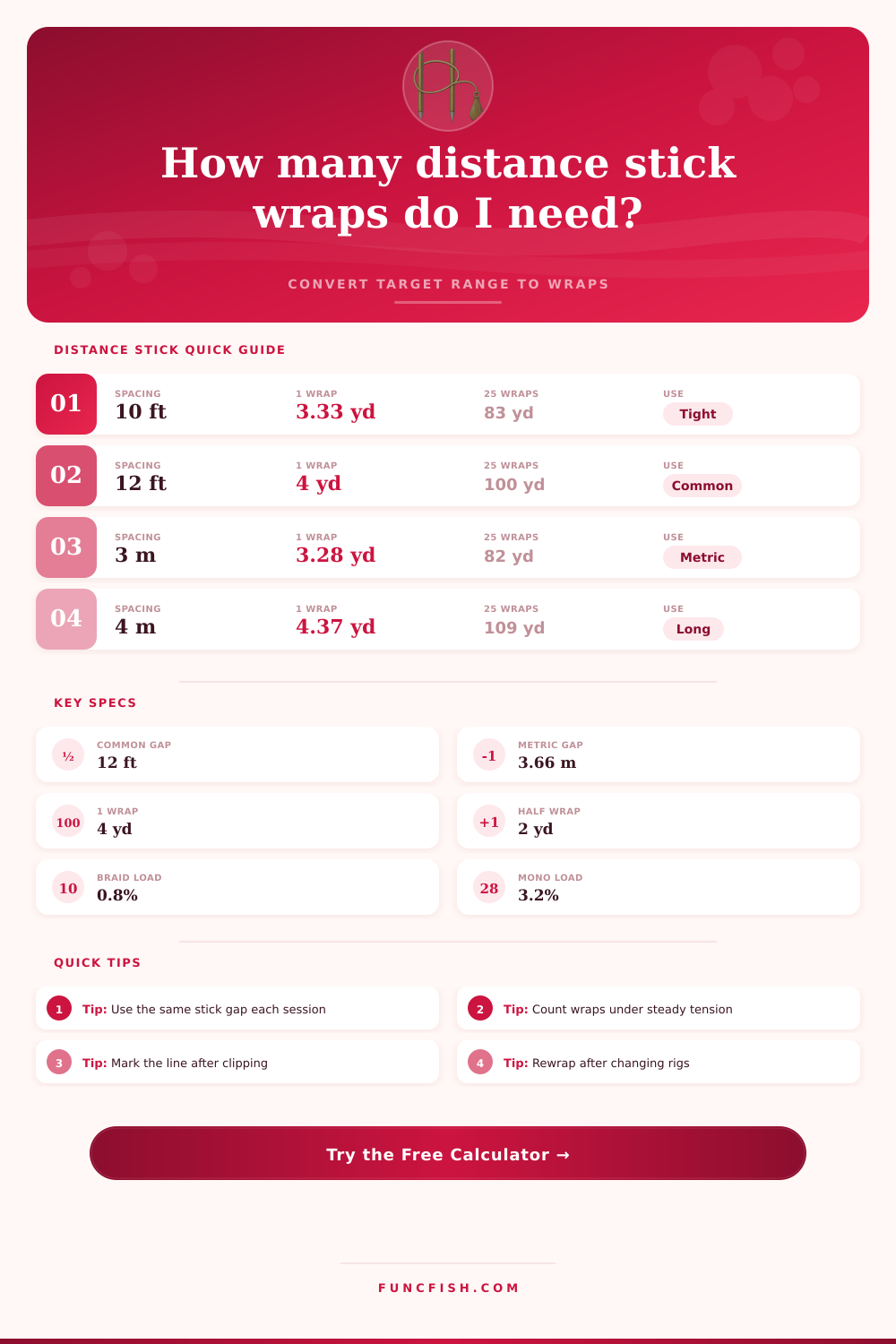
10 ft spacing
3.33 yd/wrapUseful where bank space is tight or short feeder ranges need finer wrap changes without using quarter-wrap marks.
12 ft spacing
4 yd/wrapThe common carp and feeder spacing. It is fast to count, easy to convert, and reaches 100 yd at 25 wraps.
3 m spacing
3 m/wrapBest when swims, range markers, and peg notes are already recorded in metric measurements.
4 m spacing
4 m/wrapLong spacing reduces counting on surf or range carp work, but small corrections are less convenient.
📐Distance stick reference tables
| Stick spacing | Distance per wrap | Half wrap | 25 wraps | Typical use |
|---|---|---|---|---|
| 10 ft / 3.05 m | 3.33 yd / 3.05 m | 1.67 yd / 1.52 m | 83.3 yd / 76.2 m | Tight banks and short accuracy work |
| 12 ft / 3.66 m | 4.00 yd / 3.66 m | 2.00 yd / 1.83 m | 100 yd / 91.4 m | Standard carp, feeder, bomb, and marker work |
| 3 m / 9.84 ft | 3.28 yd / 3.00 m | 1.64 yd / 1.50 m | 82.0 yd / 75.0 m | Metric peg notes and match fishing |
| 4 m / 13.12 ft | 4.37 yd / 4.00 m | 2.19 yd / 2.00 m | 109.4 yd / 100 m | Long-range carp and surf counting |
| 15 ft / 4.57 m | 5.00 yd / 4.57 m | 2.50 yd / 2.29 m | 125 yd / 114.3 m | Fast long-range measuring with wider corrections |
| Line material | Loaded stretch model | Bow model | Distance-stick note | Best use |
|---|---|---|---|---|
| Thin 8-carrier braid | 0.8% at clip load | 0.7% baseline | Very repeatable but a firm clip hit can bounce light rigs | Long feeder, marker, carp braid |
| Standard 4-carrier braid | 1.1% at clip load | 1.0% baseline | Good all-round line for repeatable wrapped distances | Feeder and method work |
| Nylon monofilament | 3.2% at clip load | 1.6% baseline | Measure carefully because hard clip hits add stretch overrun | Commercial carp and float work |
| Fluorocarbon main line | 2.3% at clip load | 1.3% baseline | Dense line settles cleanly but still needs stretch correction | Clear water and short-range rigs |
| Surf braid and leader | 1.4% at clip load | 1.9% baseline | Allow for wash and leader knot tension when clipping up | Surf bait and clipped rigs |
| Scenario | Base allowance | Depth effect | Rounding choice | Practical check |
|---|---|---|---|---|
| Feeder or bomb range | 0.6-1.5 yd | Low to moderate | Quarter wrap | Repeat two casts and watch splash against the feed line |
| Carp lead clip | 1.0-3.0 yd | Moderate | Half wrap | Match rod compression and feathering on every cast |
| River feeder | 2.0-5.0 yd | Moderate to high | Half wrap | Check downstream settle after the feeder finds bottom |
| Float or waggler | 0.2-1.0 yd | Low | Tenth or quarter wrap | Feather early so the float lands straight |
| Marker float | 1.0-4.0 yd | High | Quarter wrap | Give enough line for the lead and float to separate |
| Target range | 12 ft wraps | 3 m wraps | Quarter-wrap value | Typical correction |
|---|---|---|---|---|
| 25 yd / 22.9 m | 6.25 wraps | 7.62 wraps | 1 yd / 0.91 m | 0.25-0.5 wrap |
| 40 yd / 36.6 m | 10.00 wraps | 12.19 wraps | 1 yd / 0.91 m | 0.25-0.75 wrap |
| 60 yd / 54.9 m | 15.00 wraps | 18.29 wraps | 1 yd / 0.91 m | 0.5-1.0 wrap |
| 80 yd / 73.2 m | 20.00 wraps | 24.38 wraps | 1 yd / 0.91 m | 0.5-1.5 wraps |
| 100 yd / 91.4 m | 25.00 wraps | 30.48 wraps | 1 yd / 0.91 m | 1.0-2.0 wraps |
The calculator treats one distance-stick wrap as the selected stick spacing. Keep your local counting habit consistent, especially if you count passes around two sticks differently.
💡Measurement tips
Wrap with steady pressure rather than pulling hard on one lap and loosely on the next. The calculator can correct stretch, but inconsistent measuring tension still changes the clip point.
A note that says 18 wraps only works if the stick gap is also known. Write it as 18 wraps at 12 ft, or 18 wraps at 3 m, so the range survives the next session.
It happens to every angler who’s relied on distance sticks: They make a practice cast, clip their rod up, and then come up short of the mark due to change in bankside. It’s frustrating. The premise is easy enough. If things stay the same, it’ll work. Measure out the line. Count your wraps around the marks. Anticipate that another cast will fall in exact same location. But real life presents variables we can’t ignore with our simple math.
To make things easier, we’ve created a calculator (above) that does the work for you, but knowing what goes into it make you a better angler. The first variable is how far apart you’re sticking them. Twelve feet is typical. Most anglers do it this way simply because its convenient. It breaks down perfectly into yards and each wrap is precisely four yards. That’s simple enough to keep track of in your head during bad weather, but here’s the catch: Your reel isn’t on the water’s edge. Chances are good that there’s several feet of space between you and bank, adding imaginary line length to every single cast. Failure to consider this setback will result in constant overshooting of targets.
Why Your Casts Miss the Mark
Another thing about the bend on the cast is its effect on accuracy. If you lift your tip on the cast your line doesn’t shoot out directly. It instead arcs away from you. The more you lift your tip, the further it bows. This also makes length of line touching the water shorter before your spool kicks in. I know it sounds like physics but it absolutely will result in missed swims. So yeah you think you’re clipping up for fifty yards. But because you are lifting the tip too high over things in the way, you end up landing it closer. And the tool takes all of this into account because it asks how deep you hit your target and how high you keep your tip.
But there’s another wrinkle most fishermen fail to consider regarding line choice, braided lines do not stretch at all under load, meaning you’ll generally get about what you measure. The opposite is true with monofilaments. They will stretch quite a bit when tensioned up on a cast or when the line grabs edge of the spool as it leaves the reel under the force of the clip. So if you’re using heavy nylon, then your reel-to-water separation change constantly as soon as the rod loads. And because you didn’t consider the stretch, your measured number was always going to be too short by the time the bait splashes down.
There’s also an aspect to casting accuracy that involves wind direction. If there’s a crosswind, the line gets blown off course; if it’s a tailwind, it will go farther. And here’s where experience trumps raw data, you can enter a personal buffer into the calculator based off your own casting experience. For example, perhaps you know your float settles and your feeder spins in current, adding half a yard buffer to account for a gentle landing on the feature instead of a slap-down on hard bottom.
There’s really only one key to a consistent range: repeat this exact same process in the same conditions. Pulling as hard on one wrap as compared to letting another go loose will introduce error that even the best software can’t compensate for. Use the same tension to wrap your line around your sticks. Clip it up clearly and mark the line clearly so that you don’t have to guess where your knot fell. The distance stick is just a starting point, not the cast itself, so it’s only as helpful as whatever routine you have backing it up.
You still need to know how your gear performs in water and feel the rhythm of your own cast. That part is on you; the tool just eliminates the guess work when it comes time to measure. Whether you’re using mono or braided line doesn’t matter if you can hold a consistent technique and get the measuring part correct.
Sooner or later, one of those fish are going to bite. You should of practiced more before heading out. It could of been better.