Butterfly Jig Weight by Depth Calculator
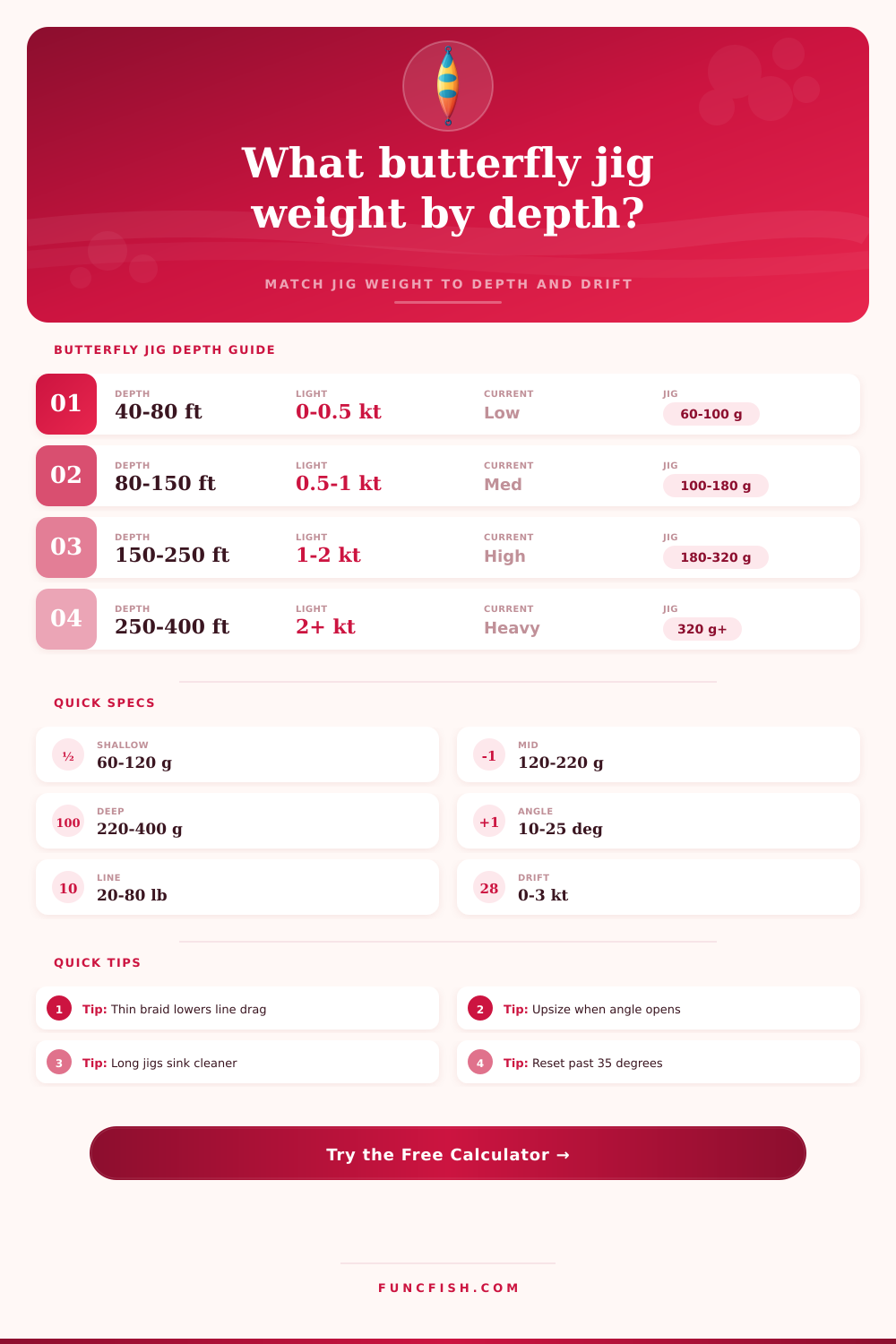
Estimate the jig weight needed to keep a butterfly jig working near vertical by combining depth, drift or current, braid diameter, jig profile, and target line angle.
| Depth band | Calm drift | Moderate drift | Strong drift | Notes |
|---|---|---|---|---|
| 30-60 ft / 9-18 m | 40-80 g | 80-120 g | 120-160 g | Compact profiles keep action lively. |
| 60-120 ft / 18-37 m | 80-130 g | 130-180 g | 180-240 g | Watch line angle after the first drop. |
| 120-220 ft / 37-67 m | 150-220 g | 220-300 g | 300-420 g | Thin braid gives the biggest gain. |
| 220-400 ft / 67-122 m | 260-360 g | 360-500 g | 500 g+ | Boat control matters as much as weight. |
| Line class | Typical braid dia. | Best depth range | Drag effect | Use case |
|---|---|---|---|---|
| 20-30 lb | 0.008-0.011 in / 0.20-0.28 mm | 40-180 ft | Low | Light reef, snapper, inshore marks. |
| 40-50 lb | 0.012-0.015 in / 0.30-0.38 mm | 80-300 ft | Medium | General butterfly jigging and tuna drift. |
| 65-80 lb | 0.016-0.020 in / 0.41-0.51 mm | 120-400 ft | High | Amberjack, grouper, rough structure. |
| 100 lb+ | 0.022 in+ / 0.56 mm+ | Heavy tackle | Very high | Needs heavier jigs or tighter boat control. |
| Target | Common depth | Line class | Jig profile | Angle goal |
|---|---|---|---|---|
| Snapper and rockfish | 60-220 ft | 30-50 lb | Center or slow | 15-25 deg |
| Yellowtail and amberjack | 80-300 ft | 50-80 lb | Long or speed | 10-20 deg |
| Tuna marks | 100-350 ft | 50-80 lb | Long or compact | 10-20 deg |
| Grouper ledges | 120-400 ft | 65-100 lb | Compact heavy | 10-18 deg |
This calculator is an estimating tool for lure presentation. Use rod ratings, line ratings, local conditions, and fish size when choosing final tackle.
What happens when a hard current grabs your lure and drags it off to one side before dropping it vertically down? Your line is now out of the correct angle from vertical and the jig doesn’t flutter and come alive; it just slithers off like a sled. Physics is key here, not guesswork.
How do you know how much weight for how deep in what kind of water flow? It all comes together with depth, weight and drag. Once you input your parameters into the calculator above, it will do the math for you and help you avoid trial and error as the fish get moving.
How to Choose the Right Jig Weight
Butterfly jigging fails because we get so fixated on achieving depth that we forget about maximizing action once it gets down there. You want enough weight for penetration; how much depends on depth. But whether that weight stays vertical depends on line drag and current. If you have a big jig and you are fishing slowly or using thick line, then you will see your lure pulled out sideways until the angle is more wider than any meaningful action. Beyond thirty degrees it’s not a live kick anymore, it’s a slow slide that predator fish won’t touch.
This is where line size become a major factor in this equation. If you’re fishing deep structure, braided line are going to offer excellent sensitivity with virtually no stretch, but it’s going to create a lot of hydrodynamic drag. That drag isn’t much of an issue at fifty-feet of water, but at two-hundred-feet of water, the cumulative force of your line will effectively double how hard you have to pull on the lure just to maintain its vertical position. This is why many seasoned anglers downsize their braid in deeper water while using a heavier leader for abrasion resistance. The smaller diameter reduces surface area against the water allowing the jig to sink cleaner and react quicker to your rod lift.
Lead content is only half the equation. In addition to weight, the shape also factors into performance. By nature, a wide flutter jig produces crazy amounts of drag on the pull, making for a nice-hanging fall in calm waters. But when the wind kicks up or the tide rolls out, that can be a big problem. Those wider bodies needs way more weight to hold their heads compared to narrow body like a compact tungsten knife jig of equal length. And a narrow jig will cut through water while a bigger one with a wider body will fight against it, so if you’re struggling with a heavy current, sometimes a heavier jig will get beat by a more narrow profile. You’ve got to learn how to read that action/control trade-off on the go.
All of this comes back to how you’re sitting in the boat. How light your line and lure is depends on how still the vertical column is below you. The more stationary you are relative to your target (i.e., spot-locked right over top) the less weight you need. However, when fishing in wind across the tide, you’re constantly changing your line angle as you drift along. Adding a little weight here provides a buffer from going off course sideways. Even if you get an unexpected burst of current while drifting, the jig will still have just the right amount of pull downward to keep it within the strike zone and not ride high out of the fishs view.
There is no one magic number for choosing the correct setup. There never really is. But there is a window where within the confines of your own limitations, you’ll find the combination that fits you best. You begin at suggested weight for the current and depth. Then you feel it out while reeling and make adjustments from there. Too slow? Too light? Go bigger and narrower. Too fast? Too heavy? Go smaller, or maybe try a wider profile. It’s all about that nice clean vertical look and getting those fish to react on instinct. Once you get it dialed in, you start catching ’em again.
The technical conversation turns to drag, angles, and reeling them in.