Bottom Fishing Dropper Count Calculator
Estimate how many dropper branches or hooks will fit on a bottom rig after top clearance, sinker clearance, bait swing, branch length, current, and leader stiffness are accounted for.
📌Scenario presets
⚙Rig count inputs
Dropper count results
Calculation breakdown
🧵Leader behavior grid
Soft mono
Fluorocarbon
Braid branch
Boom clip
📊Bottom rig count reference
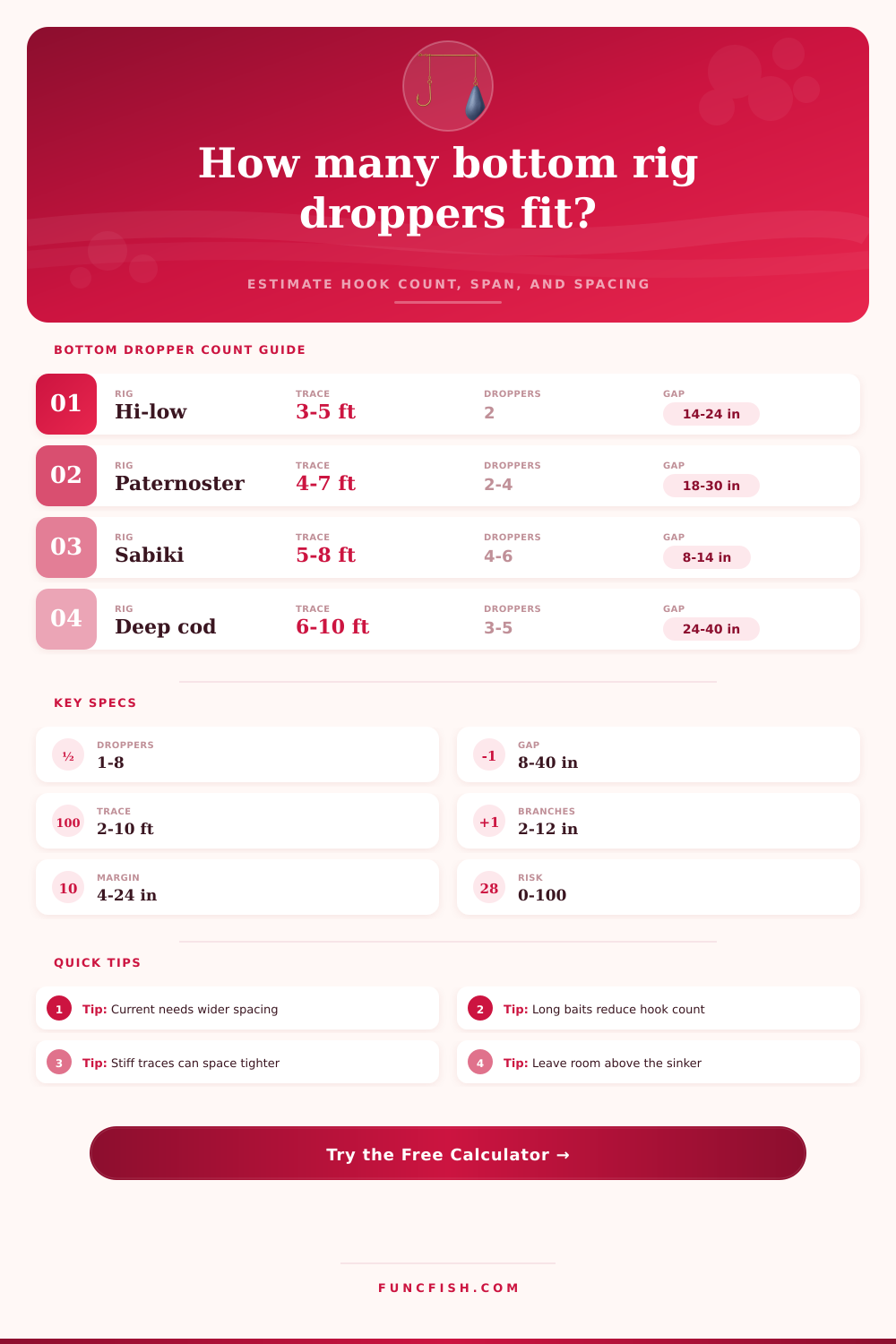
| Rig style | Typical dropper count | Common trace length | Working spacing | Best use |
|---|---|---|---|---|
| Hi-low surf rig | 2 droppers | 3 to 5 ft / 0.9 to 1.5 m | 14 to 24 in / 36 to 61 cm | Pompano, whiting, surfperch |
| Boat paternoster | 2 to 4 droppers | 4 to 7 ft / 1.2 to 2.1 m | 18 to 30 in / 46 to 76 cm | Sea bass, porgy, reef fish |
| Sabiki bait rig | 4 to 6 droppers | 5 to 8 ft / 1.5 to 2.4 m | 8 to 14 in / 20 to 36 cm | Herring, mackerel, baitfish |
| Deep drop rig | 3 to 5 droppers | 6 to 10 ft / 1.8 to 3.0 m | 24 to 40 in / 61 to 102 cm | Cod, haddock, tilefish style rigs |
| Catfish Santee rig | 1 to 2 droppers | 2.5 to 5 ft / 0.8 to 1.5 m | 18 to 36 in / 46 to 91 cm | Cut bait, float-lifted bait |
🐟Species and bait spacing table
| Species group | Common bait size | Branch length | Spacing cue | Count note |
|---|---|---|---|---|
| Baitfish and mackerel | Small flies, 0.5 to 1.5 in | 1.5 to 3 in | Close gaps work when hooks are tiny | Often 4 to 6 |
| Pompano and whiting | Small shrimp, sand flea, beads | 3 to 5 in | Leave room for surf lift | Usually 2 |
| Flounder and flatfish | Strip bait or minnow | 5 to 10 in | Long bait swing needs fewer droppers | Often 1 to 2 |
| Sea bass and porgy | Squid strip, clam, small cut bait | 4 to 7 in | Moderate branch and moderate gap | Usually 2 to 4 |
| Catfish and carp | Cut bait, boilie, dough, pellet | 6 to 12 in | Big baits need large separation | Usually 1 to 2 |
🧭Adjustment factors
| Condition | Spacing factor | Why it matters | Practical effect |
|---|---|---|---|
| Calm vertical drop | 0.90 to 1.00 | Droppers hang near the main trace | Higher count can fit cleanly |
| Moderate current | 1.18 | Branches sweep downstream | Add gap or reduce one dropper |
| Surf surge | 1.30 | Wave lift moves hooks and sinker | Most rigs stay at two droppers |
| Hard cast | 1.16 | Baits compress and spin in flight | Extra spacing lowers wrap risk |
| Stiff branch material | 0.88 to 0.95 | Stand-off resists folding back | Spacing can be slightly tighter |
💡Practical calculator notes
Count tip: Treat the lowest branch and sinker as a moving pair. If the bait can touch the sinker during a swing, the rig is crowded even when the hook gaps look even.
Spacing tip: A shorter branch usually improves count more than a longer trace. Trim branch length before adding a third or fourth dropper to a bottom rig.
You pull out that rig for bottom fishing and find yourself frustrated by a tangled mess before getting on the water. You carefully space the droppers by feel; you carefully tie the droppers… until something hits the bottom or you land a fish and it becomes a big knot. Bad knots arent typically the issue. It’s typically bad math. Most folks simply guess how long their lines will be, they don’t consider the physics of sinker clearance, branch stiffness, and swing radius. That’s where this tool can come in handy.
It eliminates guesswork. It forces you to consider each and every inch of available leader before tying that loop. So how does it work? The calculator figure out the geometry; you provide input on what’s important. Let’s begin with trace length. Five feet sounds like a lot, right? But then there is the top swivel connection (six inches), and then there’s distance between the bottom of the sinker and the trace where the lowest hook runs (another 18 or so). That leave you perhaps three feet for branch containing baits. Cram four dropper line in there with no adjustment for line stiffness, and guess what? Tangles.
How to Stop Tangled Fishing Lines
The tool first subtracts clearance areas, then divides resulting available space by the smallest gap needed for your circumstances. More rigs gets ruined by water movement than bad knots. Tight spacing’s fine when there’s no current. But in current, the branches flap like flags downstream. They can’t be close together or they just hang limp. The rig calculator incorporates water condition into equation, adding buffer space as flow increases.
Material type’s taken into account too. Monofilament flops in the current, but fluorocarbon is stiffer and stay away from the bottom. That stand-off lets you get away with a little tighter spacing without losing presentation. Soft braid has strands that easily wrap around one another; give them lots of separation.
So how about the actual bait? Multiple small sabiki hook next to each other hardly disturb the water. But a big catfish hook towing a cut off bait behind it leaves quite an arc. And if you don’t factor in the length of that swing, you’re going to run into the line or next hook down with the bait on your dropper. This is where entering the length of the bait or lure into the calculator matter. It is a tiny bit of information but it makes all the difference as to whether your rig is balanced or a mess.
Here is how they all relate. Look at the reference table above. Surf surge pompanos uses wide spacing, while deeper cod rigs use heavy lines that space them apart. Don’t think of this suggested number of droppers as an absolute limit. Think of it as a starting point for balance.
You may need four but the tool says three; how can you save some inches? How much can you shorten the branches? How stiff a leader can you use to get that extra inch of stand-off? Are you dropping straight down vs. Casting into the wind, because reducing your safety margin is an option if you aren’t fighting the wind? dropping straight down, because less stand-off means less margin for error?
This isn’t all about cramming more hooks onto a hookset. It’s also about having them organized enough to come off the bottom presenting naturaly when they do. A tangle job looks like you threw something together in a hurry. You should of kept them clean on the dock, and let the fish take care of the rest.