Pennell Rig Hook Spacing Calculator
Calculate the distance between Pennell hooks from bait length, top hook set point, tail hook bite, hook gape, bait thickness, snood stiffness, casting force, tide pressure, and rig style.
📌Pennell Rig Presets
⚙Hook Spacing Inputs
Calculation Breakdown
📊Pennell Bait Reference
📐Hook Spacing Tables
| Bait profile | Typical bait length | Common spacing | Top hook note | Tail hook note |
|---|---|---|---|---|
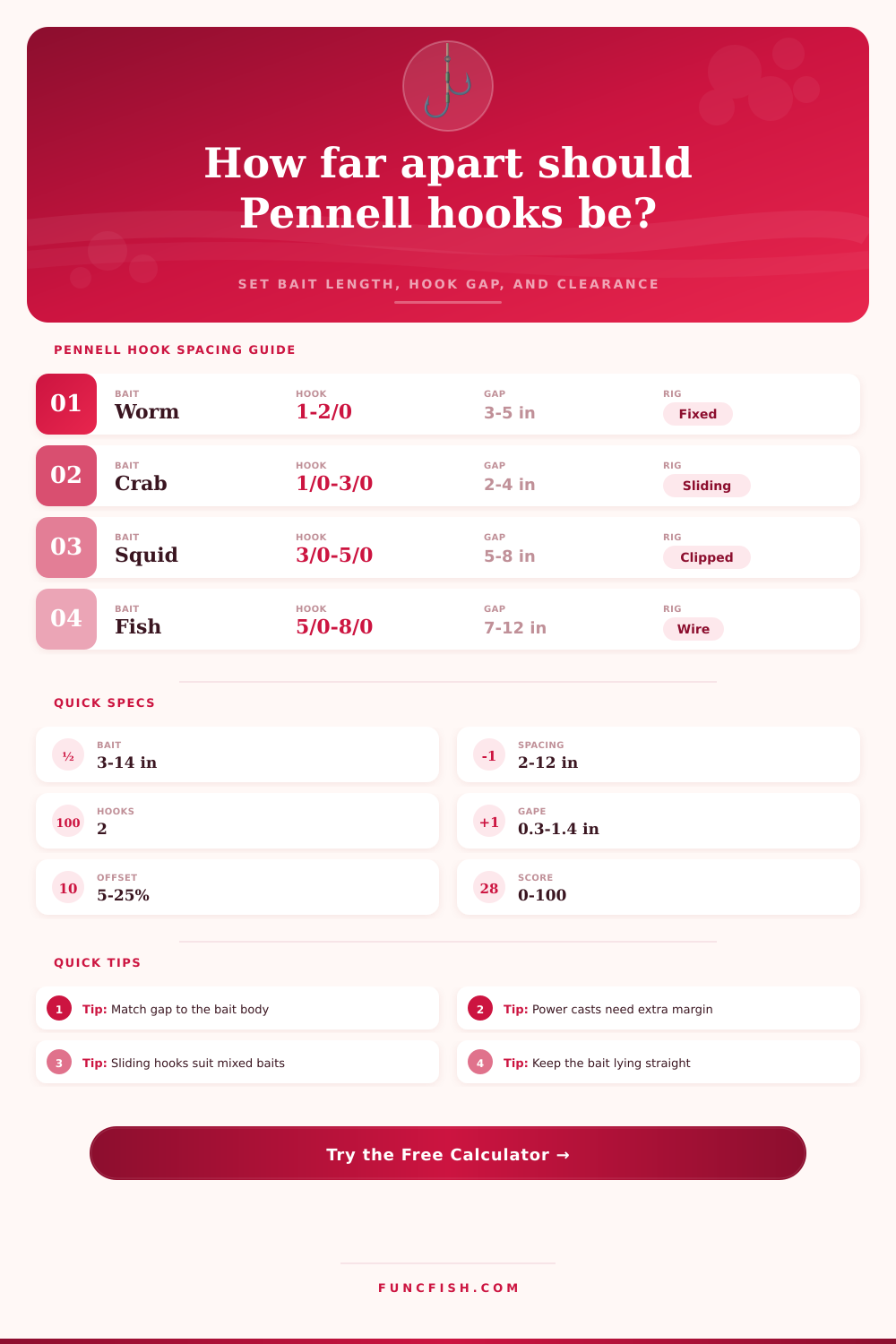
| Worm, lug, rag, clam strip | 3 to 7 in / 8 to 18 cm | 3 to 5 in / 8 to 13 cm | Light hold near the head | Keep tail hook near the end |
| Peeler crab or half crab | 2.5 to 5 in / 6 to 13 cm | 2 to 4 in / 5 to 10 cm | Sliding top hook helps | Hook through firm shell edge |
| Squid strip or whole squid | 5 to 10 in / 13 to 25 cm | 5 to 8 in / 13 to 20 cm | Set above the mantle | Pin the tail or skirt end |
| Fish strip, bunker, mackerel | 6 to 12 in / 15 to 30 cm | 6 to 10 in / 15 to 25 cm | Hold the shoulder section | Tail hook carries the bite point |
| Whole fish or flapper bait | 8 to 16 in / 20 to 41 cm | 8 to 12 in / 20 to 30 cm | Use firm head or shoulder meat | Keep clear of the tail hinge |
| Hook pattern | Spacing effect | Gape range | Best bait style | Calculator treatment |
|---|---|---|---|---|
| J hook pair | Neutral | 0.4 to 1.1 in / 1 to 3 cm | General Pennell rigs | Uses full planned span |
| Circle tail, J top | Slightly wider | 0.6 to 1.4 in / 2 to 4 cm | Big fish baits | Adds gape and roll margin |
| Wide gape surf hooks | Wider | 0.5 to 1.2 in / 1 to 3 cm | Squid, crab, fish strip | Adds bite clearance |
| Fine wire Aberdeen | Closer | 0.3 to 0.7 in / 1 to 2 cm | Worm and small baits | Reduces hardware pad |
| Wire trace hooks | Wider | 0.8 to 1.6 in / 2 to 4 cm | Tope, huss, conger | Adds wire bend allowance |
| Rig style | Top hook control | Best use | Spacing multiplier | Risk note |
|---|---|---|---|---|
| Fixed Pennell | High | Repeatable bait size | 1.00x | Wrong spacing bends the bait |
| Sliding Pennell | Adjustable | Mixed bait lengths | 0.96x | Needs a positive stop under load |
| Clipped surf Pennell | High | Power casting | 1.10x | Add cast compression margin |
| Pulley Pennell | Medium | Heavy surf baits | 1.06x | Keep hooks clear during retrieve |
| Wire Pennell | Medium | Toothy fish or conger | 1.12x | Wire bends need extra allowance |
| Condition | Spacing add-on | Material choice | Bait control | Why it matters |
|---|---|---|---|---|
| Gentle lob or boat drop | 0 to 0.4 in / 0 to 1 cm | Soft mono or fluoro | Light elastic | Little cast force compresses the bait |
| Normal surf cast | 0.4 to 0.8 in / 1 to 2 cm | Stiff mono | Moderate elastic | Cast force can slide the top hook |
| Power cast or clipped rig | 0.8 to 1.5 in / 2 to 4 cm | Stiff mono or fixed trace | Firm wrap | Compression shortens the bait body |
| Strong tide pull | 0.6 to 1.2 in / 2 to 3 cm | Fluoro or stiff mono | Secure both hook points | Water pressure folds flexible baits |
| Rough surf and weed | 1.0 to 1.8 in / 3 to 5 cm | Heavy mono | Extra elastic | Weed and surge twist exposed hooks |
🚩Pennell Calculation Notes
Hook alignment: The calculator removes the top and tail hook set distances from bait length, then adds hook gape, bait thickness, rig style, cast load, and material movement to find a practical bend-to-bend spacing.
Sliding top hooks: A sliding Pennell can cover mixed bait lengths, but the score drops when the bait is highly compressed or the planned spacing is much shorter than the calculated support span.
The result is a rig-building measurement for hook spacing and bait support. Recheck the final rig by laying the bait straight before tying duplicates.
It is a basic bit of terminal tackle for surf fishing, but it needs to be handled propery if it is to work as intended. It’s two hooks attached to a line called a snood onto which you attach your bait. When casting heavy lures into sea with some chop there are both biological factors and physics at play. Old rules and knot-based rigs is common, but they don’t take into account the mechanics of casting. Your rig will bend or tear your bait off; it won’t sit naturaly for either bass or cod.
The right amount of space between the hooks isn’t simply down to measurement. It’s a matter of creating an underlying structure that carries your bait but doesn’t inhibits its natural action. It’s not just the food that you want to think about when it comes to the spacing between your tail and top hook; also make sure you include the behavior of your snood material upon rapid slowing at end of your cast. Soft mono stretches different than stiff fluorocarbon or braid.
How to Set Up Your Fishing Rig Correctly
Forgetting about snood stiffness can cause the top hook to slide too far downward in launch position, compressing the bait and driving the hook point outward. In other words, don’t try to memorize one static measurement for all scenarios but rather know the behavior of your materials. The size of your rig also depends off casting force. For example, if you’re making a subtle lob off a rocky shoreline, there’s little strain on your knot structure and you can get away with tighter spacing on the hooks. On the other hand, if you’re hammering a big clipped rig in a wide estuary, there’s a lot of G-force being applied to your terminal tackle.
Soft baits such as fish strips or squid will compress under shock absorption, sometimes quite a lot when your line abrupty stops. So when they fly, those compressed hooks end up far too closely spaced if you had originaly positioned them according to their natural relaxed length. As a result, the top hook frequently punches all the way through prime eating meat instead of securing itself properly. Understanding this dynamic load help tell the difference between an effective rig and one that falls apart under pressure.
How you set up the geometry depends on your bait presentation. With whole baits such as large flappers or squid, you want enough space between hooks for good access but not so much that they tangle. When using slimmer baits like lugs or worms, close spacing work well because there’s no bulky body mass to prop up large gaps. The key is knowing what you’re realy measuring when planning out your rig. It’s not simply the eye-to-eye distance of the hooks. Consider also their gap (how far apart the hooks are) plus any stand-off angle created by the top hook relative to the bait line. Either a broader gap or a more open angle reduces effective bait span, so plan accordingly before even tying your first knot.
After inputting your casting conditions and bait size into the calculator (above), it crunches the numbers for you. That frees you from having to guess at complex relationships between compression forces and trace memory. And it gives you a recommended spacing that strikes a balance between hook security vs. It helps keep your bait intact. When it spits out its recommendation, be sure to look closely at its generated fit score because that tells you how well the configuration you selected will support the type/weight of food you plan on using. Typically, if the fit score is low it means your hooks is either too close together (meaning they don’t let the bait move properly) or they’re too far apart (which causes the bait to not hang straight).
Another common error among new anglers is to think that all Pennell rigs can be used in the same way. If you’re using a heavy whole squid rig, then throw on a light worm to match with the exact same spacing. That wouldn’t of worked most times. The physical requirements for the rigging are totally opposite. Your hooks should be further apart on a heavy bait so it doesn’t fold under load while being retrieved or when pulled hard by the tide. On the other hand, lighter more flimsy baits like worms need delicate attention and closer hooks to keep from ripping apart soft flesh. Consider how strong your bait is, and you’ll lose fewer fish and get better hook sets.
You’re trying to offer a natural presentation of a bait that appears alive and swims freely, yet stays on your line well enough to get the hooks to set solidly and not tear loose in soft parts. Achieving this takes some trial and error as well as being willing to break tradition and tweak things according to what’s realy happening out there during the day. Once you take the time to dial it all in, then you quit struggling with the tools and are simply able to work the water for the reads and the bites. Once you focus on catching fish consistently, casting becomes an afterthought.