
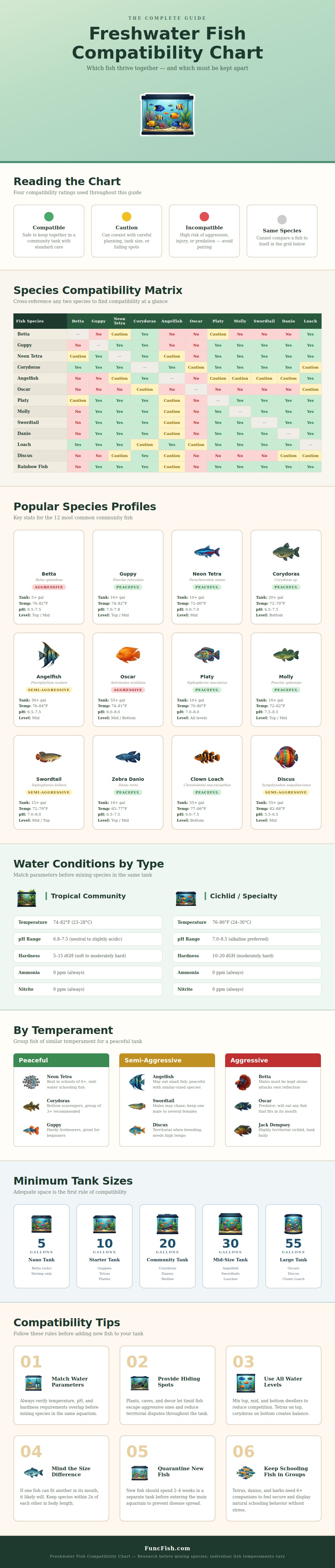
So what’s up? Well, it all comes down to the chart above (click on it for full-size). It divides up who gets along safely, those that require careful planning, and combinations that is bound to cause stress or injury. In short, it tells you who goes well together and won’t fight.
Matching water parameters should always beat temperament when mixing fish. For example, just because a guppy may be one of the most peaceful fish in existence doesn’t mean it’s going to last very long if you keep it in warm, acidic water needed for discus. Generally speaking, tropical community tank do best at neutral pH levels with temperature around seventy-five to eighty degrees Fahrenheit. Specialty species such as cichlids tend to want warmer water and more alkaline, harder water. If your tap water doesn’t naturaly align with these needs, you’re fighting a losing battle right off the bat.
Tips for Keeping Fish Together Safely
After that comes temperament. Schools of peaceful fish, like neon tetras, only feel safe when there’s at least a group of six (or even larger). The herd mentality is what protects each individual from stress and potential predators. Keep them separate and they’re skittish and vulnerable to sickness. Adding bottom-dwellers like corydoras catfish contributes an additional level of balance, they stay in the substrate, where few other mid-water swimmer go. This creates a vertical layering which make your tank into a three-dimensional habitat instead of a crowded plane. Filling volume doesn’t mean simply taking up space; it also means efficiently using all inches of available space.
Aggressive species complicate matters. By nature, bettas are loners; fighters. Some get along with tank mates; others don’t. They flare their fins, which most other fish sees as an invitation to claim territory. Then you have larger cichlids such as oscars that function on a different scale altogether. To them, smaller fish aren’t neighbors but moving sources of food. The compatibility matrix makes this obvious by flagging pairings where the size difference create a risk of one fish eating the other. When one can fit into the other’s mouth, chances are good it will. It’s biology; not malice.
All of this depends on tank size, too, and not just a little bit. Although the fish may seem tiny when you buy them, there’s no such thing as “community” in a five gallon bucket. If you wish to keep platies, guppies, or tetras, you’re starting off with a handful of fish in at least a 10-20 gallon tank to avoid constant squabbles over territory. Swordtails and angelfish (if you control their semi-aggression) open up options in a 30 gallon tank. The bigger the tank, the more shy fish can move away from aggressive fish when they become obnoxious. Space is the most affordable type of peacekeeping in your tank.
Quarantine new fish. Before introducing newcomers to the main group, isolate them for two weeks. Why? This prevents disease from killing off your established colony. Sounds like extra work, but trust me…you’ll be thanking yourself later for not watching weeks of effort go down the drain due to an infected newcomer. You should of planned ahead.
After adding fish, always watch their behavior and adjust decor accordingly (i.e., break lines of sight between rivals). Driftwood, caves, plants don’t just look nice… They also create visual barriers that decrease tension. The goal isn’t just survival, but stability. Stability means you’ve established a well planned tank that runs with a routine; that each species has a place and purpose. Observe your fish, pay attention to who’s hanging out with whom, and honor the lines they draw. Establishing harmony in water requires patience, yet the payoff is a living system which grows on its own terms different than being constantly supervised.