
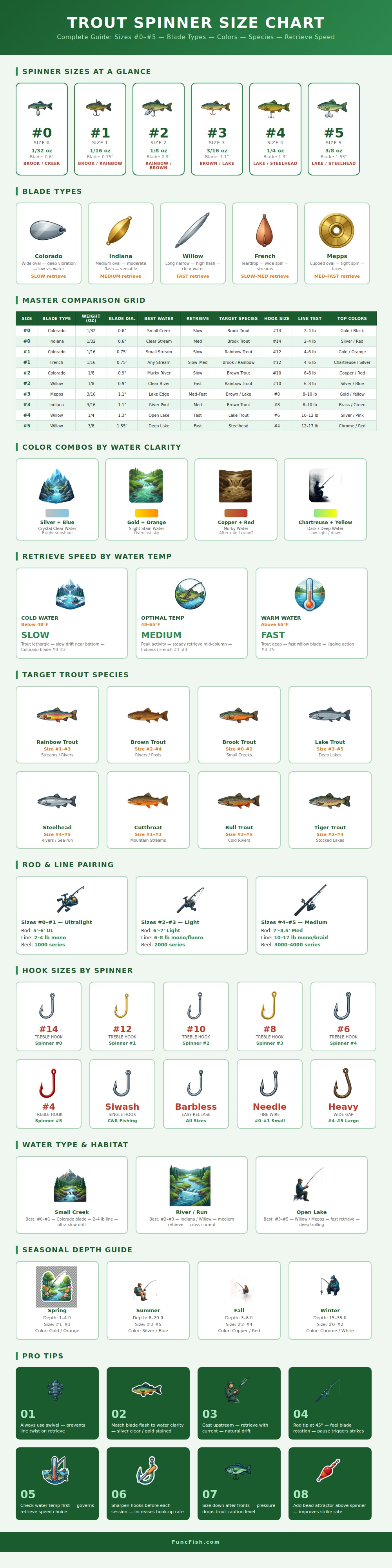
If you’ve been on a creek bank before with that sinking feeling in your gut, you’re not alone. You know you’re there to catch trout, but all those spinning lures look like a wall to you and you can’t decide which one will work. More often than not, it’s not the technique of fishing; instead, it’s matching the right lure to the current water conditions. If most anglers had their way, they’d use their favorite size three spinner on everything. Because trout are visual hunters with specific expectations about what a prey item should look like, that error cost much more then we think.
This is key to understanding as well: How do blade shapes determines your retrieve speed? The chart above explains it. The Colorado blade (a large, broad and heavy blade) turn slow on fast retrieves. But since they’re big, they puts out large vibrations and carry them far. So if you’re fishing in low-light or dirty conditions, this is for you. Conversely, the willow leaf blade are narrow, so it spins fast and puts off little vibration. This goes on crystal clear streams because too much flash will scare fish away instead of attracting them. Counter-intuitve to some, but sometimes less vibration = more bites in high-visibility water.
How to Pick the Right Trout Lure
The same holds true for color choice. Copper and gold colors shines through the dirty water better than a bright chrome color after a storm when the water is all cloudy and tea colored. In clear water on a sunny day silver imitates the scale flash of baitfish best. The point isn’t you has one for every situation. You have one and know how much light will reach the water that day. On a stained river, change your beads above spinner to orange or chartreuse to give them something to see. Do not change out the whole rig.
A big factor that influences fish reaction to your retrieve are the water temperature. Cold water trout has a much slower metabolism, so they do not chase things quickly. This equates to having to slow down your retrieve drasticly in the fall and spring. Just let the current work for you. Cast it upstream and let the lure float with a slight tug on your line. As the weather gets warmer into the summer months, trout will get more active and push out further, meaning you can pick up reel quicker and fish more water.
It also eliminates frustrating things that many new anglers run into, matching your line and rod to size of spinner you are throwing. A very small size zero spinner doesn’t feel right when cast with heavy ten-pound test line. That bait will be bogged down in thick line on stiff rod action and won’t spin properly. Those little lures needs to spin and flutter just like they were made to do, and ultralight setups with two to four pound line does that perfectly. It makes for a more delicate fishing experience instead of a brute force one.
When it comes to catch and release fishing specifically, hook size is everything. You don’t want to use a small hook because they bend easy and are hard to remove quickly, which harms the fish. The goal is to use treble hooks the same size as the scale of your spinner so you have good hook sets but also don’t do too much damage. If you intend to release your trout, crimping barbs down flat against the hook makes an enormous difference in their survival rate.
Every trip should be considered its own puzzle. The rules is dictated by the water temperature and clarity. Your choice of blade should match the visibility. Your retrieve should match the perceived water temperature. Your tackle should be light enough to allow the lure move naturaly. When you take the guesswork out and begin interpreting the conditions, the panic subsides. You’ll be making purposeful casts, rather than hopeful ones. This change in perspective is what sets average anglers apart from consistent cooler-fillers.