
They’re tough; hard to hook; spend little time near surface (where most of us do our fishing); grow up slower (which means living longer) than most anglers; and when we do get one on the line, it heads back into the dark depths.
Why is a lake trout lighter then an equal sized bass? It’s because they’re designed differently. For survival, they lives slow lives, they don’t sprint; they endure.
Why Lake Trout Are Special and Need Protection
Once you understand that, you can change your technique. This also helps you see why it is important to conserve these fish compared to other types of game fish.
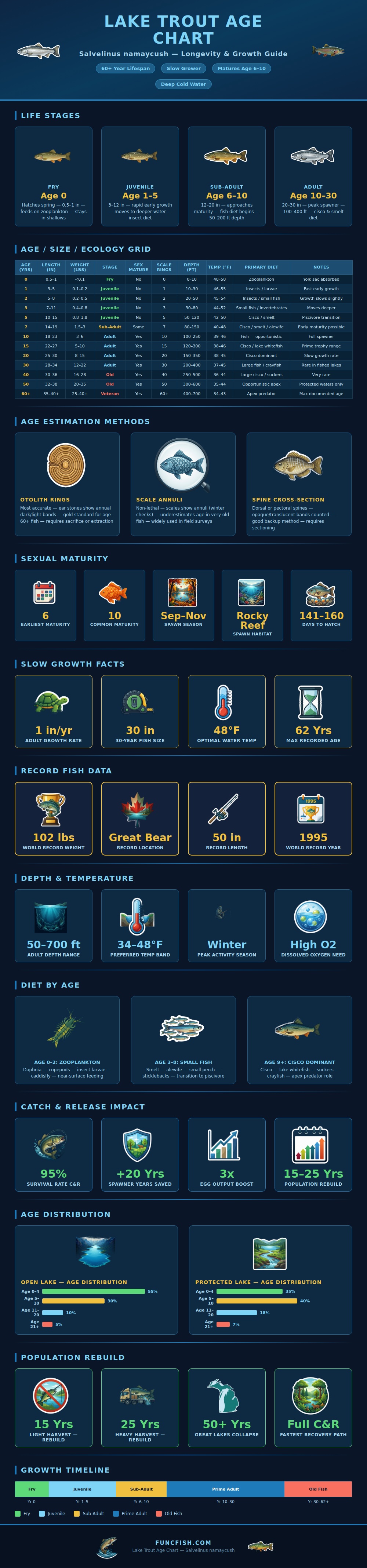
We are shown how these lake trout go from fry to giant predator with a picture book of the growth process and a very slow growing young phase. Like most cold-water fish, this species grows slowly in its early life, instead relying on feeding on small crustaceans and insects for about five seasons. So in those five seasons it only gains a couple inches a year before finally reaching sexual maturity and becoming capable of spawning (around age 6-10).
So it’s more than being big. It’s making it long enough to be mature. As a lake trout ages, it inhabits different types of habitat with the juveniles remaining shallow and adult fish becoming very deep. A 20-year-old trout will inhabit water most of us would call ice cold, usually in the range of thirty-eight to forty-five degrees Fahrenheit. This cold water slows down how they processes energy even more, sometimes allowing them to grow just an inch or two each year once past age ten.
When pursuing big fish, this slow growth rate is something we often overlook as anglers. The fish are not being rushed though; you have to respect their timeline, which is dictated by their environment. To estimate the age of lake trout, biologists counts rings in their otolith (ear stones), which are hardened structures like tree rings. They can also use scales, but very old fish tend to look younger then they really are. Otoliths is accurate for fish more than sixty years old. While you probably won’t extract an ear stone from your catch, now you know that lake trout can live well beyond fifty years.
Next time you set a big trout free, remember it’s not about good sportsmanship, it’s about ecological preservation. Lake trout live a long time, don’t reproduce until they’re pretty old and only have a few eggs compared to other species, which adds another layer to their longevity story. In the fall, they spawn on rocky reefs requiring certain conditions to get a good fertilization rate. Over fishing the population hurts it by taking out the big breeders that take decades to replenish, sometimes as much as 25 years in certain lakes. Those with healthy, protected populations can rebuild sooner without being heavily harvested. The key to recovery is to keep the big ones alive.
As you can see from the size and weight info, they gets heavier exponentially as they grow longer linearly. So just a foot or so of extra length results in a massive difference in weight. They’re dense. And those big ones are heavy! The record weights are well over a hundred pounds for a reason.
They’ve outlasted every other animal in their world for decades, making them strong fighters. Because of their scarcity, you don’t catch many of the old-timers. But what does exist has been grown on protected water. It’s the only place you find enough old growth to create giants like this.
When targeting lake trout, remember that they live in there own world with their own rules, patience, cold water, deep water and respecting their habitat and timeline. When you catch one big one let him go ASAP and do it right or you just defeat the whole purpose of the battle. Losing one of those old guys affects fish numbers and water quality. They are also key to keeping populations stable and preserving the genetic diversity of the ecosystem.
When you set the hook on a lake trout, you’re connected to an ancient survivor who’s witnessed more than his share of winters. This is why it takes patience, not just from you, but from nature. Respect this moment; collapsing populations don’t rebound in a hurry. The water will remain cold but the window for catching them won’t last long without conservation measures.
You should of seen how big they gets. It was actualy quite luxurios to watch.