
Most anglers will tell you that a large catfish is just an old catfish. After all, the larger the catfish, the more it has had to grow and eat. That makes perfect sense right? Well no…water doesn’t operate on time. There is several variables that work together to either compress or extend growth curve; genetics, food source and temperature being some of them.
A ten pound channel catfish from a hot southern reservoir might only be five years old. The very same fish from northern Minnesota could well be twelve. You cannot ignore this difference. It change your whole approach to fishing and how much pressure those fisheries can take before they collapse.
Why Some Catfish Are Older Than Others
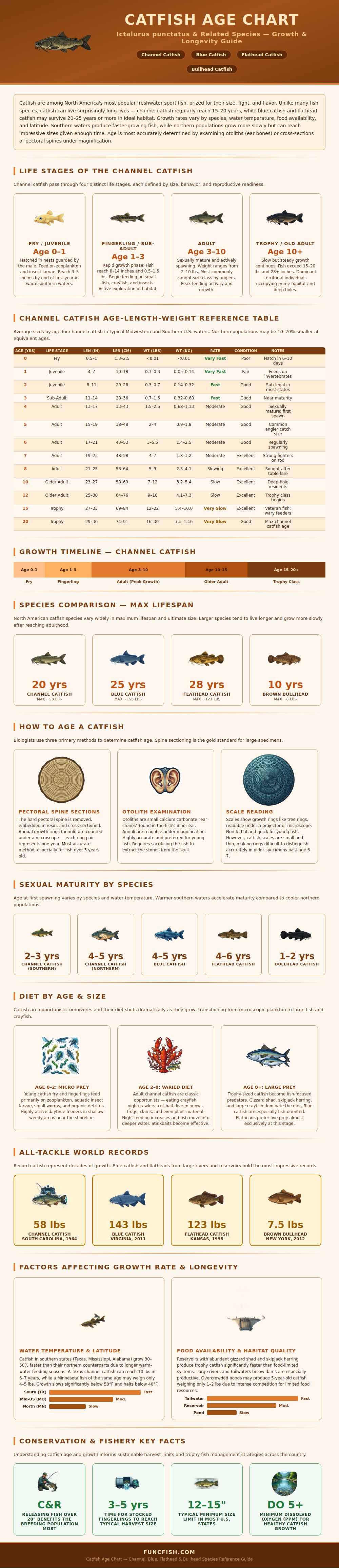
So what does it all mean? Life stages break out nicely in the above chart. What I found interesting was how rapidly fish develop during first three years. Survival is name of the game here, and fry and fingerlings hides out in shallow weedy margins and gorge themselves on insect larvae and zooplankton.
Fast forward and you’ll see that when they reach sexual maturity (which for most occurs sometime between years four and five), rate of growth dramatically slows down. You’ll notice curve begins to flatten at this point. In terms of exponential growth, these fish no longer grows; instead, they just start getting heavier. Realizing this transition helps explain why trophy class fish are so scarce. Not only do they need good genes, they also need decades uninterrupted feeding in prime habitat.
The other thing you’ll see in the chart above is how clearly it show the differences among species. Most of us follow the channel catfish as our example, which matures fast and maxes out at about 20 years of age when given sufficient luck. Flatheads and blues run on an altogether different clock. They takes longer to mature, and they usually don’t start spawning until they are four or six years old. And they don’t stop growing then either, they do so well into their teens or even twenties.
Fifteen years old marks the starting point for a blue catfish. Because of their long lives, they’re more difficult to catch. Over time, they grow extremely wary by learning from each near miss. They tend to hang on structure found off the bottom where lesser fish won’t be found.
The age of catfish is determined by biologists who read otoliths or cross sections of pectoral spines, looking for annual rings much like tree growth patterns. They do this destructively, so odds are you don’t get true age of the fish you catch unless they’re in some type of study. So you guess it; guessing based off location and size. And that is where latitude comes in.
Metabolism speeds up in warm water. It slows down in cold water. What this does is a fish living in Texas will experience far more weeks per year to feed than one up north. This causes those southern populations to churn through their growth stages quicker then those in the north, who take long road to maturity.
The other big factor is diet. Opportunistic omnivores, young catfish will feeds on any small insects and waste they can locate around shoreline. As trophy class catfish age, many of them turns into strict fish-eaters and begin targeting larger baits such as skipjack herring or gizzard shad.
Catching a twenty pound blue catfish does not involve the same presentation or tackle that catches a three pound channel. They aren’t just physically stronger, they also gets smarter when it comes to their food.
For practical purposes as well, eco-friendly anglers take note of these age markers. By releasing any fish greater than twenty inches we protect our breeding stock and give them a chance at becoming trophies in their own right. You know you never get the giants if everybody catches and keeps all the good sized fish. Apparently the data indicates that there should of been a good mix of ages in the fishery, including some older spawners, as this provides the necessary genetic diversity. It’s about balance.
The next time you’re on the bank waiting for one to eat, take some time and think about what you’re fighting. It is not just weight but history. Those rings around their bones and scars across them tell a big story. It’s a story of surviving predators, the current, and at times even the tackle they’ve encountered.
That fish on the other end has probably watched you since he was half the size as a fingerling. Give him respect for his experience and maybe just maybe you can keep him around long enough for the next generation to chase.