
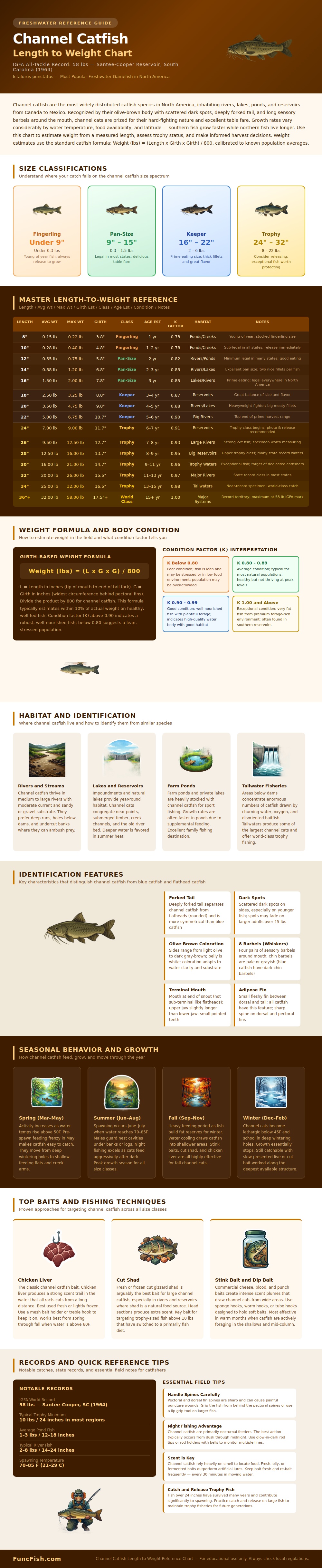
The difference between a student of channel catfish fishing and the hobbyist who loves to fish them is often seen in one moment. It happens the moment you stop thinking you have a big cat hanging on your stringer because you just pulled up a picture worthy fish. Most fishermen make assumptions based off sight, which as we all know is a poor judge of size both in and out of the water. A 20 inch channel cat will appear like a 10 pounder in a dark green body of water but could easily weighs only five pounds.
Learning how long means how much really isn’t about memorizing a spreadsheet. It’s more of an intuition for fish growth so you can be more accurate on the water. This progression of growth isn’t linear and I’ve broken it down for you in the chart above. That eighteen inch fish doesn’t seem all that different from a twenty-four-inch fish in size. But it’s a huge leap in age and biomass.
How to Tell How Big a Channel Catfish Is
In general, an eighteen-inch channel cat is probably a three- or four-year-old fish, weighing about two-and-a-half pounds. So it’s definitely a nice fish, but it is just getting into the best part of its growth phase. Fast forward to when the same fish hits twenty-four-inches, and now it’s probably doubled in size. Maybe seven or eight pounds. And it’ll have a few more years on its life. That’s what happens from surviving another winter, staying away from hooks, and accumulating fat reserves through feeding amidst more competition in the water.
Understanding the exponential curve make you admire the work a fish does to become a trophy. Growth rates vary depending on where you fish. Warmer water runs hotter year round with a longer warm season producing fast growing giants in the south. Cooler water slows their metabolism making them live longer but also grow slower in the north. So a thirty pound channel cat in Alabama might be eight years old whereas a twenty pound cat in Minnesota may be fifteen years old.
This data points to the importance of warmer water environments like those found on southern reservoirs. The southern waters produced a 58 pound IGFA all tackle record (referenced in the infographic), showing how the right habitat can make these waters world class producers. These records don’t happen every day, but they demonstrate just how underrated the potential size of channel cats realy is.
To find a healthy trophy, it’s not just about the ruler. Check out the reference guide and check out that condition factor. This is a sneaky yet important measurement of how robust and fat a fish should be compared to its length. If it’s a high condition factor, it has been living in a lot of space, has clean water and a lot of food. You’ll notice these fish has thick tails and broad heads. If it has a low condition factor, then there isn’t enough food or it’s crowded in there. These are the ones you want if you’re going after the big cats, because they will put up more of a fight and look better on camera.
This is where it all applies: when do I keep what, and when do I return it? As you can see from the table above, any fish less than nine inches should be returned immediately. Fish in the 9-15 inch range are considered panfish. They will feed several people well and are actualy legal in most states. But if you catch a channel cat over twenty-four inches, you’ve got yourself a bona fide trophy and those is good for the system. They are proven spawners and beat the odds to make it to that length. So by returning it, you’re ensuring another big fish next year for the next guy to catch. It is a fair exchange. You get one less meal, but you leave the resource intact for everybody else.
Respect this animal’s size and anatomy: It has pectoral and dorsal fin spines that are pretty sharp and will poke holes in you if not handled with care. To help keep its slime coat intact (which protects from disease), wet your hands before picking it up. If the fish is big enough, grab it by the lips with a lip grip tool; otherwise, get your hand around the fish firmly just behind the head… Don’t touch the gills. The faster you get good pictures and gently release, the higher the survival rate. You want the fish out of there as quickly as possible and back to 100% health.
It’s dark out there, literally. The big ones will be caught when you’re fishing at night. Channel cats are nocturnal predators and feed hungrily after dark. Because they’re such strong scent users, baits such as stink bait, cut shad or even chicken liver works wonders for them. The scent carries a long distance, especially in running water, where it lures interested cats to come investigate all that goodness hiding in the shadows. Get your bait close to submerged timber or deep holes. Learn how to read the water, and you’ll be in position to catch a keeper.
When you understand the weight-to-length dynamic, you begin to look at each catch differently. You no longer have a random hookup; rather, you have a data point regarding how healthy and productive the lake is. You no longer view the fish merely as a photo op or a meal, but instead as a story. A growth and survival story. Next time you measure a catfish, spend a second thinking where it falls on that curve. Every bite will mean more.