
Those red tail catfish is small. That’s why you see them in the pet store… They don’t look hard to maintain. Black bodies. They have bright red tails. They are cute little fish that will fit in your hand. It’ll get big one day, the sales person says. That word “big” is unclear. What does it mean?
Six weeks later you have the fish at home. Put it in a nice littel tank. Enjoy how cute it is for several weeks. Then the fish start growing and suddenly he/she look crowded. It happens often when folks buy these fish as juveniles. They pay attention to how big the fish are now instead of what they will be like as adults.
The Truth About Keeping Red Tail Catfish
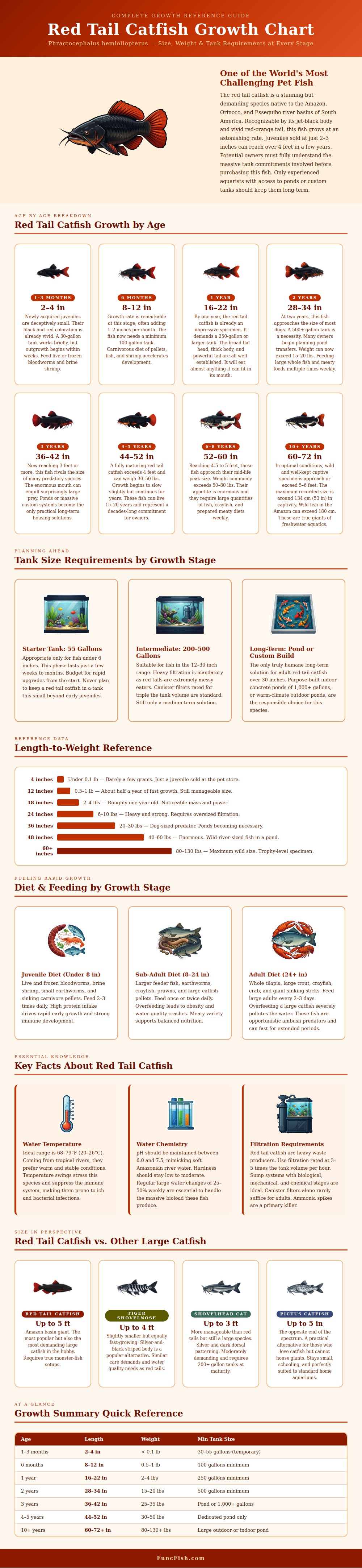
These are big river fish from the Amazon basin. Red tail catfish is big, powerful fish designed for life in a big river. They will grow very fast at first which means you’ll need to upgrade tanks regularly. It’s not linear growth, it’s explosive. This is a biological engine and you’re housing it. It require more real estate weekly, and most folks don’t expect this in the early weeks/mo. The fish appears easy to handle at first which is why people underestimate early growth.
Take a closer look at the time line, however. At 6 mos., the fry has grown 2x if not 3x it original length. That much mass require far more water volume for comfort and water quality stability. If you aren’t planning for a 200g tank within six months, you’ve fallen behind.
What’s the error? You are thinking the initial tank is the final tank. It’s not…
They grow very fast, too, and feeding is a major contributor to this. Because they’re carnivorous, they have huge appetites, especially when young. They’ll gobble down brine shrimps and blood worms like candy. Protein convert directly into muscle mass. At maturity, they switch to bigger pellets, crayfish, and whole fish. The high caloric consumption promote growth, yet it generates huge amounts of waste.
Ammonia output is proportional to fish size. A big fish make A LOT of ammonia, which means filtration becomes just as critical as tank size. Powerful filters capable of exceeding the tank volume are required or else your water quality will crash far sooner then you’ll be able to upgrade the house.
At this point (year 2) the fish is approaching thirty inches and comparable to most family pets, yet standard domestic fish tanks is now out of the question. Glass boxes give way to outdoor enclosures or custom-made indoor ponds for tropical climates. Here’s where the hobbyist confronts the greatest challenge: deciding if he/she can commit to, afford, and house such a massive tank system. Not many folks possesses those means.
And that’s why I believe most fish keepers misinterpret owning larger fish: they purchase the glamour but not the support.
The other thing people don’t talk about as much (probably because we want to buy new tanks) are water parameters. They are sensitive giants that is native to soft, slightly acidic water. Keeping temperature and pH stable is key to not stressing them out. Stress weaken their immune system and makes them susceptible to disease. A stable environment is a good environment for treating diseases; it’s much easier to treat them in a stable setting than in a chaotic one. In this case, consistency saves lives, not some elaborate tank decor.
It’s important to keep in mind that they’re not like other big catfish. Some big catfish has very distinct growth rates and size ceilings. For example, tiger shovelnose grow a little slower but still need lots of room, though they are smaller then red tails. Pictus don’t get big enough to be a problem in community tanks because they max out at 5-6″.
The red tail is the marathon runner of fish; you will have to plan your tank setup for decades to come. They’ll live up to fifteen to twenty years! You would of had to plan on keeping them for that length of time too.
In conclusion, cichlid keeping is not about caring for your fish, at least it’s not as much so in this case. This is about logistics. And you’re creating an environment for a fish that doesn’t want to be small. What once was the cute little baby quickly grows into something that needs some space and some pretty heavy duty gear. But if you have the will and the room, there’s nothing like seeing one of these genuine giants from the Amazon thrive. Just don’t get yourself into it until you’re willing to take the ride. Get that first baby home and soon you’ll realize that he won’t stay that way for long.