
Corydoras catfish are social animals. They hide behind some decoration (not shy, but afraid) if there’s only a pair or one in your community tank. The source doesn’t mention anything about dither fish. Getting a larger tank for less fish doesn’t work. Instead, you have to get more.
At least half a dozen corys is required. If not, the fish won’t show there true character. That’s why most end up being bought singly/pairs, they’re cute. As such, they’re always hiding or just lying around looking lazy. Get some more. And remember: provide enough room for a proper group.
How to Keep Corydoras Happy
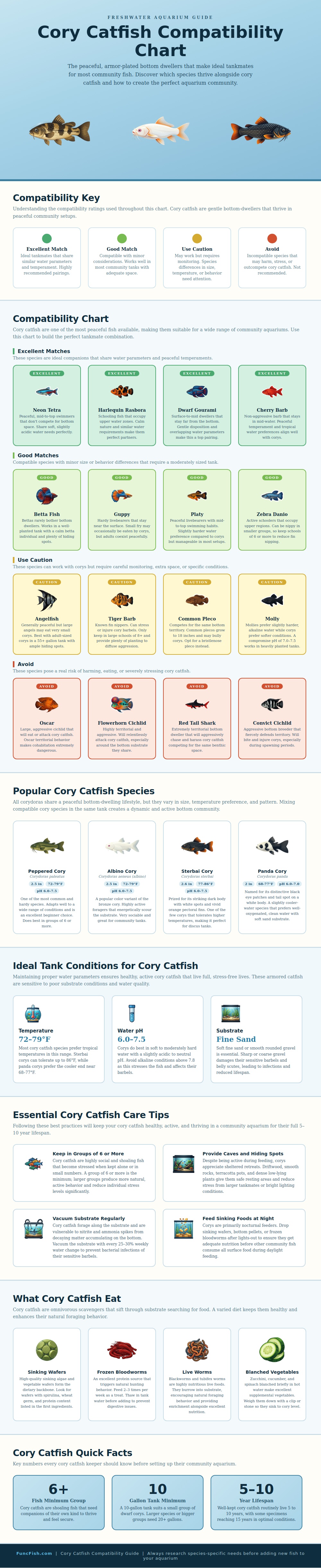
Once you have the schooling thing down, selecting tankmates will be a breeze… Mostly due to the fact that corys are basically peaceful animals. If it’s not predatory toward them (or otherwise aggressive), your other inhabitant won’t present any problem.
Compatibility charts recommend neon tetras and harlequin rasboras as good matches. These small schooling fish lives in the upper/mid-water column while leaving substrate free and clear for the corydoras. No need to worry about fin nipping or getting pushed around. Furthermore, these small schooling fish stay in the mid-to-upper water column, which creates a layered ecosystem where every species has its own vertical territory.
You may even want to include dwarf gouramis, assuming they minds their own business with the little guys rooting through the gravel at their feet. Avoid putting out recommendations that include territorial bottom dwellers. For example, don’t suggest convicts or red tail sharks. They treats the bottom area as their fortress. Any other fish, including smaller ones, that swim near them to find food will be chased, bitten, or stressed.
Because of this, both sharks and cichlids is marked on the chart as fish to avoid. Though seemingly peaceful, angelfish have also been known to gulp down juvenile corydoras if they’re small enough. That said, bettas and guppies work fine if you prefer bigger fish. However, this only works if the betta is a calm one and tank is heavily planted. Having lots of places for corydoras to hide from competition and crowding, i.e., a well-planted tank (are necessary).
Also, while cories use their barbels to find food, remember that they are very sensitive and designed to locate food even in darkness. In addition, they don’t want a sharp surface like coarse gravel rubbing on there snout and belly, because that can cause infections. Healthy corys require fine sand, which permits them to sort food by sifting in the substrate, this goes hand-in-hand with dietary preference.
As mentioned above, they’re nocturnal scavengers. Feeding sinking foods (e.g., frozen blood worms; sinking pellets/wafers) after lights out assures you that your cories gets some. Otherwise, everything gets eaten by surface-oriented animals during the day.
In addition, water quality is most important since though these fish are hearty with respect to temperature swings, corys despise bad filtration. Depending off which species you keep, they will inhabit the range of low seventies up into the eighties. But here’s the kicker: That’s right smack dab in the area where all the junk falls out. Maintaining good water quality through regular water changes/vacuuming substrate keeps nitrites and ammonia low, thus protecting their sensitive systems. A little bit of work now avoids big-time issues down the road.
Success in keeping corydoras is simple, meet there physical requirements and honor their social nature. Provide sand, provide a shoal, remove bullies from the tank. Do that and, if done correctly, watching them dance around the tank at dusk can be quite satisfying. It transforms your static tank into a living community where every fish has a purpose and a place to call home.