
It’s easy to think that a big fish will just hang in the water slowly drifting around, not doing much. That is not true of the goliath grouper, which is essentially an ambush predator with an explosiveness that would make a cheetah jealous.
Diving on Florida reefs and staring at one of these giants laying motionless on coral, you realize how hard it is to grasp the sheer size of this thing. It looks like a piece of living architecture instead of what we consider a fish. Its size isn’t just a fun fact for divers; it is something that deserves respect for an animal that has recovered from almost going extinct in the last thirty years.
The Amazing Goliath Grouper
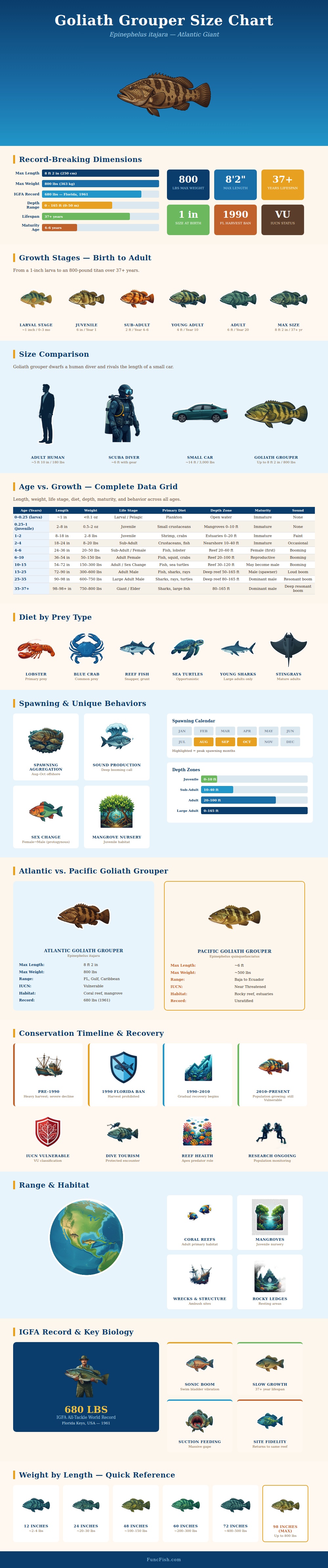
That’s still a large size, but seeing the grouper alongside common objects in visual breakdown puts the scale into easier terms. It’s as long as some small compact cars and towers over humans (and even a diver). Because we’re constantly interacting with these everyday items, it makes comparison easier to understand. Eight hundred pounds and eight feet long; that’s an imposing creature! Be sure to keep your distance and avoid swimming near them.
As the chart illustrates, the grouper’s life span starts out just inches long and reaches a titan within a few decades. By fish standards, that growth rate is extremely sluggish, which is one reason they is susceptible to overfishing. This is a story about delayed gratification. These fish live out first few years of their lives hidden in the matted roots of mangrove trees, small and cryptic enough to evade predators. It’s not until these fish reach sexual maturity (generally around four or six years old) that they start to venture onto open reefs.
And why does this matter? Nursery habitat is as important as adult feeding habitat. If the juveniles aren’t protected by healthy mangroves, there won’t be any giants left to watch over reef when they’re older.
Females frequently switch sex to male over time, an evolutionary strategy where they start as female and become male, according to infographic. So it’s the biggest and oldest animals, those with the most experience… Who end up reproducing, maximizing genetic diversity during relatively short spawning aggregations in late summer.
These days, there are still plenty of these fish around thanks solely to conservation measures. Before 1990, almost all big adults was removed through commercial fishing. But when harvest was banned, the population started to crawl back from the brink of extinction. They remain classified as a vulnerable species by international conservation organizations. This means we need to keep reminding ourselves just how shaky this recovery process is.
Yes, they’re everywhere now on dive boats in the Keys and up and down the Gulf coast…but their numbers aren’t anywhere near historic levels yet. According to the data, it can take decades before an individual reaches its maximum size. So when you see a big male today, you’re seeing an animal that’s beaten human pressure and environmental challenges for three decades.
Still, divers frequently assume that because they’re so motionless, the fish aren’t paying attention. In fact, they knows every move you make around them. In late summer through fall (August-October), particularly during mating season, many divers witness what happens when they vibrate their swim bladder, creating deep booms that echo throughout the water column, most evident in courtship. This sonic display communicates more than just a willingness to reproduce; it conveys dominance. And no photo can do it justice.
If you come across one, know this: It’s not there for your aquatic portfolio. Instead, it represents a species that nearly collapsed, but which survived, thanks to savvy management and a legal mandate to protect it. Their actual physical existence is told on the size chart, but the story behind the number is about survival. To have such creatures in our waters at all is nothing short of good fortune, one relying off our continued respect, protection, and watchful eyes.