Weightless Worm Sink Rate Calculator
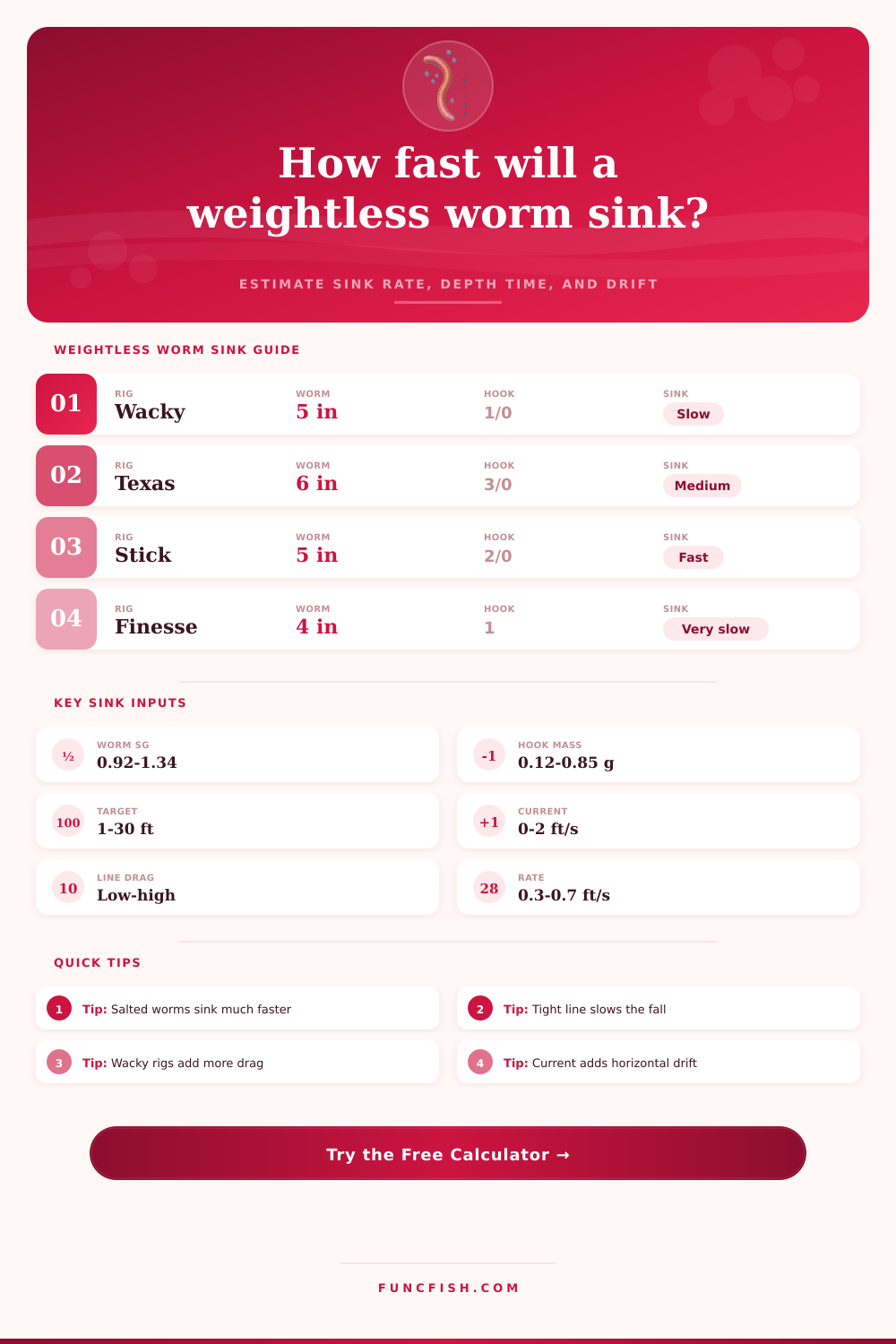
Estimate how fast a weightless soft worm falls by combining plastic density, worm volume, hook mass, rig drag, line tension, temperature, depth, and current.
📌Scenario presets
⚙Worm fall settings
Model note: This estimate uses buoyancy, displaced water, projected area, drag, and line drag. Soft worms flutter, roll, and spiral, so on-water count-down marks are still the best final calibration.
Weightless worm fall forecast
Calculation breakdown
🧪Plastic density reference
Floating Elastomer
Standard Plastic
Salted Stick
Heavy Salt
🪝Hook mass and fall influence
| Hook choice | Approx. mass | Net sinking help | Typical worm length | Fall note |
|---|---|---|---|---|
| Size 1 finesse | 0.12 g | 0.10 g | 3-4.5 in | Lets buoyant worms hover or glide |
| 1/0 light wire | 0.20 g | 0.17 g | 4-5 in | Good for wacky and clear water |
| 2/0 worm hook | 0.30 g | 0.26 g | 4.5-5.5 in | Balanced for stick worms |
| 3/0 EWG | 0.42 g | 0.37 g | 5-6 in | Common Texas rig baseline |
| 4/0 EWG | 0.56 g | 0.49 g | 6-7 in | Faster nose-down fall |
| 5/0 heavy EWG | 0.72 g | 0.63 g | 6.5-8 in | Helps punch through sparse cover |
| 6/0 magnum | 0.88 g | 0.77 g | 7-10 in | Strong influence on sink angle |
📏Sink rate interpretation
| Rate band | Imperial rate | Metric rate | Best count-down use | Likely presentation |
|---|---|---|---|---|
| Hovering | 0 to 0.10 ft/s | 0 to 3 cm/s | Not reliable for depth | Suspending or rising beside cover |
| Very slow | 0.10 to 0.25 ft/s | 3 to 8 cm/s | 4 to 10 ft in 40 sec | Cold front, shallow docks |
| Slow natural | 0.25 to 0.45 ft/s | 8 to 14 cm/s | 4 to 10 ft in 16-40 sec | Wacky and light Texas rigs |
| Moderate | 0.45 to 0.70 ft/s | 14 to 21 cm/s | 6 to 15 ft in 9-33 sec | Salted stick worms and deeper shade |
| Fast | 0.70 ft/s plus | 21 cm/s plus | Deep targets with shorter counts | Dense salt and heavier hooks |
🎣Rig and line drag comparison
| Setup | Drag effect | Fall angle | When it matters | Adjustment to watch |
|---|---|---|---|---|
| Slack braid | Low | Most vertical | Short casts and shallow targets | Watch jumps in the line |
| Semi-slack fluoro | Medium | Slight bow | Standard weightless bass fishing | Count starts after splash-down |
| Tight mono | High | Pendulum | Long casts and bank fishing | Actual depth can be shallower |
| Wacky rig | High worm drag | Shimmying glide | Docks, shade lines, clear water | Expect slower than straight rig |
| Texas EWG | Lower worm drag | Nose-down | Grass edges, brush, skips | Hook mass changes rate quickly |
💡Calculation notes
Count-down calibration: If you can see the worm beside the boat or bank, time a known 2 ft or 0.5 m fall and use that measured count to tune the calculator's fall calibration choice.
Line angle warning: A tight line can make a weightless worm swing toward you. The calculator reports vertical depth and drift separately so you can spot that pendulum effect.
It’s really the disconnect of throwing a weightless worm only to find out it falls six feet short of reaching bottom. So you rip it out there, lower your rod tip and begin counting down the seconds and then SNAP! There was nothing. What happened? The bass was all tight to the ledge below and your bait fell right into their faces in midwater where they think it would be obvious.
This helps you move from guessing to knowing exactly how fast your soft plastic falls. This lets you make educated guesses instead of just hoping your timing is right.
Why Your Worm Falls Slowly
Water’s pretty dense compared to air, and it doesn’t like to be messed with, it’s complicated When we’re fishing worms in water, there’s a lot of factors at play, such as the shape of the rig, its buoyancy, and the drag of the water. When you hook one through the tail, its center of gravity shifts; this makes a straight-fished stick worm act different than a wacky-rigged creature bait. Input all the details of your tackle into the calculator above, and it’ll do the rest for you. But even without the computer, knowing why those inputs make a difference means you’re a smarter angler.
The most significant variable here is plastic density. Due to being slightly denser than water, standard soft plastics has a slow fall rate. Floating rubber materials naturaly try to float until weighted down by the hook. To give you an idea, salted baits use additives to add weight, causing them to sink quick through the water. Understanding whether your bait is neutral buoyant or actively sinking change how you interpret every second of that countdown.
The other wrinkle most guys miss is hook weight. Even if you tie on a size 1/0, it may still be so slight as to register on a scale with ounces rather than grams, but that tiny amount of hook weigh down on the nose to stabilize the fall. Otherwise a floaty worm tumbles all over itself or hovers endlessly. The chart on the page breaks down where various hook sizes contributes to falling speed. For example heavier hooks will drop harder, but impact your action. A light finesse hook allows a light bait to softly glide while a beefy EWG forces a more direct, rapid fall to get into deeper water before the worm begins to float off in the current. Balance action versus rate of speed.
The surprising factor in how fast your lure falls is what kind of line you’re using. Thin braids cut through the water easily and provide very little resistance on the fall. Mono or thick fluorocarbon form a “parachute” bow in the line which pulls the worm back towards boat and slows its descent. It’s measurable and a tight-line effect does exist. When you fish a long steep bank with heavy line, chances are your worm won’t get down as deep as you think it should of. That drag is taken into account in the calculator and helps you know what to expect before the first cast.
Horizontal current adds another part to the mix. Your bait will move sideways considerably in moving water making it take longer to fall. That’s a good thing if you’re trying to cover a lot of riverbank, but not so much if you want to specificly target something below the surface. For most accuracy, calibrating your count in practice is still the gold standard. These numbers are estimates given best case scenario conditions and average plastic formulation. Viscosity and fall rate will be affected by real world variables such as immediate water temp changes and weeds snagging the hook.
Treat them as a starting point for your experimentation and once you have an idea about what an eight foot drop should feel like, then you’ll find yourself spending less time counting and more time fishing. It’s not about having exact math down to a science, but rather it’s about having a consistent presentation that copies the behavior of wounded prey. Once your worm hits that sweet spot at the proper level of drama, the bites won’t be far behind. There is nothing like that moment where the line tightens up after that perfectly timed count. It makes all that number crunching worthwhiles.