Surgeon Loop Size Calculator
Estimate a practical surgeon loop opening, starting bight, knot take-up, trim tag, and working strength for tippet loops, loop-to-loop leaders, droppers, and lure attachment loops.
📌Surgeon loop presets
⚙Loop sizing inputs
Use the rated breaking strength of the line that forms the loop.
Diameter controls bend radius, knot bulk, and how small the loop can safely seat.
Measure the eye, ring, swivel barrel, cork wire, or sinker attachment that must swing inside the loop.
Clearance is extra room beyond the terminal eye so the rig can pivot without binding.
Leave at 0 to have the calculator choose a recommended finished inside loop length.
Surgeon loop sizing forecast
Calculation breakdown
🧵Line material comparison grid
Nylon Mono
Surgeon loop behaviorFluorocarbon
Surgeon loop behaviorBraided Line
Surgeon loop behaviorCoated Wire
Surgeon loop behavior📏Finished surgeon loop size references
| Fishing use | Common finished inside length | Terminal fit | Line range | Loop note |
|---|---|---|---|---|
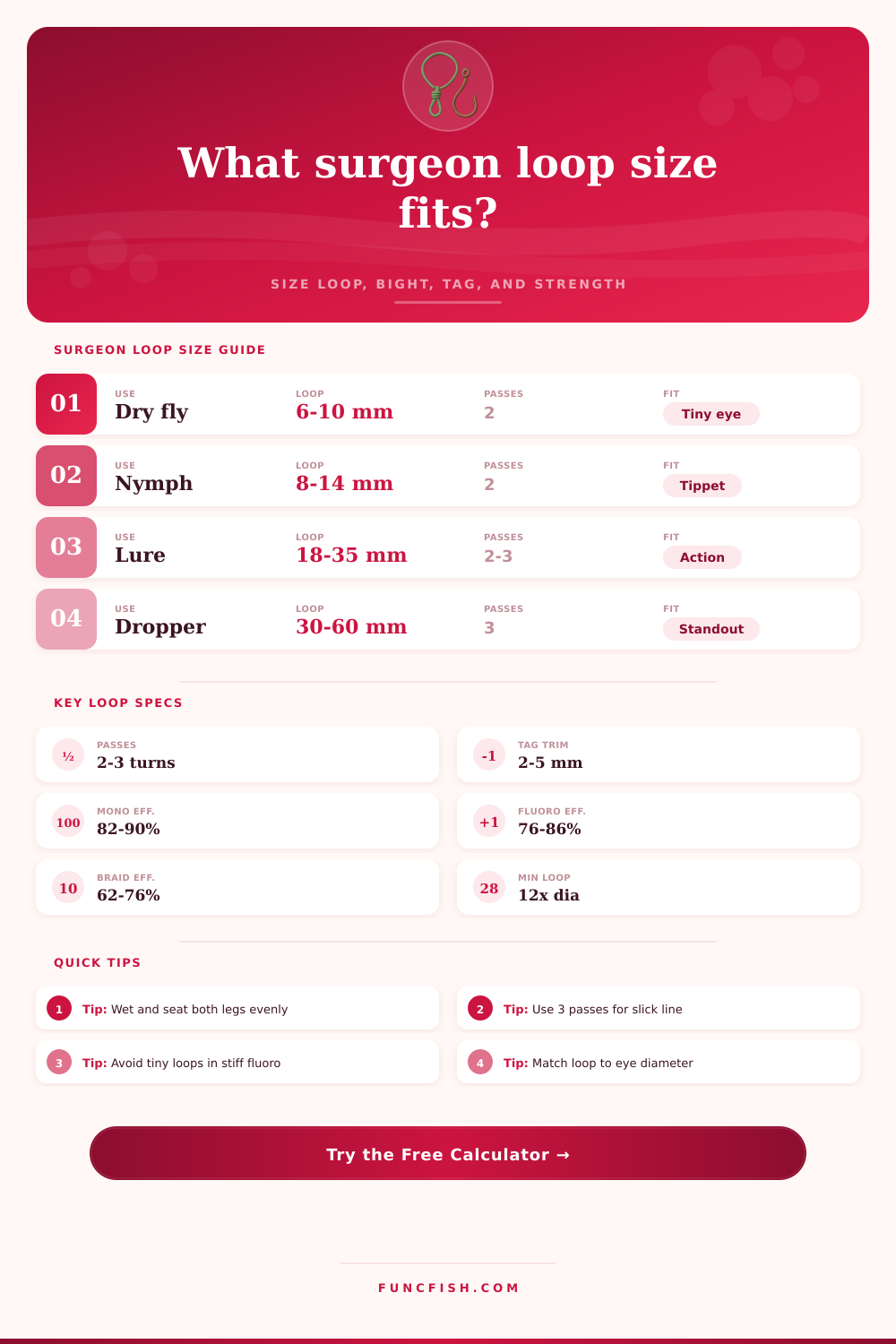
| Small dry fly or midge tippet | 6-10 mm / 0.24-0.39 in | Small hook eye | 2-5 lb / 0.9-2.3 kg | Smallest reliable loop should still exceed the line bend minimum. |
| Nymph or wet fly tippet loop | 8-14 mm / 0.31-0.55 in | Hook eye or tippet ring | 4-8 lb / 1.8-3.6 kg | A slightly larger loop seats cleaner with fluorocarbon tippet. |
| Loop-to-loop leader butt | 20-40 mm / 0.79-1.57 in | Welded fly line loop | 8-20 lb / 3.6-9.1 kg | Large enough to pass the leader spool or looped butt section through. |
| Dropper loop substitute | 35-75 mm / 1.38-2.95 in | Hook snood or bait branch | 8-30 lb / 3.6-13.6 kg | Longer loops stand out better but twist more in current. |
| Small lure action loop | 16-30 mm / 0.63-1.18 in | Snap, jig, or spoon eye | 6-15 lb / 2.7-6.8 kg | Keep the loop around three to five eye diameters for free swing. |
| Surf rig sinker loop | 45-90 mm / 1.77-3.54 in | Bank sinker or clip | 15-50 lb / 6.8-22.7 kg | Allow enough opening to change sinkers without crushing the knot. |
| Popping cork or float loop | 25-55 mm / 0.98-2.17 in | Cork wire or swivel | 10-30 lb / 4.5-13.6 kg | Moderate loop size reduces hinge slap while keeping the float free. |
| Heavy clip or swivel loop | 35-70 mm / 1.38-2.76 in | Large swivel eye | 20-60 lb / 9.1-27.2 kg | Heavy mono and fluoro need extra radius to avoid a sharp crease. |
💪Surgeon loop strength and pass count table
| Line type | Double surgeon loop | Triple surgeon loop | Four-pass use | Sizing adjustment |
|---|---|---|---|---|
| Soft nylon mono | 84-90% of line test | 86-91% of line test | Rarely needed | Use 12-16 line diameters minimum loop length. |
| Copolymer leader | 82-88% of line test | 84-90% of line test | Only for slick finishes | Use 14-18 line diameters minimum loop length. |
| Light fluorocarbon | 78-85% of line test | 80-86% of line test | Not usually better | Use 18-24 line diameters minimum loop length. |
| Stiff fluorocarbon | 74-82% of line test | 77-84% of line test | Bulky above 40 lb | Use 22-30 line diameters minimum loop length. |
| Coated braid | 66-76% of line test | 70-80% of line test | Useful if knot seats clean | Use 20-28 line diameters and a longer tag. |
| Slick 8-strand braid | 58-70% of line test | 64-74% of line test | Often improves holding | Use 24-32 line diameters and test the finished loop. |
| Nylon-coated wire | 50-62% of wire rating | 54-66% of wire rating | Can damage coating | Use large loops; crimps are often stronger for heavy wire. |
🎣Species and gear comparison grid
| Target | Common leader test | Typical line diameter | Useful loop size | Rig match |
|---|---|---|---|---|
| Trout, grayling, small stream fish | 2-6 lb / 0.9-2.7 kg | 0.13-0.23 mm | 6-14 mm / 0.24-0.55 in | Micro tippet loop or loop-to-loop leader. |
| Panfish and crappie | 4-8 lb / 1.8-3.6 kg | 0.18-0.28 mm | 10-25 mm / 0.39-0.98 in | Small jig, float, or hook eye loop. |
| Bass and walleye | 8-15 lb / 3.6-6.8 kg | 0.28-0.40 mm | 18-40 mm / 0.71-1.57 in | Lure action loop or snap loop. |
| Steelhead and sea trout | 8-15 lb / 3.6-6.8 kg | 0.26-0.38 mm | 18-45 mm / 0.71-1.77 in | Egg loop, fly loop, or float rig connection. |
| Redfish and inshore drum | 15-30 lb / 6.8-13.6 kg | 0.38-0.55 mm | 25-55 mm / 0.98-2.17 in | Popping cork, jig eye, or swivel loop. |
| Surf stripers and salmon | 20-40 lb / 9.1-18.1 kg | 0.45-0.70 mm | 40-85 mm / 1.57-3.35 in | Dropper branch or sinker-change loop. |
| Pike with coated trace | 20-60 lb / 9.1-27.2 kg | 0.35-0.80 mm | 35-75 mm / 1.38-2.95 in | Light trace loop where a crimp is unavailable. |
| Heavy bottom rigs | 30-80 lb / 13.6-36.3 kg | 0.60-0.90 mm | 55-110 mm / 2.17-4.33 in | Large sinker loop, clip loop, or branch loop. |
🔬Line diameter reference table
| Nominal test | Mono diameter | Fluoro diameter | Braid diameter | Loop sizing note |
|---|---|---|---|---|
| 2 lb / 0.9 kg | 0.13 mm / .005 in | 0.14 mm / .006 in | 0.06 mm / .002 in | Minimum loop is set by handling, not just bend radius. |
| 4 lb / 1.8 kg | 0.18 mm / .007 in | 0.18 mm / .007 in | 0.08 mm / .003 in | Good for small tippet loops and panfish rigs. |
| 6 lb / 2.7 kg | 0.23 mm / .009 in | 0.22 mm / .009 in | 0.10 mm / .004 in | Common trout, walleye, and finesse bass size. |
| 8 lb / 3.6 kg | 0.28 mm / .011 in | 0.25 mm / .010 in | 0.13 mm / .005 in | Small lure loops should clear the eye by several diameters. |
| 12 lb / 5.4 kg | 0.33 mm / .013 in | 0.30 mm / .012 in | 0.16 mm / .006 in | Loop-to-loop and small snap loops usually seat well. |
| 20 lb / 9.1 kg | 0.45 mm / .018 in | 0.40 mm / .016 in | 0.23 mm / .009 in | Increase loop radius for stiff fluorocarbon leaders. |
| 30 lb / 13.6 kg | 0.55 mm / .022 in | 0.50 mm / .020 in | 0.28 mm / .011 in | Large terminal eyes and dropper loops need visible clearance. |
| 50 lb / 22.7 kg | 0.70 mm / .028 in | 0.62 mm / .024 in | 0.36 mm / .014 in | Surgeon loops become bulky; test before relying on them. |
✅Loop sizing notes
Seat before trimming: Pull both standing line and loop legs steadily until the turns roll tight, then trim. A tag that looked safe before seating can shorten as the surgeon loop draws down.
Size from the object: The loop should clear the hook eye, swivel, cork wire, or sinker clip first, then satisfy the line diameter minimum. Stiff fluorocarbon often needs the larger of those two numbers.
The surgeon loop seems easy enough but there is a very fine art to getting them small enough to keep a fish pinned on the right size. Unfortunately for most fishermen, they learn this knot tying by feel and then when push comes to shove, they find themselves out-fighting a steelhead in swift current. Millimeters can make all the difference between a solid hookset and severing your leader.
Sometimes, it is all about the right bend radius for whatever line you use. When you enter the eyelet size and line diameter into the calculator above it does all the math for you. So you don’t have to guess if a loose loop is going to slip through or if a tight loop will bind. You simply enter in the rig scenario, material type, test strength, and how many passes you want to make. And it give you the starting bight mark and the finished length of the inside loop. It even estimates knot efficiency based on the number of passes you choose.
How to Tie a Perfect Surgeon Loop
Knowing that fluorocarbon doesn’t hold its strength as well as nylon lets you know when you can open up radius to avoid harming the fiber or if you need to add another turn for security. The nature of the loop also depends upon the materials used. Nylon loops flex easily while maintaining good breaking strength. It will fold up tightly in a circle with no loss in breaking strength. That’s why it works well for tying onto small hooks like those on a dry fly. It work even when the eye of the hook is very small.
When tying on fluorocarbon, however, you have a different animal; fluorocarbon has memory and is stiffer than nylon. It doesn’t want to bend and if forced to do so, when the loop is cinched down, it forms a hard crease which then becomes the weak point of the entire rig. The loop size calculator takes this into account and sets the smallest safe loop size depending on the stiffness of your leader material (mono vs. Stiff fluorocarbon).
Because braid has no stretch and is slippery, it makes things more complex. If you’re used to monofilament leaders tied to a braided main line, you know the difficulty of making them seat consistantly. That’s where a four- or even five-pass surgeon loop comes into play, adding grip and sticking power to the otherwise slippery fiber. The chart on the page breaks down material performance by number of passes. You’ll note that each additional pass strengthens the knot, but adds bulk to the knot as well.
Security vs. Profile is a tradeoff: a huge knot may hang onto a pike, but it can also spook a spooky trout, or catch on weed growth in weedy cover. Consider the eye of the hook you’re attaching to. Are you tying on a big swivel or a loop to a popping cork? How much diameter should that loop have? You want the loop to spin freely. Any binding will kill the action of lure and result in fewer hook-ups. So the calculator allows you to input the inside diameter of that eye and makes sure the resulting loop has sufficient room to clear. It also provides some slack for clearance, so when the rig turns the knot doesn’t actualy rub up against the knot. That’s particularly critical if you’re fishing a dropper setup or maybe a surf rig where turning that bait can twist the line.
Many anglers who are new to tying surgeon’s knots will snip down on the tag end. They think the tag should be as short as possible to avoid dangling threads. But a good surgeon requires some length to keep it together and to generate friction when it unravels. Two to five millimeters will ensure that the turns stays in place under shock loads. It may be clean looking, but you’ll risk exposure to the center of the knot where abrasion and fatigue occur. Depending on line diameter and material, the tool would of advised how much to leave for a trim allowance. Softer monofilament tends to compress more evenly than stiffer lines (e.g., heavy fluorocarbon) so leaving them with a little longer tag helps.
Nothing tests a knot like water. To seat a loop, you want your line wet so the turns can slide over one another without making too much friction heat as they tighten. Pull firmly in both directions, the loop and the two standing ends, and the turns will roll neatly together to form a compact loop with no gaps or weakness from rushing. There shouldn’t be any obvious gaps between coil turns; just a neat little package that looks the same all around. Again, it’s not a big deal but when the fish goes ballistic, it really makes a difference.
In short, mastering a good surgeon loop comes down to knowing what you’re working with. You’re juggling three things: Size. Strength. Flexibility. We adjust all these variables based off how much strength we need for the species we are pursuing. That’s where the calculator kicks in; it offers up a good starting point for those parameters. But then it’s time for your hands to finish.
Tie that sucker tight. Leave plenty of tag. Respect the bend radius. Seat that loop right and get its size right. Then you can stop worrying about the link and start concentrating on the fish.