Nail Knot Wrap Count Calculator
Estimate nail knot wraps, coil bite length, tag allowance, and expected connection strength from fly line diameter, leader material, line slickness, target load, and tying conditions.
This is the leader, backing, or mono making the nail-knot coils.
| Connection | Typical wraps | Diameter relationship | Primary concern |
|---|---|---|---|
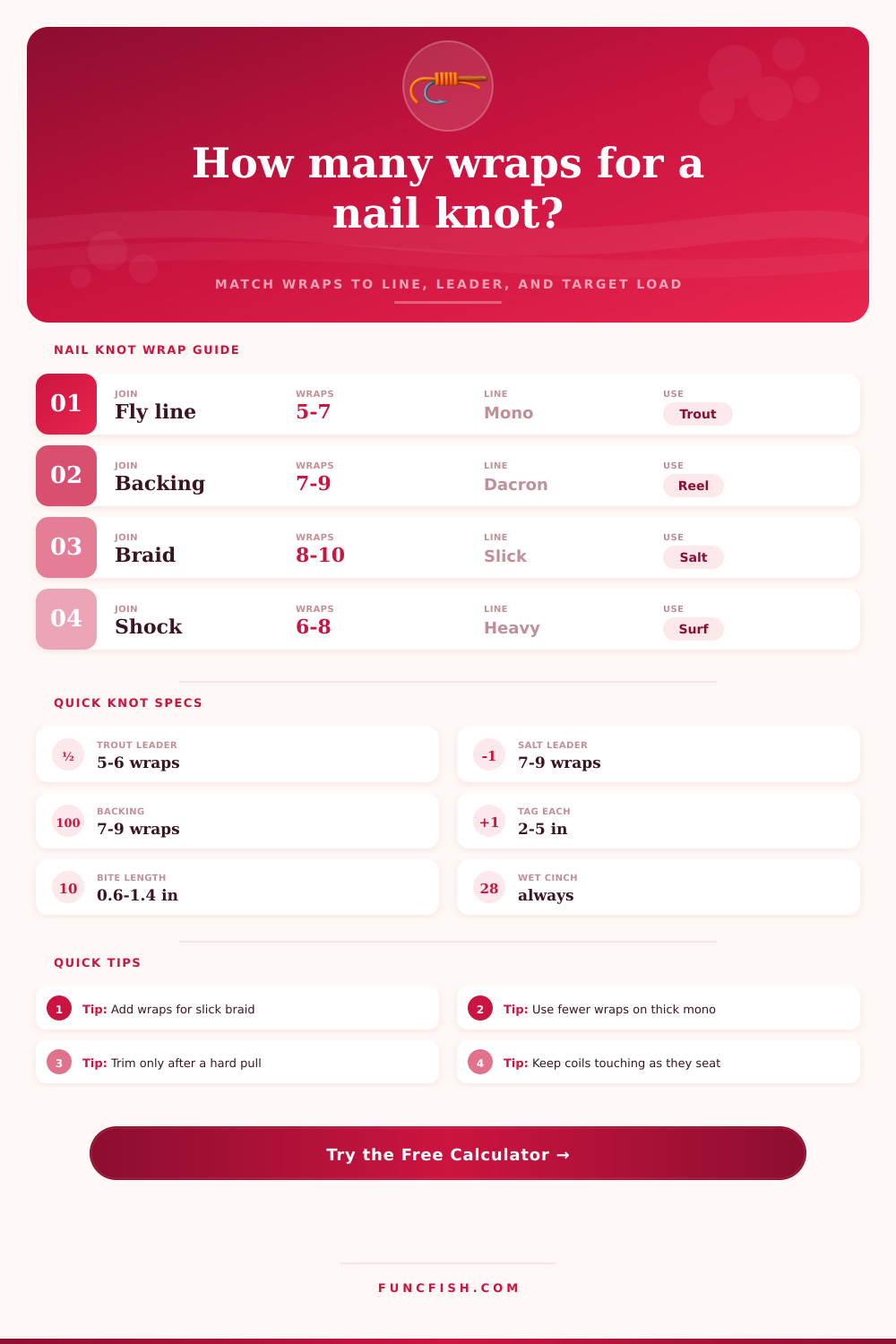
| Fly line to 3X-6X trout leader | 5-6 wraps | Leader much thinner | Neat, small coil that enters guides cleanly |
| Fly line to heavy bass butt section | 6-7 wraps | Butt close to coating diameter | Enough bite without making a hinge |
| Dacron backing to fly line core or coating | 7-9 wraps | Soft backing over larger cylinder | Coil length and steady seating pressure |
| Braid or gel-spun backing nail knot | 8-10 wraps | Slick line over coated surface | Slip resistance before trimming tags |
| Saltwater shock butt to fly line | 7-9 wraps | Stiff leader, large pull spikes | Grip, lubrication, and coating compression |
| Surf casting mono shock join | 6-8 wraps | Heavy mono over heavy mono | Compact strength under casting load |
| Wrapped material | Friction behavior | Suggested adjustment | Seating note |
|---|---|---|---|
| Nylon monofilament | Moderate friction, elastic | Base wrap count | Seats smoothly when wet and tensioned evenly |
| Fluorocarbon | Harder, springier surface | Add 1 wrap when above 20 lb | Pull slowly to avoid heat and crossing coils |
| Copolymer mono | Similar to mono with firmer jacket | Base count or plus 1 | Check that each coil lays shoulder to shoulder |
| Hard mono leader | Stiff and memory-prone | Add 1-2 wraps | Pre-straighten the butt before wrapping |
| Dacron backing | Soft and grippy but compressible | Add 1 wrap | Use a long, even pull before final trim |
| Braided PE or gel-spun | Slick and thin for its strength | Add 2-3 wraps | Leave longer tags until a hard pull test passes |
| Setup | Typical leader | Peak pull estimate | Wrap range |
|---|---|---|---|
| Small-stream trout, 3-5 wt | 4-8 lb butt or 3X-5X leader | 1-3 lb | 5-6 wraps |
| Panfish fly rod, 2-4 wt | 4-6 lb mono leader | 1-2 lb | 5-6 wraps |
| Bass bugs, 6-8 wt | 12-20 lb mono butt | 4-8 lb | 6-7 wraps |
| Steelhead or salmon Spey | 20-30 lb butt section | 8-14 lb | 7-8 wraps |
| Bonefish flats, 7-9 wt | 16-20 lb saltwater butt | 6-10 lb | 7-8 wraps |
| Tarpon or pike shock leader | 40-60 lb hard mono butt | 15-25 lb | 8-10 wraps |
| Tool | Best use | Wrap control | Adjustment |
|---|---|---|---|
| Smooth nail or knot tool | General fly line nail knots | Good coil spacing and easy withdrawal | Base count |
| Hollow needle or tube | Threading tag through tight coils | Excellent alignment if the tube is smooth | Base count |
| Small straw or coffee stirrer | Heavy mono and surf joins | Good for larger diameters | Add 0-1 wrap |
| Hand wrap only | Emergency field repair | Coils spread more easily | Add 1 wrap |
| Hemostat or small pliers | Cold hands or slippery backing | Can flatten coating if over-clamped | Use lighter seating pulls |
To most anglers, the nail knot is just a piece of string threaded on a stick. Wrap it till your fingers fall off, cinch it down, and hope for the best. Your fatigued fingers don’t know anything about friction. Friction knows all about coefficient of grip, line diameter and surface area between two material. How a slick braid slides across a dry fly line differs entirely from supple nylon biting into a coated core.
If you ignore those factors, you will get knots that either slip when under load or form such a bulky hinge they won’t fit through your rod guides. With this calculator above, we’ll do the math for you. We’ll convert those material properties into an exact number of wraps for you to tie and have confidence in, not guess at.
How Many Wraps You Need For Your Nail Knot
This is wrapped line material. This is backing or leader used as a main input that makes all the difference in the world. There are three types of line material: nylon monofilament, fluorocarbon, and braided PE line. Nylon monofilament is naturaly tacky and soft. So it will bite hard onto whatever it’s wrapped around. A few turns create quite a bit of friction by itself so you typically don’t need many.
Fluorocarbon is slick and stiff and takes a turn or two more than mono to hold as tight. At the other side of the spectrum is braided PE line. It’s very thin for its strength rating, super slippery and smooth. If you try to tie a braid nail knot using the same number of wraps as mono…you’re asking for trouble. When the fish hits hard, the braid simply slides over the core. Use more turns to account for it lacking grip.
And finally we come back to the core, whatever it may be (e.g., backing or fly line). You typically wrap with that. If it has a lot of coating, especially if it’s a full sinking line, the core is going to have a bigger diameter and might be waxed up as well. So now you’ve got a small coil that tucks down onto a bigger cylinder, and with a slicker coating you’ll want to have some number of wraps in order to create enough pressure over that greater girth.
The calculator accounts for that by measuring the core’s diameter relative to that of the wrapping material. And it makes sure you get a knot with the right length-to-thickness ratio; one that’s too short compared to the bulk will become a rigid hinge point that wrecks your casting cadence and stresses the tie-in. A well-sized knot moves effortlessy through the guides just as though it were part of the line.
And then think about what you’re tying when. On cold days, fingers don’t cooperate well with making precise coils. Leader material resist proper neat seating. The calculator has options for what type of conditions you’re using so adjust accordingly if you’re stuck on the shore of an ice hole or in a windy salt water environment. You can choose a finish quality rating and it compensates for the real world. It will recommend a couple more wraps if it knows you may not seat it perfectly. Better to go long on a knot than short on a knot that comes untied in the middle of the fight.
So rather than just telling you how many turns, it outputs a coil bite length: how long your core will be covered by a wrap. And then it estimates the seated strength at your desired load and the amount of extra safety for that load. Do you want a lot of margin of safety for tarpon? It is different than wanting some for panfish in a small creek. The tool helps you see that tradeoff. How to add wraps makes it stronger but also bulkier. There is a sweet spot where the knot is compact enough to cast easily, yet strong enough to hold.
Lastly, be sure not to trim the tags till you pull good and hard on the connection. Water or spit on the coils, seat them well and then pull steadily. Once you’re doing that, look for the wraps to touch each other side by side. Pull hard on the connection to seat the coils before you cut off any tag ends, and it’s good. That one step prevents most failures.
The nail knot is simple beauty but demands a certain attention to detail. Know the difference between materials and get the number of wraps correct. If you do, you’ll hardly notice the connection instead of having it hold you back.