Reel Torque by Handle Length Calculator
Compare crank torque, knob force, spool drag torque, and line pickup for spinning, baitcasting, conventional, surf, and jigging reels using handle length, gear ratio, drag load, and spool radius.
📌Handle torque presets
⚙Reel, handle, and drag settings
Higher ratios retrieve faster but require more handle torque at the same drag and spool radius.
Measure from spool center to the top layer of line; a full spool increases torque demand.
Use a lower limit for cold hands, small knobs, or long fights; use a higher limit for large power knobs.
Torque and handle-length results
Calculation breakdown
🎣Gear and species comparison grid
UL Trout
Bass Fast
Inshore
Pike Cast
Catfish
Surf
Jigging
Tuna Pop
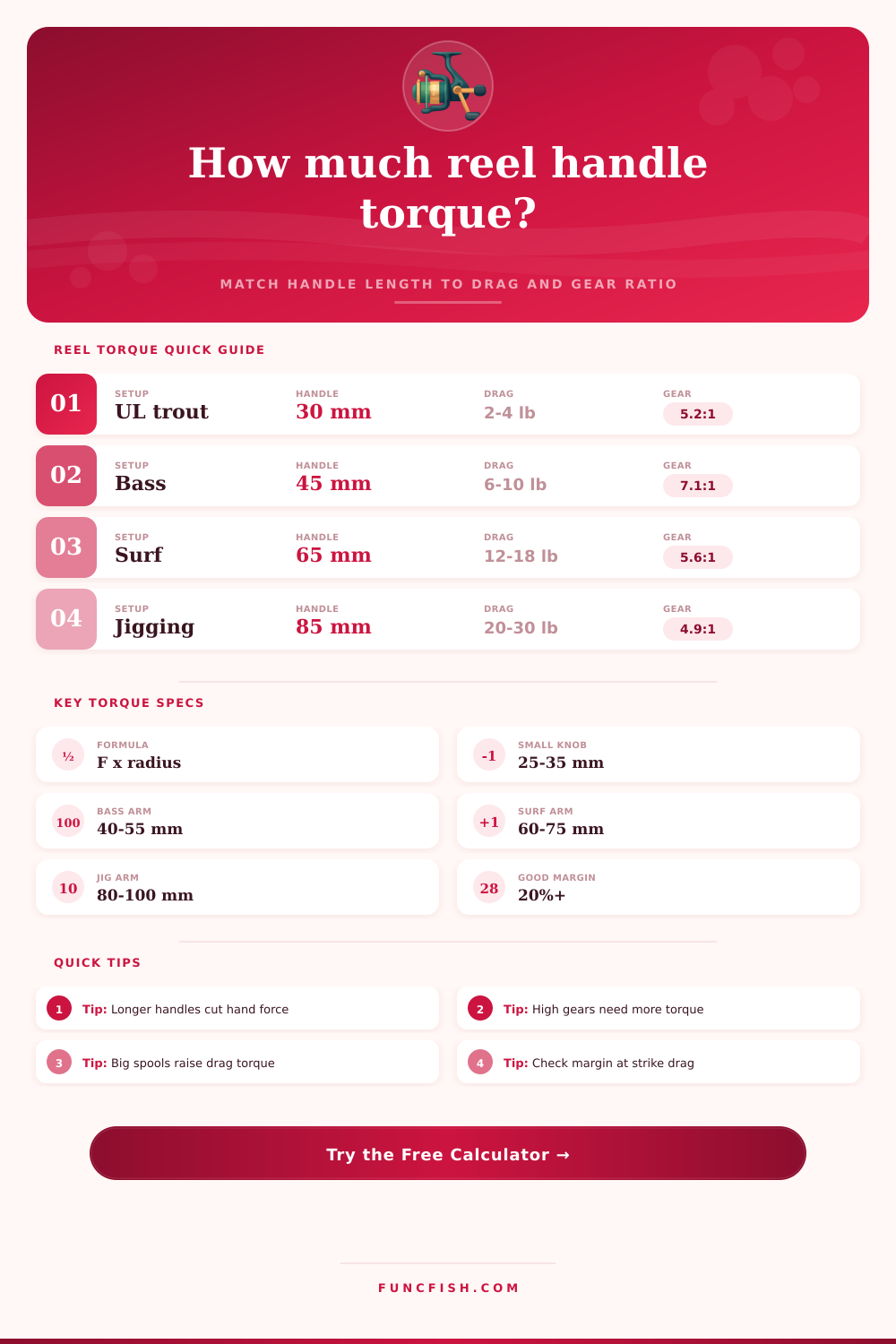
📏Typical reel handle arm lengths
| Reel class | Common arm length | Best use | Torque note |
|---|---|---|---|
| 500-1000 ultralight spinning | 25-35 mm / 0.98-1.38 in | Panfish, brook trout, ice rods | Fast fingers, low drag, limited leverage |
| 2500-3000 spinning | 40-50 mm / 1.57-1.97 in | Bass, trout, walleye, light inshore | Balanced retrieve and drag control |
| Low-profile baitcaster | 42-55 mm / 1.65-2.17 in per side | Bass, pike, casting lures | Longer arms help high gear ratios |
| Round baitcaster | 55-80 mm / 2.17-3.15 in | Catfish, swimbaits, trolling | Power handles reduce knob force |
| Surf spinning | 60-75 mm / 2.36-2.95 in | Stripers, salmon, surf casting | Large spool radius raises drag torque |
| Lever drag jigging | 75-100 mm / 2.95-3.94 in | Vertical jigging, amberjack, tuna | Long cranks suit low gears and high drag |
⚖Gear ratio effect on handle torque
| Gear ratio | Torque demand | Line pickup tendency | Good match |
|---|---|---|---|
| 4.1:1 to 4.9:1 | Lowest handle torque for a given drag load | Slow to moderate pickup | Deep cranking, bottom rigs, vertical jigging |
| 5.0:1 to 5.8:1 | Moderate demand with useful winching feel | Moderate pickup | Walleye, surf, catfish, all-round spinning |
| 6.0:1 to 6.8:1 | Noticeably higher torque at heavy drag | Fast pickup | Bass, inshore, lure casting |
| 7.0:1 to 8.5:1 | High knob force unless handle arm is longer | Very fast pickup | Slack-line techniques, frogs, jigs, pitching |
| 9.0:1 and higher | Highest torque demand under load | Maximum pickup | Specialized baitcasters with modest drag |
💪Comfortable knob-force reference
| Crank feel | Approx knob force | Typical duration | When to use in calculator |
|---|---|---|---|
| Finger-light retrieve | 2-5 lb / 0.9-2.3 kgf | All day | Small trout, panfish, finesse plastics |
| Comfortable fight | 6-12 lb / 2.7-5.4 kgf | Several minutes | Bass, walleye, redfish, schoolie stripers |
| Hard cranking | 13-20 lb / 5.9-9.1 kgf | Short bursts | Pike, surf fish, strong current, heavy lures |
| Power knob pull | 21-35 lb / 9.5-15.9 kgf | Brief pumps | Jigging, tuna, amberjack, heavy conventional reels |
| Too much for most reels | 36 lb+ / 16.3 kgf+ | Emergency only | Signals need for lower gear, longer arm, or less drag |
🐟Species drag and spool-radius reference
| Species or method | Working drag | Common loaded spool radius | Handle-length note |
|---|---|---|---|
| Panfish and stream trout | 1.5-4 lb / 0.7-1.8 kg | 0.45-0.65 in / 11-17 mm | Short handles are usually fine |
| Bass and walleye | 4-10 lb / 1.8-4.5 kg | 0.65-0.95 in / 17-24 mm | High gears benefit from 45-55 mm arms |
| Redfish, snook, pike | 8-16 lb / 3.6-7.3 kg | 0.80-1.15 in / 20-29 mm | Power knobs reduce fatigue |
| Surf stripers and salmon | 10-20 lb / 4.5-9.1 kg | 1.05-1.45 in / 27-37 mm | Large spools need extra leverage |
| Catfish and heavy bottom rigs | 12-25 lb / 5.4-11.3 kg | 0.95-1.35 in / 24-34 mm | Lower gear plus long arm feels steadier |
| Tuna, amberjack, vertical jigging | 20-40 lb / 9.1-18.1 kg | 1.00-1.60 in / 25-41 mm | Use long crank arms and high efficiency |
💡Torque calculation tips
Measure the real handle arm. Use the distance from the handle shaft center to the knob center, not the total handle plate length. Double-paddle baitcaster handles list overall plate length, so divide center-to-center plate length by two before entering it.
Check the full-spool case. Drag torque equals line tension times loaded spool radius, so a full surf or offshore spool can feel much harder at the handle than the same drag setting on a smaller or partly emptied spool.
When a big one hits, you’ll notice the line pulling hard. Your wrist cranks as drag seems heavier then ever. That’s physics in action, and a sign you need to adjust your reel setup to better suit this challenge.
Most of us think about line size or gear ratio. But we seldom consider the lever action involved in maintaining control of fast-moving fish. Before casting, the calculator above will do the math. That includes interaction between drag load and handle length.
Why You Need a Longer Reel Handle
Leverage is at the heart of it all Imagine your reel handle is a wrench turning a bolt. The longer the handle, the more leverage you have. Your hand doesn’t have to exert as much force to move an equal amount of resistance.
As you ramp up gear ratio to haul in your line more quickly, you’re multiplying the spool’s resistance. For instance, if you use a seven-to-one gear ratio, it retracts your line faster. It also require a lot more force from your crank to hold a consistent drag pressure on your line.
That’s why some bass anglers who fish with high-speed reels will change out their reel handles for longer ones when they’re fishing heavy cover. Longer handles reduce strain and help; without them, you are fighting the gears as much as you are fighting the fish.
Another factor in amount of effort is spool radius. Even though the drag might be set the same, turning a half-full spool take much less effort than does turning a full spool. As it gets more full, it loads on arbor and effectively makes its diameter larger. That means you now have to multiply the torque by the diameter which goes right back through the handle. For those who fish big tuna or other heavy species with a big conventional reel, it can mean several extra pounds of apparent force each time you turn the handle.
The chart on the page breaks all this down nicely so you see what sort of setup apply to species and accounts for loaded spool conditions. Ideally, you’d like to keep your margin positive even when the spool is full. But efficiency matters here as well.
Reels are not all perfect. Old grease in their reels’ gears, or a little extra friction in there bearings, can eat away at power applied by your hand. A new reel might pass ninety percent of your power to the line, but a ratty old reel might only pass on seventy-five. That’s where you have to work harder to get the job done and then some.
Say your hand strength limit is twenty-pounds of pressure on the knob. And by the math, you’re already at eighteen. Then a dirty reel moves you up into the pain zone. But checking that margin lets you know if you want something longer to help take some of the load off. Or you might want to service your gear ahead of time so you can head out.
When you start shopping around for new gear it’s tempting to get caught up in the technical specs. Gear ratio, drag rating, they makes those things front and center. But what about how the reel feels in your hand while you’re cranking on fish? Sure, maybe you have a reel rated at forty pounds max drag. But with too many gears or an inadequate handle length, you won’t be able to put anywhere near that much pressure on them before your wrist gives out.
Don’t forget; we’re not talking about pure brute strength here. We’re looking for controlled power that you can maintain throughout a long fight. You don’t want to winch hard for three seconds then give out because your arm is tired, you want to wind smoothly for twenty minutes.
Keeping your handle length appropriate for your load saves your energy. It protects your joints as well. It just works when it’s matched well. It requires much less effort because the leverage is doing the heavy lifting.
The next time a fish hurts your forearm, consider using a longer rod instead of your standard one. Before throwing blame at your fitness level check your gear first. You can be as strong as you want but physics don’t care. They only care about how long the lever you hold is. Match that up correctly and what was once a brutal struggle becomes a manageable rhythm keeping both you and the fish in the game for the long haul.