Kite Fishing Line Length Calculator
Estimate the fly line to reach your farthest release clip, the drift-adjusted bait window, clip spacing, kite height, and backing reserve for live-bait kite fishing spreads.
📌Kite spread presets
⚙Line geometry and drift inputs
Use true wind at the boat, not apparent wind during a turn.
Lower angles require more line for the same downwind bait distance.
Include tower, bow, pier rail, or cockpit separation from kite reel to bait rod.
Enter usable capacity after arbor, knots, markers, swivels, and clip hardware are considered.
Kite line length estimate
Full calculation breakdown
📊Kite and line data grid
Light-Wind Sled
Standard Sled
Heavy-Wind Kite
Helium Assist
80 lb Dacron
100 lb Dacron
80 lb Braid
80 lb Mono
📏Reference tables
| Wind class | True wind | Common kite angle | Typical clip spacing | Line planning note |
|---|---|---|---|---|
| Very light | 3-8 kt / 6-15 km/h | 32-44° unless helium assisted | 25-40 ft / 8-12 m | Low angle uses extra line quickly |
| Light | 8-12 kt / 15-22 km/h | 38-48° | 35-50 ft / 11-15 m | Good for two close live baits |
| Steady | 12-20 kt / 22-37 km/h | 45-58° | 45-65 ft / 14-20 m | Most three-clip spreads fit here |
| Fresh | 20-28 kt / 37-52 km/h | 52-65° | 50-75 ft / 15-23 m | Higher kite angle offsets longer spread |
| Gusty | Variable 15+ kt | Reduce by 3-8° | Shorten 10-20% | Carry more spare line for surges |
| Clip layout | Clip count | Spacing range | Added stack length | Best spread shape |
|---|---|---|---|---|
| Single bait | 1 | 0 ft / 0 m | 0 ft / 0 m | Close pitch bait or rough sea |
| Compact pair | 2 | 30-45 ft / 9-14 m | 30-45 ft / 9-14 m | Small boat sailfish or kingfish |
| Standard triple | 3 | 45-60 ft / 14-18 m | 90-120 ft / 27-37 m | Common offshore kite line |
| Wide triple | 3 | 60-80 ft / 18-24 m | 120-160 ft / 37-49 m | Tournament or clear-water spread |
| Four-clip line | 4 | 35-55 ft / 11-17 m | 105-165 ft / 32-50 m | Double-kite or tuna layout |
| Kite reel line | Nominal strength | Typical diameter | Use case | Capacity effect |
|---|---|---|---|---|
| Dacron kite line | 80-130 lb / 36-59 kg | 0.030-0.040 in / 0.76-1.02 mm | Clip-friendly offshore setups | Bulky but easy to handle |
| Hollow braid | 65-100 lb / 29-45 kg | 0.016-0.022 in / 0.41-0.56 mm | Long capacity with low stretch | Fits more line on small reels |
| Monofilament | 50-80 lb / 23-36 kg | 0.028-0.035 in / 0.71-0.89 mm | Smooth release and simple knots | Stretch softens gust loads |
| Spectra backing | 80-130 lb / 36-59 kg | 0.018-0.025 in / 0.46-0.64 mm | Capacity behind Dacron top shot | High capacity reserve |
| Target species | Bait reach from boat | Bait drop below clip | Typical soak | Line planning priority |
|---|---|---|---|---|
| Sailfish | 120-240 ft / 37-73 m | 15-35 ft / 5-11 m | 20-40 min | Clean separation between baits |
| Yellowfin tuna | 180-360 ft / 55-110 m | 20-50 ft / 6-15 m | 30-60 min | Long reserve for boat drift |
| Blackfin tuna | 90-180 ft / 27-55 m | 12-30 ft / 4-9 m | 15-35 min | Compact clips and fast reset |
| Kingfish | 80-180 ft / 24-55 m | 10-30 ft / 3-9 m | 20-45 min | Keep bait near current edge |
| Shark | 150-400 ft / 46-122 m | 25-80 ft / 8-24 m | 45-90 min | Large reserve and heavy line |
🎣Gear and species comparison grid
| Scenario | Kite choice | Line type | Clip layout | Recommended reel capacity |
|---|---|---|---|---|
| Two-bait sailfish, light wind | Light sled or helium assist | 80 lb Dacron top shot | 2 clips at 35-45 ft | 350-450 yd / 320-410 m |
| Three-bait sailfish, steady wind | Standard sled | 80-100 lb Dacron | 3 clips at 45-60 ft | 450-600 yd / 410-550 m |
| Yellowfin long soak | Large sled or foil | 80 lb braid with Dacron section | 3-4 clips at 60-75 ft | 600-800 yd / 550-730 m |
| Kingfish pier or edge | Pier kite or standard sled | 50-80 lb mono or Dacron | 1-2 clips at 25-45 ft | 300-500 yd / 275-455 m |
| Gusty rough-water spread | Heavy-wind kite | 100-130 lb Dacron | 1-2 clips, shortened | 450-650 yd / 410-595 m |
💡Calculation notes
Clip spacing note: The calculator treats the farthest clip as the controlling point. If three clips are spaced 50 ft apart, the stack adds 100 ft of line between the near and far release positions before spare line is added.
Drift note: Drift allowance is projected into the wind line. A downwind drift adds most of the distance, crosswind drift adds less, and opposing current can reduce the required reach for the same bait window.
When your kite line runs out while still short of desired depth, you panic. Why? Because you viewed line capacity as a straight length issue instead of a geometry issue. By learning math of kiting, which balances your reel’s physical constraints against wind direction and current flow, you can fish the kite effectivly.
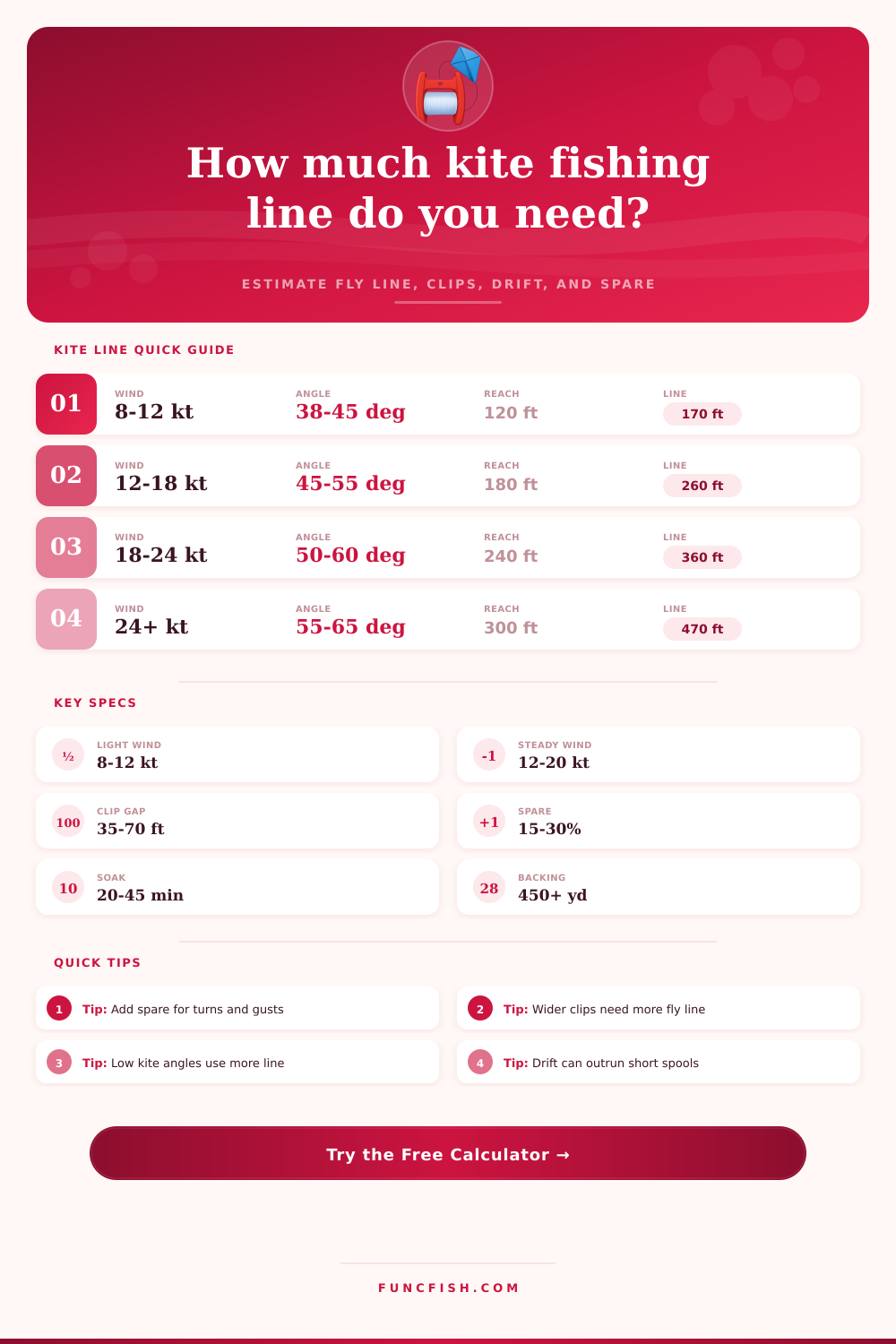
Line payout isn’t necessarily horizontal distance. When you’re flying your kites in light winds, they tend to be about thirty-five to forty-five degrees off the water, which means they are low to the surface. That means you’d better have plenty of braid or Dacron on deck to pull a bait out sixty feet down wind from you… not just what a ruler says it is.
How to Calculate Your Kite Line Needs
This calculator does trigonometry for you and turns that angle into real world footage for you. It shows how much braid or dacron to drop. Most folks forget this when they start spooling out their final fifty feet on a critical bite.
What may work well in a fifteen knot wind could strand you in ten knots, and the boat hasn’t budged. Static charts don’t tell you about drifting, which add another dimension to the equation. Even a half knot downwind current means your bait cluster are going farther from the reel than the kite line indicates; most anglers figure the boat’s holding station based off that.
Soak time is also important. With moderate drift, release clips goes hundreds of feet in just a half hour. Estimate your drift speed and time, and the calculator above will compute how far it went. It then factors that into total line needed, plus a safety margin (often twenty percent) for gusts and turns. That gives you an insurance policy against running out of line when you set hook and lose fish.
How much spread is needed varies by species. You can see this on the page. Certain species, like yellowfin tuna, require deeper drops and longer lines. This stretches total rigged length beyond three hundred feet, sometimes up to four hundred feet, especially in consistent wind. In lighter air, sailfish may only want less bait, but they need wider spacing between two adult-sized sofa so the baits do not tangle. You are not prepared for other situation if you fill up for just one.
Filling a reel to capacity in one scenario only to hope for the best is no good. A heavy tuna rig in a light-wind sailfish day slow down the retrieve and makes handling thinner lines difficult. Skimping on line to suit a single scenario could of cost you a lot of money at boat.
To use it, find your reel’s true usable capacity by subtracting space for knots, swivels, etc., then enter that number into calculator and go from there. Enter that number into the calculator and go from there. If it says you’re cutting it close, either tighten up your planned clip spacing or shorten your soaking time. You’d rather fish a tight line confidently than risk running out mid-spread when trying to cover a wider area.
Preparation is a confidence booster. It puts anxiety in its place. You know where your limit lies before you set foot in the boat. And now you can read the water instead of staring at that reel counter. Bait hangs right and the kite flies true. When they come you have line to back them up. Those are the things that make for a trip you remember versus a frustrating one.