Pitch Distance Accuracy Calculator
Estimate pitching accuracy score, hit probability, aim correction, target size, wind drift, and practice progression for close-range fishing casts around docks, cover, bank slots, brush, and current seams.
📌Pitch accuracy presets
⚙Pitch measurement settings
Measure from rod tip position to the middle of the opening or target ring.
Use the clear landing window, not the whole dock slip or grass hole.
Average absolute miss sideways from a 10 to 20 cast set.
Track distance misses separately so the aim correction stays useful.
Pitch distance accuracy forecast
Full formula breakdown
📊Line and rig response grid
Monofilament
Fluorocarbon
Braid
Wire Leader
📏Pitch distance target table
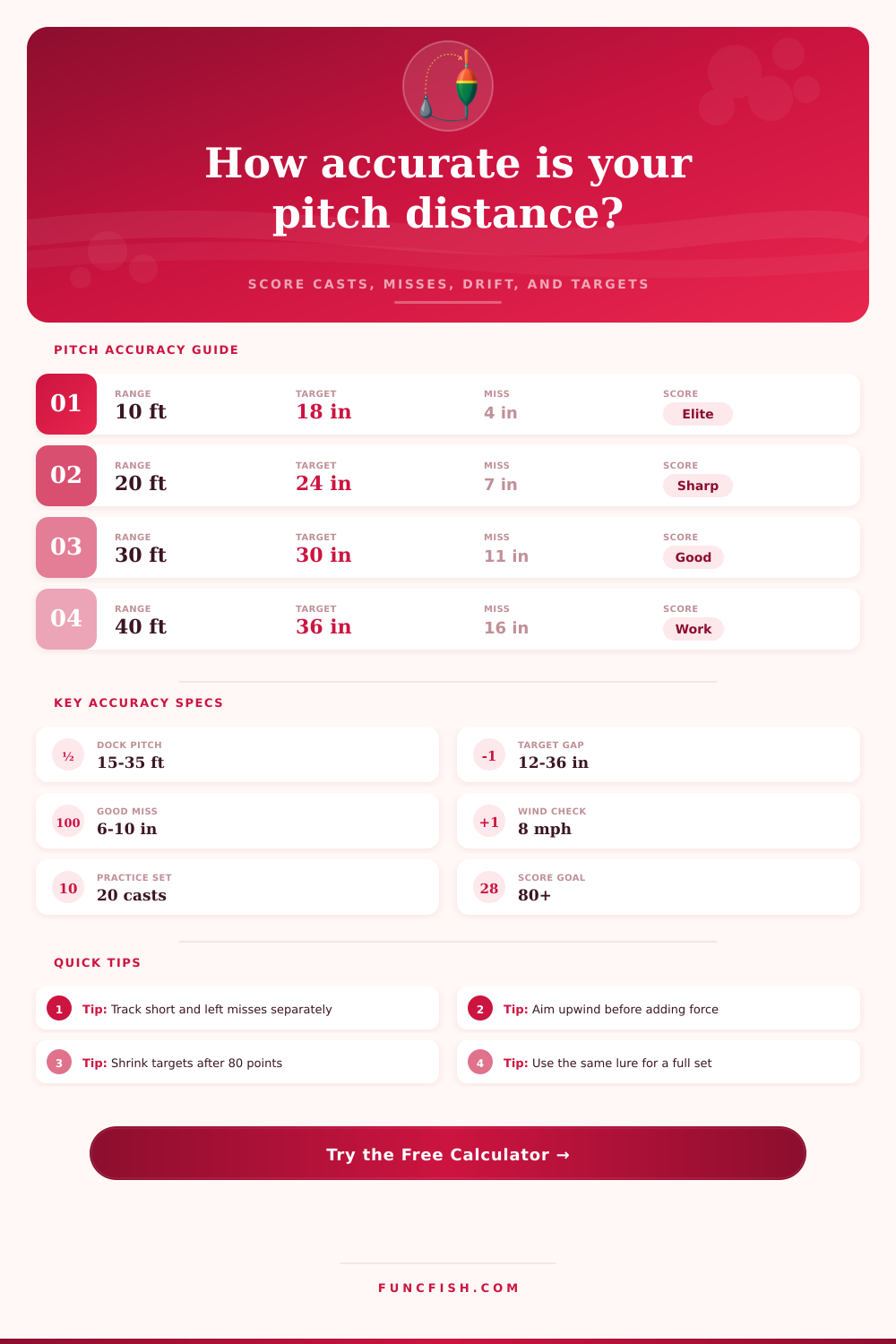
| Pitch range | Training target | Strong average miss | Practical fishing use |
|---|---|---|---|
| 8-12 ft / 2.4-3.7 m | 10-14 in / 25-36 cm | 2-4 in / 5-10 cm | Short flip to holes, posts, or roots |
| 13-22 ft / 4.0-6.7 m | 14-22 in / 36-56 cm | 4-7 in / 10-18 cm | Dock edges, brush pockets, and bank slots |
| 23-32 ft / 7.0-9.8 m | 22-30 in / 56-76 cm | 7-11 in / 18-28 cm | Laydowns, grass holes, and current pockets |
| 33-45 ft / 10.1-13.7 m | 30-42 in / 76-107 cm | 11-17 in / 28-43 cm | Long bank pitch, bridge face, or open reeds |
🌀Wind and lure correction table
| Condition | Light rig under 1/8 oz | Medium rig 1/4-3/8 oz | Heavy rig over 1/2 oz |
|---|---|---|---|
| Calm to 4 mph | Small aim change | Small aim change | Almost none |
| 5-9 mph crosswind | Aim 8-16 in upwind | Aim 4-10 in upwind | Aim 2-6 in upwind |
| 10-14 mph crosswind | Open target only | Aim 10-18 in upwind | Aim 5-10 in upwind |
| Headwind | Add range aim | Lower flight path | Use normal line |
| Tailwind | Reduce force | Reduce range aim | Keep thumb pressure |
🐟Species and cover reference
| Target fish or cover | Typical pitch distance | Opening size | Accuracy priority |
|---|---|---|---|
| Bass dock posts | 15-35 ft / 4.6-10.7 m | 12-30 in / 30-76 cm | Side miss control |
| Crappie brush pockets | 10-25 ft / 3.0-7.6 m | 10-24 in / 25-61 cm | Soft entry and depth |
| Walleye current eddies | 18-38 ft / 5.5-11.6 m | 24-48 in / 61-122 cm | Range and drift |
| Redfish grass holes | 20-45 ft / 6.1-13.7 m | 18-42 in / 46-107 cm | Wind correction |
| Trout branch windows | 8-22 ft / 2.4-6.7 m | 8-18 in / 20-46 cm | Low trajectory |
⚖Pitch method comparison grid
Pendulum Pitch
Best for repeatable dock and brush targets. It rewards a stable rod stop and consistent lure hang length.
Roll Pitch
Best when cover blocks a straight underhand path. It usually adds side bias but protects low clearance.
Skip Pitch
Best for shaded dock lanes and overhangs. It uses a wider target because bounce angle adds scatter.
Fixed-Line Flip
Best inside 15 ft. It has low range error but needs close boat or bank positioning.
📋Score bands and practice progression
| Score band | Hit rate | Practice target change | Fishing interpretation |
|---|---|---|---|
| 90-100 | Very high | Shrink target 10-20% | Ready for narrow posts and small holes |
| 75-89 | High | Hold target, add wind angle | Reliable working accuracy for cover |
| 60-74 | Moderate | Repeat set at same distance | Usable, but misses may bump cover |
| 40-59 | Low | Move closer or enlarge target | Needs a larger window before fishing tight cover |
| Under 40 | Very low | Reset mechanics and distance | Measure bias before changing tackle |
Accuracy tip: Record lateral miss and range miss as two separate averages. A pitcher who misses 8 inches short needs a different correction than a pitcher who misses 8 inches left.
Wind tip: For crosswind practice, aim upwind first and keep the same pitch force for a full set. Changing force and aim together makes the correction hard to read.
Casting precision is what make the difference between catching a fish or scaring one off. Inches is often the difference. Sometimes you’ll get it right on the money. Other times, even with a perfect read of current and the best rig in water, your lure falls three feet left and the fish dives for deeper water.
Precision casting isn’t about brute force; it’s about control. It shows the difference between good angler and mediocre ones around cover. Folks think they’re pretty good casters until they attempt to place a bait within an inch or two of the same piece of cover five casts in a row. That’s when the reality check come in….and it typically hits fast.
How to Cast with Precision
Precision casting is less about raw power and more about control; whereas to pitch, you keep a hand on reel and make very short, controlled strokes with rod tip. You’re trying to place your bait in a certain area, not necessarily hit specific distance. When fishing near something like mangroves, dock legs, brush piles, etc., you don’t have much room for error.
Your accuracy is measured by how well you can hits a specific target size compared to your average miss distances. The above calculator puts that number into perspective by showing you what that score mean for your actual fishing success rate.
Pitching accuracy is hugely influenced by wind. In open water, maybe you don’t notice a slight breeze, but if you’re trying thread your lure through narrow opening between branches in a laydown, that same breeze pushes your bait out to the side. Even five miles per hour crosswind cause noticeable drift. To compensate, the tool allow you to input wind direction and wind speed to adjust your aim accordingly.
That’s important because most of us undercompensate for wind drift on short casts. We believe the lure will just plow right through but long line lengths and light lures actualy behave like sails. By aiming upwind and then raising the rod tip, you’ll change the outcome.
Another big factor in the accuracy is line choice. Because braid doesn’t stretch, whatever you do with your wrist goes direct to the lure. It is super accurate, but there is no forgiveness if you’re not perfect. On the other hand, monofilament will stretch and absorbs some of those little details in your timing in releasing the bait. But it will also lose a bit of energy causing you to overshoot distance ever-so-slightly. Somewhere in between is fluorocarbon, giving you a good view of lure while providing moderate amount of stretch.
These tables come preloaded with tool that breaks down how each of the lines behave when stressed. So instead of defaulting to whatever’s on the spool, you can choose correct combo for the conditions.
Tracking your misses separately improves results faster than just feeling your way through a day of fishing. Consistent short misses is fixed with adjustment to release timing or rod stop. Left and right equal misses indicates footwork or stance different than lack of power. Two mistakes mixed up are difficult to isolate. Addressing each separately can be done with specific mechanical changes. The calculator show you which areas need more attention… Distance control or side-to-side accuracy.
You should mimic tournament pressure. “When I’m practicing, I don’t throw at an open-water spot because there’s no consequence if I miss. There has to be something to aim at. A particular limb or a dock piling, and as you get more accurate, you have to make them smaller. So if you can hit a 20-inch window with ease, tighten them down to 12-inches. That creates muscle memory that carry over when a fish is right in front of you. Sometimes it’s boring practice stuff, but if you want to make technical presentations consistently, this is how.”
At its core, good pitching comes down to repetition and rhythm, not brute force. When you understand your own biases, the weight of your lures, and how wind affects them, the math flows through your hands and becomes second nature. Instead of thinking in inches, they rely off feel. You can put the bait right where it should go; no noisy slap downs on top of water or worry about snagging on weed tops. It makes fishing fun again, which translates into making tough-to-fish cover approachable. And that’s the essence of precision casting.