Line Pickup Rate by Spool Diameter Calculator
Estimate real retrieve rate from spool diameter, gear ratio, fill depth, line lay, handle cadence, and drag slip so pickup matches your fishing presentation.
📌Scenario presets
⚙Spool and retrieve inputs
Line pickup forecast
Calculation breakdown
🎣Reel pickup comparison grid
Small Spinning
2500 Spinning
Baitcaster
Surf Spinning
📊Spool diameter pickup table
| Effective diameter | Circumference | Pickup at 5.2:1 | Pickup at 6.2:1 | Pickup at 7.1:1 |
|---|---|---|---|---|
| 1.25 in / 31.8 mm | 3.93 in / 10.0 cm | 20.4 in / 51.9 cm | 24.3 in / 61.8 cm | 27.9 in / 70.8 cm |
| 1.50 in / 38.1 mm | 4.71 in / 12.0 cm | 24.5 in / 62.2 cm | 29.2 in / 74.2 cm | 33.5 in / 85.0 cm |
| 1.75 in / 44.5 mm | 5.50 in / 14.0 cm | 28.6 in / 72.6 cm | 34.1 in / 86.5 cm | 39.0 in / 99.0 cm |
| 2.00 in / 50.8 mm | 6.28 in / 16.0 cm | 32.7 in / 83.0 cm | 39.0 in / 99.0 cm | 44.6 in / 113 cm |
| 2.40 in / 61.0 mm | 7.54 in / 19.1 cm | 39.2 in / 99.6 cm | 46.7 in / 119 cm | 53.5 in / 136 cm |
⚖Line and fill adjustment table
| Adjustment | Typical range | Pickup effect | Calculation note |
|---|---|---|---|
| Spool fill level | 60-98% | largest effect | Fill changes effective diameter before every crank |
| Line lay efficiency | 86-99% | small to moderate | Cross-wraps and spool oscillation reduce clean circumference |
| Drag slip | 0-18% | direct loss | Line leaving the spool cancels part of each handle turn |
| Line compression | 0-5% | minor loss | Soft mono beds into lower wraps more than braid |
| Cadence | 20-90 rpm | speed only | Cadence changes pickup per minute, not pickup per turn |
🐟Fishing scenario reference
| Scenario | Common pickup target | Useful spool range | Cadence cue |
|---|---|---|---|
| Finesse bass slack pickup | 27-36 in/turn | 44-50 mm spinning | Short bursts after rod lift |
| Trout stream drifting | 18-26 in/turn | 34-42 mm spinning | Match current without dragging lure |
| Surf plug recovery | 40-55 in/turn | 58-72 mm long spool | High cadence between sweeps |
| Jig pitching baitcaster | 25-34 in/turn | 32-36 mm baitcast | Fast slack pickup before hookset |
| Vertical walleye jigging | 22-32 in/turn | 38-48 mm spinning | Controlled pickup after lift |
| Offshore line recovery | 35-60 in/turn | 55-90 mm conventional | Pump-and-wind with low slip |
🔀Pickup style comparison
High Ratio
fastBest when slack has to disappear quickly after a sweep, pitch, or missed strike.
Large Spool
wideMaintains more pickup late in a long cast because the diameter drops less.
Full Fill
near maxGives the advertised retrieve rate; a low spool can lose several inches per turn.
Slip Load
realDrag, line belly, and lure resistance trim the theoretical pickup into usable pickup.
💡Calculation tips
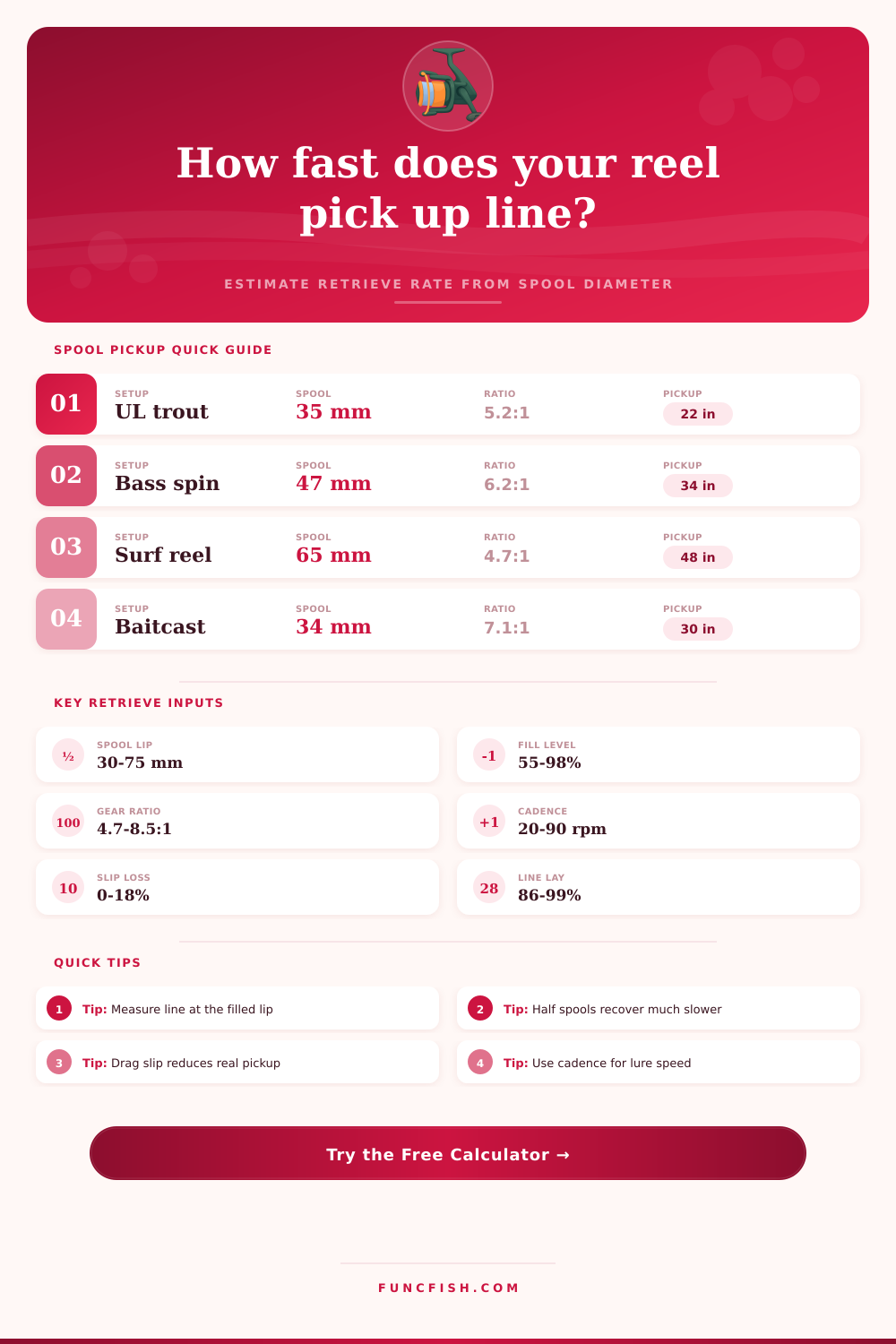
Measure the diameter that line actually leaves from. On spinning reels, measure near the filled spool lip; on baitcasters and conventional reels, use the current wrapped line diameter across the spool.
Use fill level for the moment you care about. A long cast starts near full diameter and ends at a smaller diameter, so this calculator estimates the average working pickup after fill and loss adjustments.
If you’re like most of us, you purchase a reel by its stated retrieve rate. They say it’s 34 inches per turn so you figure each time you thumb the handle, you’ll be getting 34. That is not true. As soon as you dial back your line count, that number dissapears. This happens especially when using small arbor reels with heavy braid or mono.
Knowing how gear ratio, spool diameter and fill level works together gives you a better perspective on selecting the right tool for the task at hand. But it also enlightens you as to why your ultralight trout rod is feeling slow on a long drift followed by needing to play some slack. So what does this all mean?
Why Your Reel Speed Changes
You’ll notice when you input your specific setup in the calculator (above), that it factors in variables that other companies don’t consider. Drag slip, handle cadence, you enter those variables and the calculator runs numbers for you. And it do so realistically. Fishing is dynamic. Open-water retrieves require a different approach than frantic burning of line to close the distance on a jig-biting bass. Enter the variables into the equation and you’re given an estimate of how fast you can expect to pull in 80 feet of line based off your situation.
The retrieval speed depend on how full the spool is. A full spool has much greater diameter than a half full spool. In other words, you bring up less line with every handle turn. That’s particularly true of big conventional offshore setups and big spinning reel. The page provides a clear table that shows how much shrinkage occurs to the effective circumference as you pull the wraps off the spool. So if you reel out 100 yards of heavy braid on a baitcaster, you may have half the retrieve rate when you begin the fight compared to the rate at which you were casting. Physics doesn’t care; you just need to plan accordingly. Going to a bigger spool will always provide a higher minimum diameter so that you keep picking up the same amount regardless of how low the level get.
Finally there is line lay efficiency. Not all line wraps neatly every time. Uneven stacking causes cross-wrapping and reduces actual circumference a bit. For example, braided lines are known to lay down a little cleaner than chunky monofilaments. Monofilament can compact on itself creating new layers. This affects the circumference. You can account for that with the calculator. It provides a truer representation of your reel’s mechanical advantage. It is a small point, but it adds up cast after cast.
Another consideration is gear ratio. Gear ratio matters but in a way most of us don’t realize. Higher ratio reels picks up line quicker with each turn. It’s very satisfying when trying to strip slack. But that doesn’t mean it has more power. A lower ratio provide more torque, which helps when fighting big fish or pulling hard on the line with heavy baits.
So what do you need? That will depend on what type of technique you do most. If you use light techniques to fish then higher ratios can help eliminate slack quicker. If you love to pull heavy jigs then go low as you get more power and control. Pick the one you feel matches the load you anticipate putting on it. Don’t pick it purely because you like how fast it goes on paper.
The human factor comes from cadence Not all anglers crank equally. You can set your own personal turns per minute. It takes a static set of gear specifications and makes them alive with performance numbers. For example, you might have a high-ratio reel that feel sluggish if you turn the handle slowly and steadily. Or maybe you’ve got a fast cranker on a low-ratio reel who can still maintain impressive retrieve speeds. It goes to show that it’s not just about the gear ratio; it’s also about how you pair it. If the reel is heavier than what you can crank comfortabley on your wrist, you’ll never see what this reel is capable of picking up.
But at its core, line pickup is all about joining the mechanics of the process with the presentation. Quick-paced retrieves demand quick slack retrieval while maintaining steady tension. Slow retrieves call for tender handling without pulling the bait away from an uncertain fish. Dialing in that combo comes when you know your true speed. It takes you out of marketing numbers and puts you squarely in the area of application. Now you choose reels not by looks on the store shelf but by performance under load.
Next time you set the hook and feel it pull drag more than anticipated, take a peek at the spool fill. Chances are, that’s all that stands between you and the fish.