Trolling Depth by Line Out and Speed Calculator
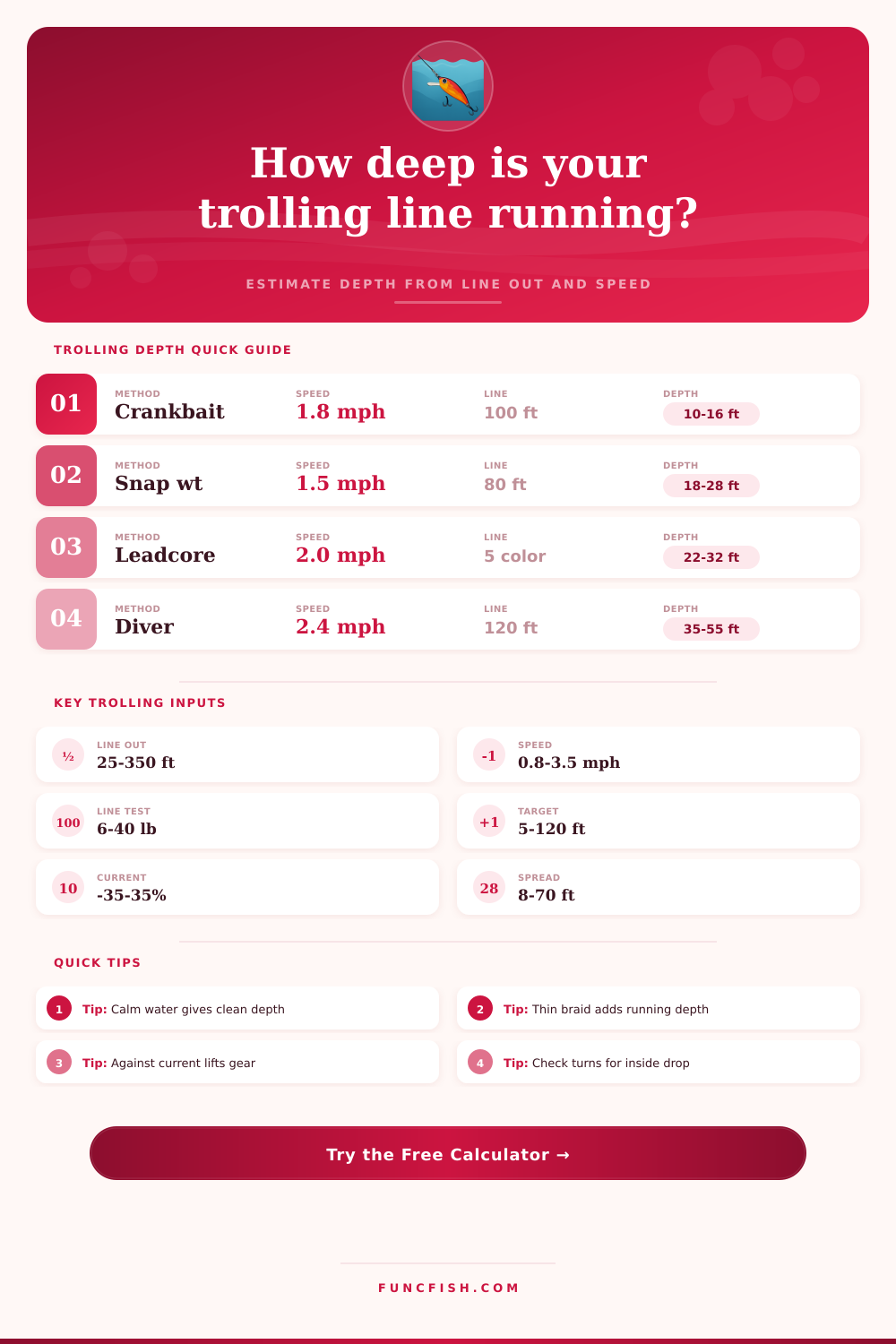
Estimate running depth from line out, boat speed, trolling device, line diameter, current, rod height, and terminal drag.
📌Scenario presets
⚙Trolling depth inputs
Trolling depth forecast
Full calculation breakdown
📊Method depth profile grid
Flatline Crank
Snap Weight
Leadcore
Diver Disk
📐Line-out depth reference
| Setup | Line out | Typical speed | Expected running depth | Primary limiter |
|---|---|---|---|---|
| Small walleye crank on braid | 90-140 ft / 27-43 m | 1.5-2.0 mph / 2.4-3.2 km/h | 10-20 ft / 3-6 m | Crankbait dive curve and line diameter |
| 1 oz snap weight with crawler harness | 50-110 ft / 15-34 m | 1.0-1.5 mph / 1.6-2.4 km/h | 12-25 ft / 4-8 m | Weight, leader drag, and speed lift |
| Leadcore with spoon | 3-7 colors / 90-210 ft | 1.8-2.4 mph / 2.9-3.9 km/h | 15-38 ft / 5-12 m | Core segment length and terminal drag |
| Directional diver on wire | 90-220 ft / 27-67 m | 2.1-2.8 mph / 3.4-4.5 km/h | 30-85 ft / 9-26 m | Diver setting and side sweep |
| Downrigger ball | Ball cable set depth | 1.5-3.0 mph / 2.4-4.8 km/h | Set depth minus blowback | Cable blowback and ball weight |
🎯Species and presentation comparison
| Target | Common depth zone | Typical speed | Useful method | Line note |
|---|---|---|---|---|
| Walleye | 8-35 ft / 2-11 m | 1.0-2.2 mph / 1.6-3.5 km/h | Crankbait, snap weight, crawler harness | Thin braid helps repeat depth on long lines |
| Salmon | 25-100 ft / 8-30 m | 2.0-3.0 mph / 3.2-4.8 km/h | Diver, leadcore, copper, downrigger | Wire and copper run deeper with less bow |
| Kokanee | 10-60 ft / 3-18 m | 0.9-1.6 mph / 1.4-2.6 km/h | Dodger, small weight, downrigger | Dodgers add lift and need slower speed |
| Lake trout | 30-120 ft / 9-37 m | 1.3-2.2 mph / 2.1-3.5 km/h | Leadcore, copper, downrigger | Heavy segments keep depth through turns |
| Striper | 12-55 ft / 4-17 m | 2.0-3.2 mph / 3.2-5.1 km/h | Umbrella rig, plug, wire line | High drag rigs run shallower than weight alone |
| Musky | 5-25 ft / 2-8 m | 3.0-5.0 mph / 4.8-8.0 km/h | Large plug or planer board spread | High speed can lift even large lures |
⚖Line and device adjustment table
| Variable | Deeper tendency | Shallower tendency | Calculator effect |
|---|---|---|---|
| Main line diameter | Thin braid, wire, copper | Heavy mono, large knots | Changes drag factor and effective sink ratio |
| Boat speed over water | Moderate speed near device rating | Too fast for weight or high-drag lure | Applies speed lift and method-specific curve |
| Current direction | Following current can deepen gear | Head current can lift or bow gear | Adjusts water pressure and line bow |
| Side setting or board | Centerline runs cleanest | Wide side sweep loses vertical depth | Subtracts side-angle depth loss |
| Terminal profile | Slim spoons and probe weights | Dodgers, umbrellas, big plugs | Applies terminal drag and lure dive bonus |
📋Calibration log table
| On-water check | What to record | Depth clue | Adjustment to try |
|---|---|---|---|
| Ticking bottom | Line out, speed, bottom depth | True depth is near bottom contour | Save as a custom baseline for that setup |
| Thermocline hits | Probe depth and lure line length | Fish marks show if lure is above or below | Add or subtract line in 10 ft steps |
| Inside turn strike | Boat speed and which rod fired | Inside line dropped deeper during turn | Reduce line out before tight turns |
| Outside turn strike | Outside board or diver setting | Outside lure rose or sped up | Increase line out or slow the pass |
💡Depth calculation tips
Line-out tip: Treat the result as a repeatable starting point. Once a lure taps bottom or crosses a known probe depth, use that observation to fine-tune the same line, lure, speed, and rod position.
Speed tip: Compare speed over water whenever possible. GPS speed over ground can be misleading when current changes, and trolling depth is driven by water pressure on the line, device, and lure.
So as long as you plug your particular set up into the calculator it do all the math for you. You no longer has to guess which coefficient will change depending on each bit of tackle. Most folks spend all their time worrying about lure and forget all about line running from the lure to the boat. And the line create the angle that determines the depth.
The heavier line like fluorocarbon or monofilament have drag in the water, raising bottom end of the line. It forms a bow, keeping bait high above the bottom, even with hundreds of feet of line out. Thin braid cuts through water with less resistance and makes all the differnce. This is accounted for by the calculator which increase the sink rate depending on how much of your line is mono, braid or heavy leadcore.
Stop Guessing Your Trolling Depth
Why? Because a two-pound difference in line weight can translate into five extra feet of depth on a long spread (which is significant). Because five more feet of depth on a long spread translates to about two pounds of line (which is significant). The other variable that throw things off for most people is speed. As you get faster, your lure will tend to be lifted higher in the water due to increased water pressure on your line. So a crankbait that runs sweet at a mile and a half an hour may ride up on the surface when you need to kick it up to two knots to cover water quickely. The tool consider the speed adjustment and lets you see exactly how much depth loss there is with increased speed. This also helps when spacing out your spreads because now you know just how far apart your lines are vertically. You don’t want your outside planer board line getting tangled up with inside divers, and knowing what the real angles are will help avoid those heartbreakers when fish finally turn on.
A third factor is where static numbers can’t quite do it justice: current. Water pushing down the line have the effect of weighting your setup when fishing into a head current. It will push you harder then the speedo indicates. Pushing with the flow does the reverse, lifting it up off bottom as the boat pushes forward. On tidal flats or moving rivers, you can change the situation to keep your prediction in line with reality. Just choose the correct direction from the drop downs and it’ll update actualy.
The more accurate the mathematics become however, the more important real-world calibration remains. There’s simply nothing like lowering a downrigger ball to the bottom and ticking it before verifying on sonar. This is your benchmark for the rest of the day. If a particular speed has your ball sitting 40-feet deep when you have two-hundred feet of line out, you now have a starting place that you can tweak based off changing conditions. Your own experiences will continue to fine tune these reference points even further.
The tables provided with the tool is just general guidelines to help you start with different techniques. Consider the first result as more of a beginning then an end. Once you understand how this works, trolling becomes less of a guessing game and more of something that’s controlled. Instead of running depths blind, you can run them intentionaly. You should of known it would be easier.
The next time you get one to hit your spoon and you feel that thud, you’ll understand exactly why it happened. It wasn’t luck. You knew exactly where that bait was in the water when everybody else was still wondering what depth they were actually running.