Sink Tip Sink Rate Calculator
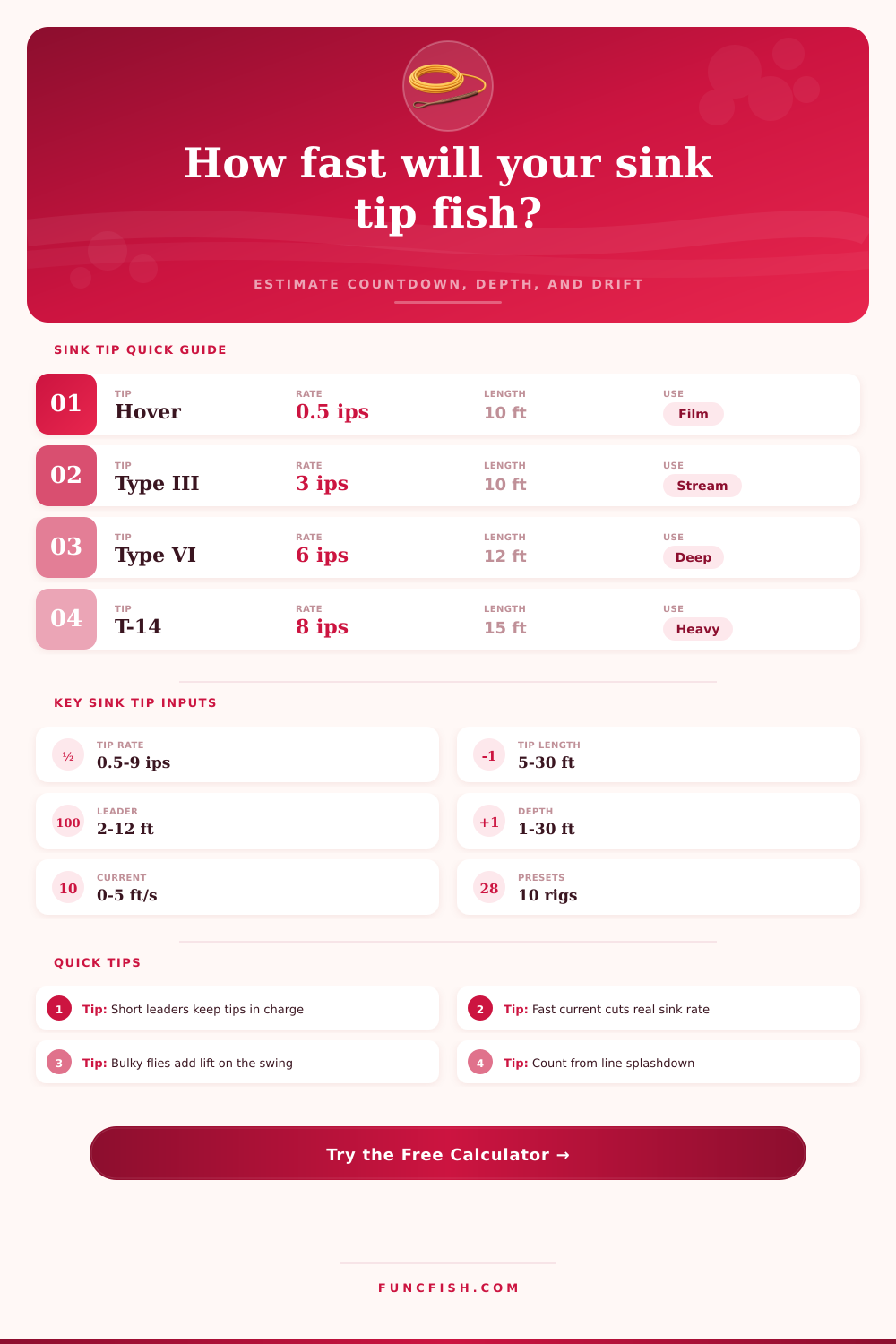
Estimate effective sink-tip sink rate, countdown time, swing depth, and downstream travel from tip class, tip length, leader, fly drag, water type, current, retrieve, and line tension.
📌Scenario presets
⚙Sink tip and water inputs
Use only the sinking section length, not the full head or running line.
Sink-tip depth estimate
Calculation breakdown
🎣Sink tip comparison grid
Hover and Intermediate
Type III to V
Type VI to VII
Tungsten T Tips
📋Sink tip rating reference
| Tip class | Nominal sink rate | Common length | Line weight match | Practical use |
|---|---|---|---|---|
| Hover tip | 0.5 to 1.0 in/sec | 8 to 12 ft | 4 to 8 wt | Film, shallow flats, wary fish |
| Intermediate | 1.5 to 2.0 in/sec | 10 to 15 ft | 5 to 9 wt | Stillwater edges and slow retrieves |
| Type II | 2.0 to 2.5 in/sec | 10 to 15 ft | 5 to 8 wt | Soft streamers and shallow runs |
| Type III | 3.0 to 3.5 in/sec | 10 to 15 ft | 5 to 8 wt | All-around trout streamer tip |
| Type V | 4.5 to 5.0 in/sec | 10 to 24 ft | 6 to 9 wt | Banks, ledges, float-tube fishing |
| Type VI | 5.5 to 6.5 in/sec | 10 to 30 ft | 7 to 10 wt | Deep lake lines and heavy streamers |
| Type VII | 6.5 to 7.5 in/sec | 10 to 30 ft | 8 to 11 wt | Fast descent with compact heads |
| T-8 to T-17 | 6.0 to 9.0 in/sec | 8 to 15 ft | 6 wt to two-hand | Custom spey tips and heavy current |
⏱Countdown depth table
| Effective rate | 10 sec depth | 20 sec depth | 30 sec depth | Best use |
|---|---|---|---|---|
| 1.5 in/sec | 1.3 ft | 2.5 ft | 3.8 ft | Intermediate flats and ponds |
| 3.0 in/sec | 2.5 ft | 5.0 ft | 7.5 ft | Type III trout streamers |
| 5.0 in/sec | 4.2 ft | 8.3 ft | 12.5 ft | Type V banks and ledges |
| 6.5 in/sec | 5.4 ft | 10.8 ft | 16.3 ft | Type VI or VII lake work |
| 8.0 in/sec | 6.7 ft | 13.3 ft | 20.0 ft | T tips and heavy current |
🌊Current and swing correction table
| Water movement | Current speed | Sink loss | Swing behavior | Calculator setting |
|---|---|---|---|---|
| Stillwater | 0 to 0.3 ft/s | 0 to 4 percent | Clean vertical countdown | Stillwater or vertical drop |
| Walking pace riffle | 0.8 to 1.5 ft/s | 8 to 18 percent | Tip tracks with a shallow belly | River swing with mended tension |
| Strong run | 1.8 to 2.8 ft/s | 20 to 35 percent | Line belly can lift bulky flies | Use heavier tip or shorter leader |
| Salt rip or tide seam | 2.5 to 4.0 ft/s | 28 to 45 percent | Swing travel dominates countdown | Saltwater current seam |
| Slow troll or kick | 0.5 to 1.2 ft/s | 5 to 16 percent | Speed keeps fly shallower than line | Slow troll or float-tube kick |
⚖Leader, fly, and rod matching table
| Rig style | Leader length | Fly profile | Rod size | Depth note |
|---|---|---|---|---|
| Trout streamer tip | 3 to 5 ft | Bead or clouser | 5 to 7 wt | Short leader keeps tip control strong |
| Two-hand winter tip | 3 to 4 ft | Tube or intruder | 7 to 9 wt spey | T tips need room to turn over |
| Lake full-sink style | 5 to 8 ft | Sparse or leech | 5 to 8 wt | Longer leader softens depth response |
| Saltwater baitfish | 4 to 7 ft | Deceiver or crab | 8 to 10 wt | Current and fly drag matter most |
| Pike or musky | 2 to 5 ft | Bulky synthetic | 9 to 11 wt | Big fly lift often needs T-14 or T-17 |
💡Calculation tips
Countdown timing: Start the count when the sink tip lands, then use the result as a repeatable reference. The fly may fish slightly shallower than the tip if the leader is long or buoyant.
Current adjustment: In moving water, the nominal box rating is only a starting point. Mends, tension, belly, and fly drag can remove a large share of the vertical sink.
The fly lands in the water, and now it’s up to you to see if it sank. If you’re standing on a bank or floating tube, all you do is wait for your line to fall back down onto your hand. How deep will that fly go? You have learned to count on the number printed on the spool sticker. A type six tip mean the fly should sink six inches per second, right? No. This almost never happens. Drag from the fly itself, buoyancy of leader and even current will drastically slow your rate of descent.
The variables are out of control, so the calculator above do the work for you by turning those crazy variables into an estimated countdown. The key thing is that all those ratings is done in still water with nothing on the end. Now when you add a big streamer and a floaty nylon leader, laws of physics kick in. The light leader resists being pulled down by heavy tip; instead it want to stay up on top. That makes the line take more of a curve different than just falling straight down. So the fly actualy fishes shallower then the tip for longer than you think.
Why Fly Line Ratings Are Not Accurate
If you have a six-foot leader and a ten-foot sink tip, the first several seconds of your countdown are spent battling against rising tension. And shortening the leader can make a huge difference because it decreases amount of drag keeping the system at the surface. Then there’s current, which adds another wrinkle as it puts slack into the line. If your fly move downstream faster than you’re able to both mend and reel, it will form a belly upstream. Now you have this loop of excess line with mass and it produce drag on the water flow. This results in lift instead of sinking. This is the same as an airfoil in pressure. The faster the current, the more vertical fall you lose to horizontal travel. In slow water, you may believe you have 30 seconds to cover 10 feet. In a swift run, you could easily lose all that depth in 40 or 50 seconds because river itself is holding your line up.
If you don’t compensate for those factors, then your choice of tip class won’t make much difference. In slack water, a shorter leader and a tight tension will often beat a longer one on a type seven. That’s where the raw speed ratings conflicts with the practical uses as laid out in the reference table on the page. Don’t get hung up on buying the sink rate that matches the depth. Match it to the presentation too.
When drifting nymphs through pools, or swinging steelhead flies, keeping some tension on the line is more critical than having a faster sinking line. More tension mean less of a lift from current pushing on slack, and means you’ll keep the tip deeper. Surprisingly, fly profile matters as well. Because a leech-style fly presents less frontal area to the water, it will sink faster at the same weight as a bigger clouser minnow. If you want to use a big fly anyway, you can add weight to hook itself or choose a heavier material such as tungsten for the fly’s head. Again, this is an area where experience trumps gear specifications any day.
By entering the fly profile and weight into the tool, you get a more accurate idea of what depth your rig will realy fish out of the gate. This turns out to be the critical phase of that initial drift. Forget guessing when to swing or strip line. Count down from the second your sink tip hits the water. You should of counted down from the second your sink tip hits the water. Don’t believe the box rating, believe what works. And lengthen your leader accordingly to match water speed. Tighten your connection. Allow your line to go slack when you want. Know that depth is a struggle between drag and gravity. Get that right, and you’ll find fish where others see nothing but ripples on the surface.