
Maybe a pike jumped at surface of the water on a weed line. You’re thinking, “How do I handle that? Is the fish big enough to keep? In those instances, most angler is guessing. Many trophies is lost, and others are sent back to the water too soon by improper handling.
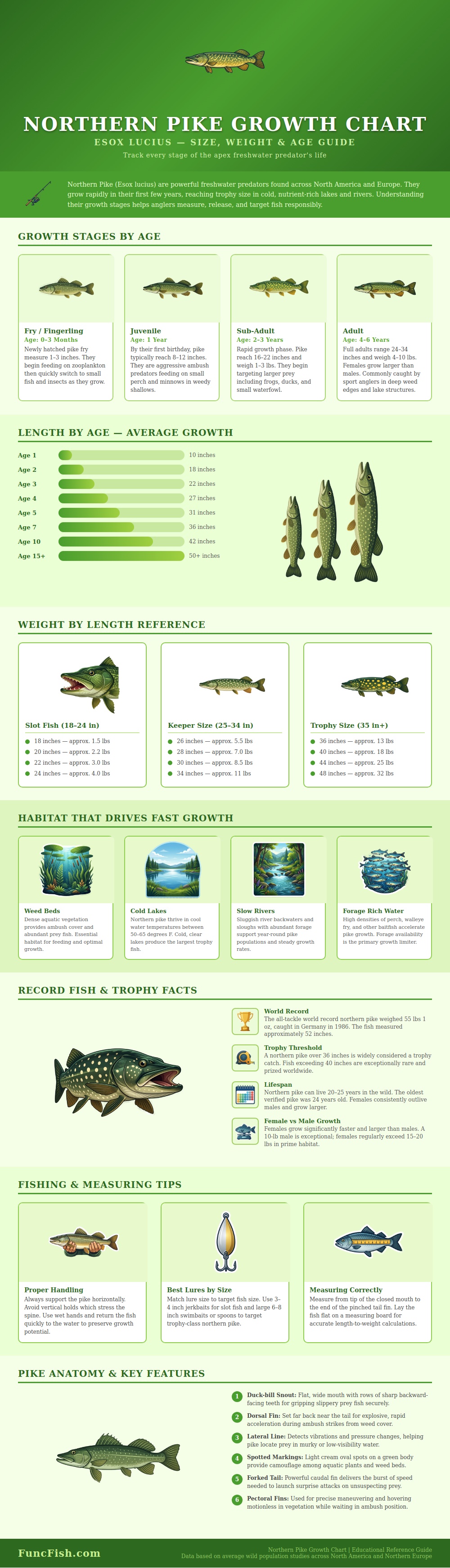
The quick growth period in early stages makes you think different about each cast as this infographic explains. It’s not just about catching a fish but understanding what stage of its life you are fishing for. Young pike is plentiful and aggressive. But young pike are delicate too. In their first year, a pike may only measure ten inches or so. Sounds puny? Remember it’s a miniature version of an apex predator.
How Northern Pike Grow
As the chart demonstrates, most pike put on pounds fast from ages one through three. By age two many have reached eighteen-inch mark; by age three most will be pushing 22-inches. Because they add on quickly feeding habits can make all the difference between a keeper and a lunker…often in as little as a single season. For bigger pike, you must allow them to feed, and feed well’ in rich environments.
What does the chart reveal? Pikes growing in nutrient-rich lakes with ample forage grow much faster then those found in warm nutrient-poor waters. Location is everything. Luck has less to do with it.
And that’s due to the pike’s anatomy. It have rows of razor-sharp teeth and that duck-bill snout, built for only one thing; grabbing slippery prey quickly. And it has an amazing ability to accelerate from a dead stop thanks to its placement of dorsal fin located so far back on its body. That’s why they don’t go after prey; it’s an ambush creature. It sits motionless among the weeds, camouflaged by its spotted patterns, and explodes out at baitfish that get a little too close.
Your job when fishing these structures is to match the retrieve to the cover. You can’t pull your lures too fast through heavy cover because you’ll spook the fish. A good retrieve involve letting the lure sink a bit and then coming up to the pike’s optimal striking range.
When you do catch a fish of this caliber, how should they be handled? According to the handbook, females grows larger and faster than males, often exceeding twenty pounds in prime waters. What does that mean? A forty-inch female needs to be treated different than a thirty-inch male. And always hold them in horizontal position to avoid stressing their spine. Holding them vertically places great pressure on all of the fish’s internal organs and in many cases will kill the fish, even if it survives the release.
Also, wet your hands before handling the slime coat on the fish. The slime coat helps prevent parasites and disease. That may seem like a minor point but it’s hugely important when considering conservation. Don’t you want that fish to live longer so it can get bigger next year instead of dying from handling shock?
If you are targeting trophies, then patience is your bait. Very few reach more than fifty-five pounds these days which is the world record. Not many of us will ever recieve catching one that big, but knowing where the threshold for growth is can help establish realistic expectations. In general, a pike measuring more than thirty-six inches are seen as trophy class. If it reaches that length in the wild, it took at least a decade to do so.
As you can see from the chart, after age five they slow down significantly. This means they have already lived through numerous fishing season and several winters. To target them, you’ll need to use bigger baits like heavy spoons or six-to-eight-inch swimbaits. Younger pike won’t be able to fit anything that big into their mouths. This selective sizing technique isn’t only good for reducing waste but also boost your odds of catching a real trophy.
Understanding how northern pike grow will ultimateley affect your fishing. It will change how you think about time and habitat. Eventually, you’ll quit guessing their size and start to respect their biology. You’ll begin understanding why they act the way they do, from their ambush hunting habits to their slow maturity that leads to trophy sizes.
The next time you’re out on the water, open your eyes and view those weed beds differently. View them not simply as structure but also as a feeding area and a nursery for growth each day. Big pike don’t get caught by luck; give nature some time to do her job. You should of seen them grow.