
Slab crappie are widely regarded as the ultimate trophy of all freshwater panfish catches, but most folks assume catching a big fish simply depends off the bait and/or their own good fortune. In reality, slabs is the product of survival (time and place). So what makes certain bodies of water produce huge fish, while other lakes only produces small fish? A close look into growth and development of crappies over time explains that.
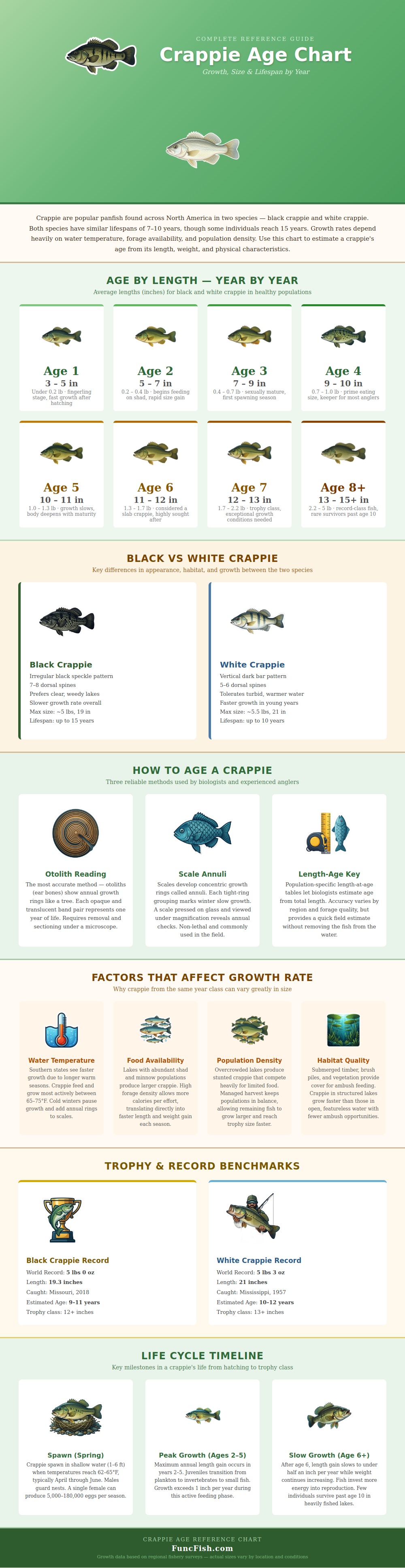
Look at diagram above. What’s the difference? It’s not your imagination. The early years were all about growth. Year one: The fish are tiny, barely reaching five inches in ideal conditions, as part of a period of rapid expansion. And since they’re very close to shore, they feeds on small invertebrates and plankton along the bank of their birthplace.
Why Some Crappie Grow Big and Others Stay Small
Year two: Fish begin consuming minnows and shad, which is rich in protein and promote faster growth. This is also when location becomes most important. Because water temperature controls their metabolic rate, fish in northern waters don’t grow as fast than fish from southern states that enjoy extended warm periods. A lake that freezes over in November will produce smaller fish compared to a body of water that never dips below sixty-five degrees for six months.
This is when crappie start to grow sexually mature (age three or four), which also puts them into the sweet spot of prime eating size for most anglers. This is where they realy begin to slow down on gaining length, but keep gaining weight as they increases in depth. The transformation occurs from being primarily taller to wider, which is known as “vertical” versus “horizontal. “horizontal.”
That’s an important change to consider when targeting certain sizes. While a three- and five-year-old crappie may not appear that much different in length, the five will certainly weigh a lot more in the net. Understanding this difference should of helped you decide whether you’re looking to catch bulk or volume.
Even growth rates differs by species. White and black crappie are closely related, but they has different growth habits. White crappie generaly grow faster during their early years. However, they never seem to reach the same size or age as black crappie. Generally speaking, white crappie top out at about 10 years old and blacks at 15 under ideal circumstances. With such a long lifespan, it’s not uncommon for a black crappie to exceed the five pound mark on occasion, whereas white crappies often grow longer but typically weighs less. You should know which species is dominant in your fishing area since black crappie are generally associated with clear lakes with abundant vegetation and white crappie is more tolerant of warmer, dirtier water.
The way biologists determine an exact age of a crappie is by studying its biological history. To do this, they look at the otoliths (tiny ear bones located within the head) and actualy count growth rings, similar to a tree ring, although it’s a destructive process and not something you’d want to do to a living crappie in the field. Instead, anglers who have suitable magnification equipment can also use their scale annuli as a non-lethal option. Otherwise, most of us simply make an educated guess using general size estimates from local population data. For example, if your lake happens to be overpopulated, then expect slower growth rates throughout; high density = less available food resources per fish.
So what is the key to catching big crappie? Simply put it’s about finding those fish that was given the best chance at life. Big crappie require low competition and plenty of food. They also need structure they can use to ambush prey while hiding out of sight. Lakes that has brush piles or submerged timber give them that competitive edge. They don’t spend much energy chasing food over open water; instead, they holds their position and save energy.
As you’re sitting in your boat or standing on the bank thinking about making the next cast, realize that the trophy you eventually catch has stacked the odds in his or her favor through years of good conditions. Each ring on their scale is a story of survival. And that’s what makes each cast different.