
A crappie lays on the dock in your hand. It doesn’t look like anything in your guide book. The patterns isn’t right and the colors don’t look right either. Could be you caught something else, but the fish won’t give any clues except for those constantly changing scales. That’s just how crappie are; they’re master camouflage experts and they adjust themselves by season, location, sex, and even water clarity. By learning to read these visual cues, you’ll begin to figure out not only where the fish came from but where they’ll go next.
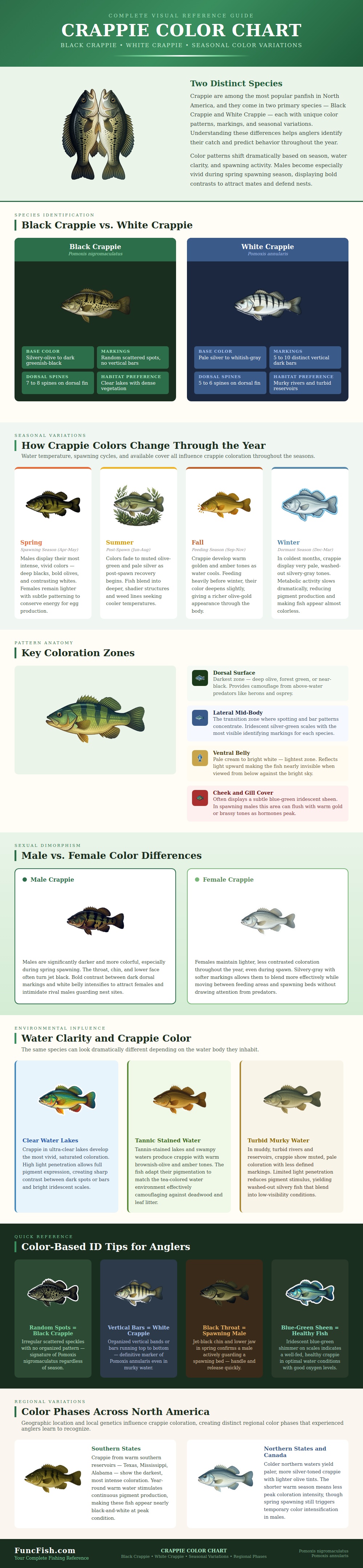
White vs. Black Crappie, This is the simplest dichotomy: black crappie have random spots all over body, while white crappie exhibit clear vertical bars going up and down the fish’s body. Most folks make mistake of looking at color (i.e. They look at how light or dark they are instead of pattern of the markings. Sometimes you’ll see really pale white crappie that look brighter then darker black crappie, which is why people misdiagnose them. It’s not about how light a fish is, it’s whether the markings are randomly spaced spots or clearly defined vertical lines. That goes for any time of year and under any type of water condition. You will never be wrong about that.
How to Read Crappie Colors
This visual display has a lot to do with water clarity. The clearer the water, the more high-contrast colors the crappie will have. Their pigment really shows through when water is super clear. This allows light to penetrate deep into lake. So if you’re fishing a muddy river with a ton of dirt in the water, all those same crappie is going to look pale and washed out. It’s not a health problem, but rather camouflage. Darker markings stand out too well in dirty water. They fade into background where they won’t be seen by pike or bass. When you fish stained water, don’t be surprised to see dull colors. Don’t get down on catching dull-looking fish because that just means they’re adapted for that habitat.
Complicating matters further are seasonal shifts in color. Male crappie changes dramatically during springtime spawn. Their body color deepens to rich shades of black and olive, and their throats turns an all-out jet-black. It’s intended to be intimidating to other males, and irresistible to females, but the females stays fairly pale and subdued throughout the whole show. Summer finds those aggressive colors muted to earthy browns and greens as the fish disperse to seek deeper cover. Then come winter; they get pretty much all silver and melt right into the dark, frigid depths as metabolism eases off throttle. Understand the life cycle to know when to expect these changes.
There’s also geography to consider. Crappie caught in the south (Alabama, Texas etc.) will have deeper colors all year long; their water is warmer which trigger their pigments into continual production. Crappie out of the north are generally lighter and more silvery colored simply because their active season is abbreviated and there is less time for them to get dark. That means a Minnesotan isn’t likely to run across deep blacks very often, even though he may be catching same species, while an angler in Florida is. It makes for an entirely different perspective when you go on the water and understand those color clues.
When you see a dark and aggressive male defending his bed, you know it’s nesting season. The fish will be tight to some kind of structure because they’re territorial. When you’re finding those pale, straggler fish out in deeper weed lines you know what’s going on. They’re either wintering up there or they might be acting that way because they just spawned, but you can tell what’s happening by their color.
You’re not just catching fish. Every fish you catch is another piece of information that will help lead you to the next one. It’s about being able to see crappie as clues, where every catch is a piece of information. You should of seen how fast they change.