
Cold spring morning: You hook a fish and start reeling her in, feeling the familiar thump-thump as she takes up line. Sleek, stripped, and it seems like every perch you’ve hooked before. Wait. Does it have a white tip on its tail? What are those bars like, thin or thick? When you raise net to bring it aboard, the hard part starts.
Because when it comes to these guys, looking alike is exactly what they want you to do. From hefty walleye hiding out in dark shadows to tiny jewel-like darters tucked beneath rocks, they’re all over North America. Whether you’re hoping for a feast of fishy goodness on your dinner plate or just not wanting something that tastes like nothing at all, knowing what’s in that bucket mean much more to an angler than they might think. This is especially true when the rules varies so widely from species to species. So how does one make sense of all this?
How to Tell Fish Apart
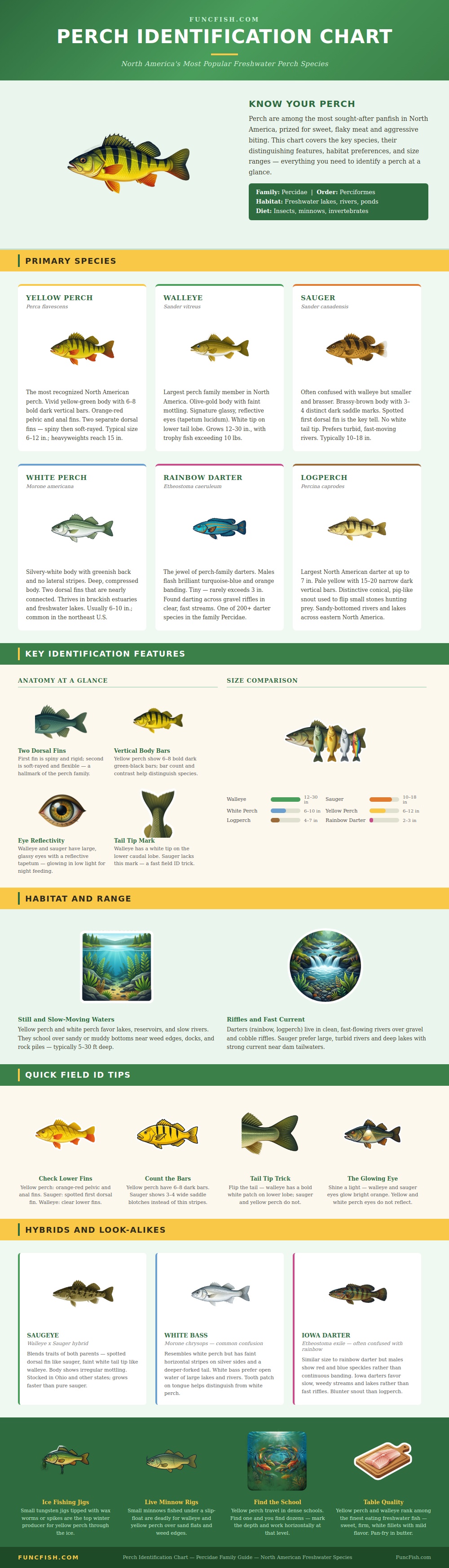
Well, as shown in the visual breakdown above, we isolated some key indicators that tells one fish apart from another. The yellow perch is at the top of the list as a poster child of panfish. Everybody has seen them. They’re that bright yellow-green body with clear dark vertical bands running down each side. Not sure? Count ‘em. Most yellow perch will have six to eight bold stripe. Next, glance toward lower fins. Red and orange-colored fins equal, well, you get the idea.
Color patterns among fish in this family are surprisingly consistent. That’s what makes this such an easy check, and it always gets the answer right. The chart breaks these physical features down cleanly without requiring you to memorize a biology book before hitting the water. But once we step outside easy examples, it becomes dicey.
Anglers will argue with each other about walleyes vs. Saugers. For good reason too. They is very similar to one another to the naked eye. Fortunately there’s an easy field test. Hold it by its tail, flip the tail fin over. A walleye has a distinct white patch on the lower lobe of its caudal fin; while a sauger will be plain brown or olive without that white accent. This simple fact could of save some heartache if you’re asked what fish you’ve been catching.
But more importantly for strategy, saugers likes deeper water closer to the river bottom and want faster, dirtier water. Walleyes will position themselves over flatter areas like sand flats, in somewhat clearer water, where they can ambush prey. Another hint lie in size. As the graph shows, we’re talking some drastic size difference in this one family.
Downstream a few miles in the same river, you may be catching a little rainbow darter. It is big enough to fit on your thumb. The fish flashes shiny shades of orange and turquoise as it darts over the gravel riffles. On the other hand, downriver a ways you’ll find twenty feet of water where a walleye might lurk. It could be a ten-pounder or bigger. It can be up to thirty inches long.
And it require different tackle to catch different members of the same species. Live minnows dragged around structure will be deadlier on the larger predators such as sauger and walleye. Wax worms and small jigs does wonders on the smaller darters and perch. There are also hybrids to muddy the water. Many lakes stock saugeye, which are hybrids made from a cross between walleye and sauger. Since these are crosses of both parents, they may have spots on their backs like a sauger but a hint of a white tail like a walleye.
That’s where experience, not just fortune, comes into play. You begin paying more attention to the entire fish versus any single characteristic. Another good indicator is there eye shine. In dim conditions, you can pick up a light. The walleye eyes reflects a bright orange color from that reflecting layer behind the retina. Daytime feeding yellow perch don’t need that adaptation and therefore don’t have it. An evolutionary distinction you can observe with your own bare hands if you simply take notice.
But lastly this helps with all aspects of the day out on the water as well. Instead of confusing protected species with fair game fish. You won’t waste time trying to guess which is which or throwing the wrong lure in there. And then when you get them home and fillet that nice flaky white meat, you will know exactly why it’s so good.
You start by looking a little closer than most folks do. Count the bars, check the fins, look at the tail tip. The small details tells the entire story about what just stole your bait.