
Standing at the edge of a Great Lakes shore, you feel something tugging on your line. Not the stubborn, heavy weight of a catfish. Not the wild run-and-gun action of a bass. This is lighter and more subtle. You haul it out of the water and see its golden side with bold vertical bars. It is a yellow perch. Congratulations, you’ve caught one.
But that’s only half the battle. Any angler will tell you the other half is figuring out if you just hauled in a trophy or a mere snack. And that answer can be found by knowing about age, size and the fish’s biological clock.
How to Measure and Catch Yellow Perch
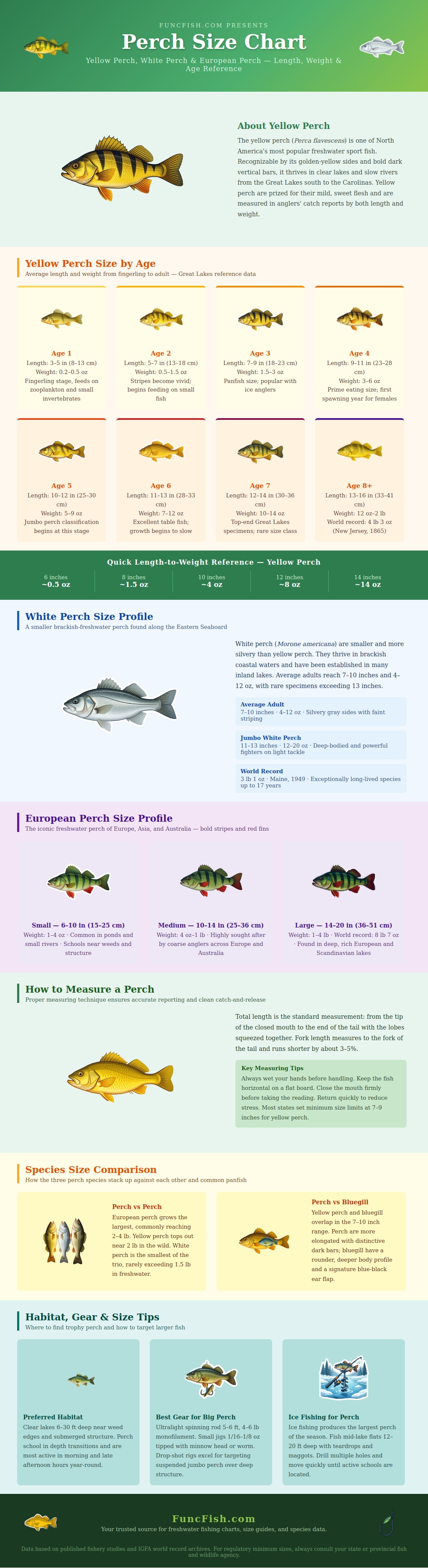
Age; When you look at your scale and just guess at how old a fish is, it’s hard to get a good frame of reference. But here is how it plays out based off weight and length mapped out in the chart above. A perch less than a year old is literally still just a fingerling. It will be weighing maybe half an ounce and living strictly off zooplankton. In dirty water, it is realy difficult to see.
Fast forward to years three or four though and that’s when they become prime eating size. At nearly ten inches long and several ounces, that fish is really starting to fill out and get fat. And that is logical. By this age, they have switched from drifting plankton to hunting small fish, meaning their bodies are denser and their flavor is richer. At this point they taste good and weigh more.
Size Limits. Most states has minimum size limits on perch of between seven and nine inches. Coincidence? No. Those limits perfectly match allowing these fish to grow into their sweet spot and experience that important growth spurt before harvesting them.
Here’s where folks misunderstand this. Bigger does not equal old. After about the sixth year, their growth slows down significantly. Maybe an inch or so each subsequent year. Their bodies become deeper and they get heavier. Now you’re talking some serious specimens by the time they reach eight years of age or more. A fourteen-inch, plus a pounder. It is a rarity. It has endured fishing pressure, harsh winter weather, and predatory species for nearly a decade. The catch doesn’t even feel the same; it’s symbolic of not just numbers, but of survival.
The infographic goes on to make clear that not all perch are alike. Also shown are European perch and white perch. These fish resemble each other but act quite differently. White perch are silver and smaller. They are most commonly found in brackish coastal waters. On light tackle, they put up a heck of a fight, but rarely top a couple of pound.
European perch is what coarse anglers call it in Australia and across Europe. And this is the fish that can get realy large. There are world records well over eight pounds. If you catch a perch that you believe might be a monster in inland waters in North America, inspect its fins. A tall dorsal fin and red lower fins indicate it might be a European variety, which would most likely live in a managed lake where they were introduced.
Correct measurement of the fish is more important than many think. Total length is what you are after. Close the mouth and pinch the tail lobes together. Then lay a ruler along the side and take the measurement from the top of the closed mouth to the farthest point of the fork at the end. Don’t measure to the open mouth and don’t leave the tail laid out. That will add extra inches and screw up your records.
Use wet hands when handling them. Hold them horizontal. Take your reading. Put them back fast. This routine ensures that all the information you use from now on is correct. If you decide to let the fish go, they will live.
Your best clue to finding them out there is habitat. Structure and clear water is their thing. Lakes from six to thirty feet deep has some type of structure. This includes things like rocky drop offs, submerged logs, and weed edges. During the summer, they’ll stay deeper around thermoclines. On winter days, particularly if you’re ice fishing, look for mid-lake flats over gravel or sand where they congregate.
It’s mostly a matter of patience. Drill a hole, drop a small jig tipped with a maggot or minnow head, and wait. Wait. If nothing feels like it wants to eat, move on. When you find the school, it’s going to get crazy.
The key to perch then, is truly grasping their size based on their life story rather than the bag limit. It’s one thing to have a 7 inch fork fillet in the frying pan but an entirely different experience when you hold up a 12 inch trophy destined for the wall. When you know how each fish fits into its own growth story, the bite seems more meaningful. Not only did you catch dinner; you caught a survivor from the clear, frigid depths. You should of seen it.